Euclid — "The square on the side subtending the right angle in right-angled triangles is e…"
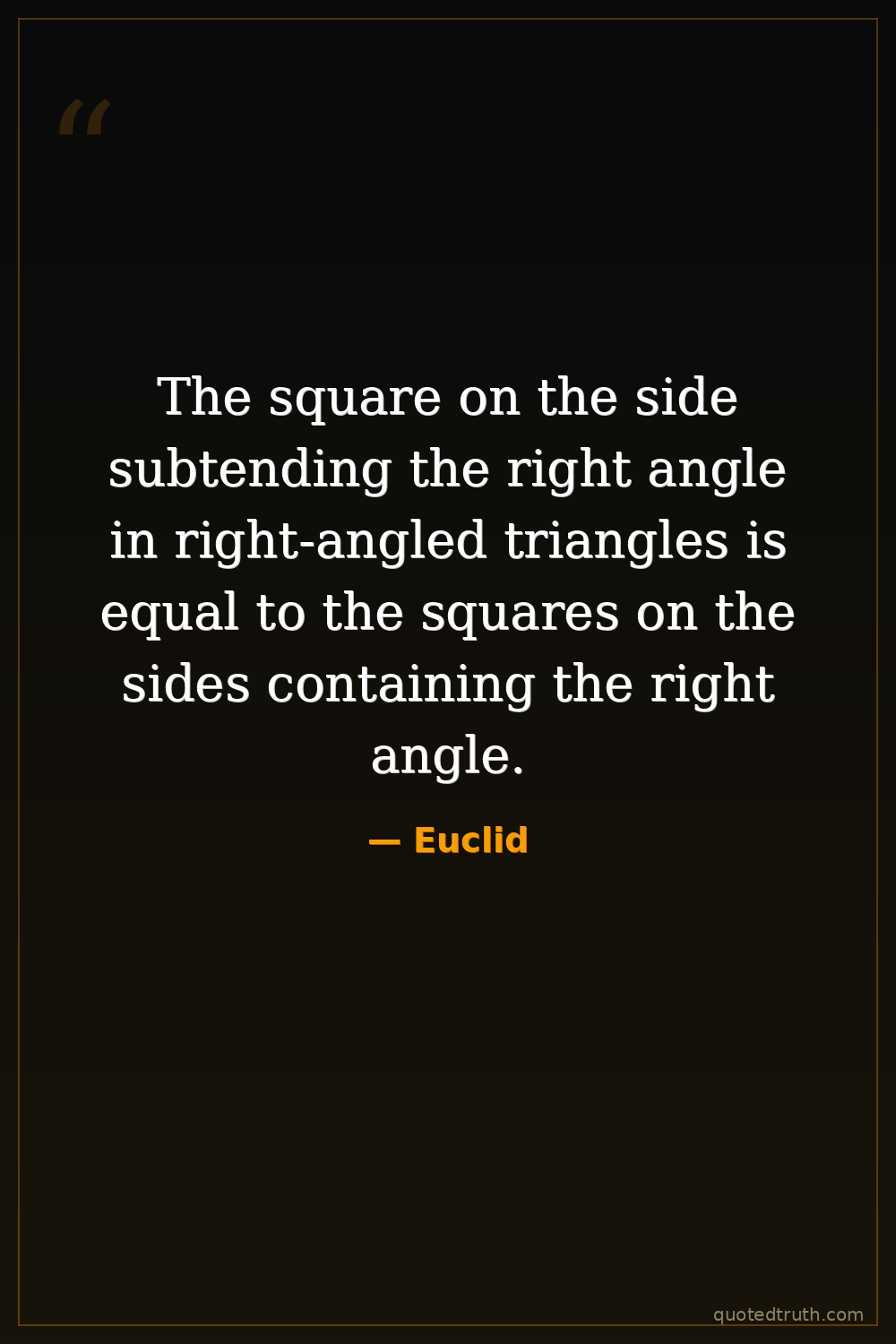
The square on the side subtending the right angle in right-angled triangles is equal to the squares on the sides containing the right angle.
The square on the side subtending the right angle in right-angled triangles is equal to the squares on the sides containing the right angle.
Click any product to generate a realistic preview. Up to 3 at a time.
* Initial load can take up to 90 seconds — revising the preview in another color is nearly instant.
"If a straight line be cut in extreme and mean ratio, the greater segment is also cut in extreme and mean ratio by the lesser segment."
"A prime number is that which is measured by a unit alone."
"An acute angle is an angle less than a right angle."
"A ratio is a sort of relation in respect of size between two magnitudes of the same kind."
"Let the following be postulated:"
From 'Elements', Book I, Proposition 47 (Euclidean statement of the Pythagorean Theorem)
Date: c. 300 BCE
ShockingFound in 1 providers: grok
1 source checked
In any right triangle, the area of the square built on the hypotenuse equals the combined areas of the squares built on the other two sides. This is the Pythagorean theorem stated with geometric precision: a² + b² = c². It is not merely a formula but a spatial truth — shapes and areas relate to each other in exact, provable ways that hold universally across all right triangles without exception.
Euclid did not discover this theorem but immortalized it in Elements, his systematic compilation of Greek mathematics. His genius was proof and logical rigor: he derived this result from a small set of axioms using deductive reasoning. As Father of Geometry, Euclid believed truth must be demonstrated, not assumed — this theorem exemplifies his method of building complex certainty from simple, self-evident foundations.
Around 300 BCE Alexandria was the intellectual capital of the Hellenistic world, where Greek rationalism met Egyptian and Babylonian mathematical traditions. Babylonians had used Pythagorean triples for millennia, but Greeks demanded logical proof. Euclid's era prized rigorous demonstration as the highest form of knowledge, distinct from practical rule-of-thumb calculation — formalizing geometry gave civilization a model for all systematic reasoning that followed.
AI-generated insights based on extensive research and information for context. Factual errors? Email [email protected].
Your cart is empty