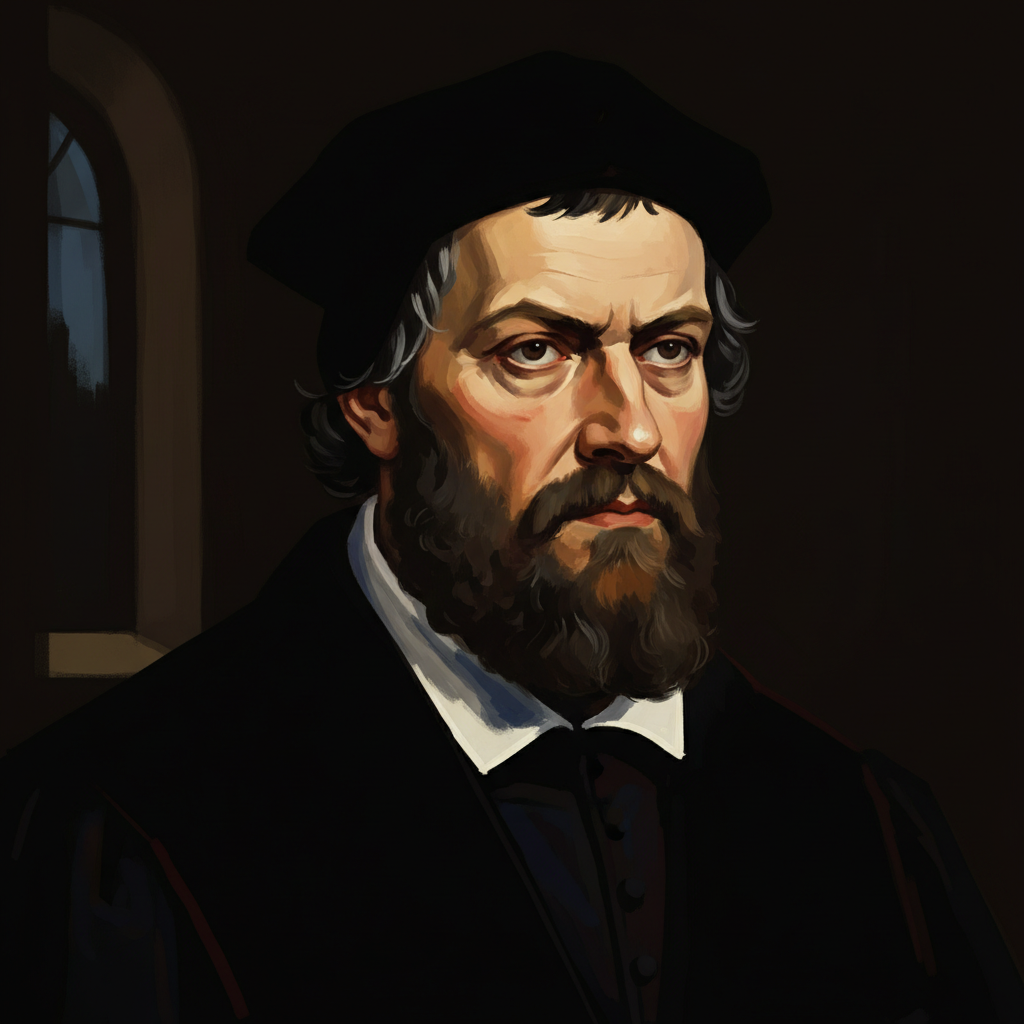
Martin Luther — "Reason is the Devil's greatest whore."
Reason is the Devil's greatest whore.
Reason is the Devil's greatest whore.
Click any product to generate a realistic preview. Up to 3 at a time.
* Initial load can take up to 90 seconds — revising the preview in another color is nearly instant.
"Faith is permitting ourselves to be seized by the things we do not see."
"Your Hellishness."
"My conscience is captive to the Word of God."
"Seventhly, let the young and strong Jews and Jewesses be given flail, axe, spade, and spindle, and let them earn their bread in the sweat of their brow, as was imposed on Adam's children."
"Reason is the greatest enemy that faith has."
German theologian whose 95 Theses (1517) launched the Protestant Reformation and broke the Catholic Church's monopoly on Western Christianity. Closely associated with Philipp Melanchthon (Lutheran systematizer) and John Calvin (later Reformer who built on Luther's break). For an intellectual contrast, see Pope Leo X, Renaissance pope (1513-1521) — Leo X's indulgence sales triggered Luther's break and Leo excommunicated him in 1521 — Luther's entire Reformation is structured as a direct answer to the indulgence-funded Vatican Leo represented.
Found in 1 providers: deepseek
1 source checked
Human reasoning, when trusted above divine revelation, becomes a corrupting force that seduces people away from faith. Luther argues that intellect unanchored from Scripture will sell itself to any argument, rationalizing sin and pride. Rather than rejecting thinking itself, he warns that reason serves whoever pays it, and when separated from God it inevitably serves evil, dressing up falsehood in persuasive logic.
Luther was a trained theologian and Augustinian friar who built the Reformation on sola scriptura, insisting Scripture outranks philosophical argument. Having battled Scholastic theologians who used Aristotelian logic to defend indulgences and papal authority, he distrusted reason detached from faith. His own conversion came through Romans, not syllogisms. This quote captures his lifelong polemic against human wisdom replacing God's word, a theme running through his Heidelberg Disputation and debates with Erasmus.
Luther's early modern era, the 16th century, was dominated by Scholasticism, where universities synthesized Aristotle with Catholic doctrine. The Renaissance had revived classical reason, and humanists like Erasmus championed intellect as a path to reform. The printing press spread competing ideas rapidly. Luther's 1517 Ninety-Five Theses launched the Reformation against a Church that used philosophical reasoning to justify indulgences, purgatory, and papal supremacy, making his attack on reason both theological and politically explosive.
AI-generated insights based on extensive research and information for context. Factual errors? Email [email protected].
Your cart is empty