Dmitri Mendeleev — "Science begins where measurement begins."
Science begins where measurement begins.
Science begins where measurement begins.
Click any product to generate a realistic preview. Up to 3 at a time.
* Initial load can take up to 90 seconds — revising the preview in another color is nearly instant.
"Atomic weight belongs not to coal or diamond but carbon."
"There is no death, but only change."
"My table will serve as an instrument for discovering new facts and for correcting old ones."
"I have achieved neither fame nor wealth, but I have learned to know the human heart."
"I have spent twenty-five years in the study of petroleum and have come to the conclusion that it is a product of the earth's interior, formed at great depths."
Found in 1 providers: grok
1 source checked
Real scientific knowledge starts only when you can quantify what you observe. Vague impressions, guesses, and qualitative descriptions are not yet science. The moment you attach numbers, units, and reproducible measurements to a phenomenon, it becomes testable, comparable, and capable of revealing patterns. Without measurement, you have opinions or philosophy; with it, you have data that others can verify, challenge, and build upon to uncover underlying laws of nature.
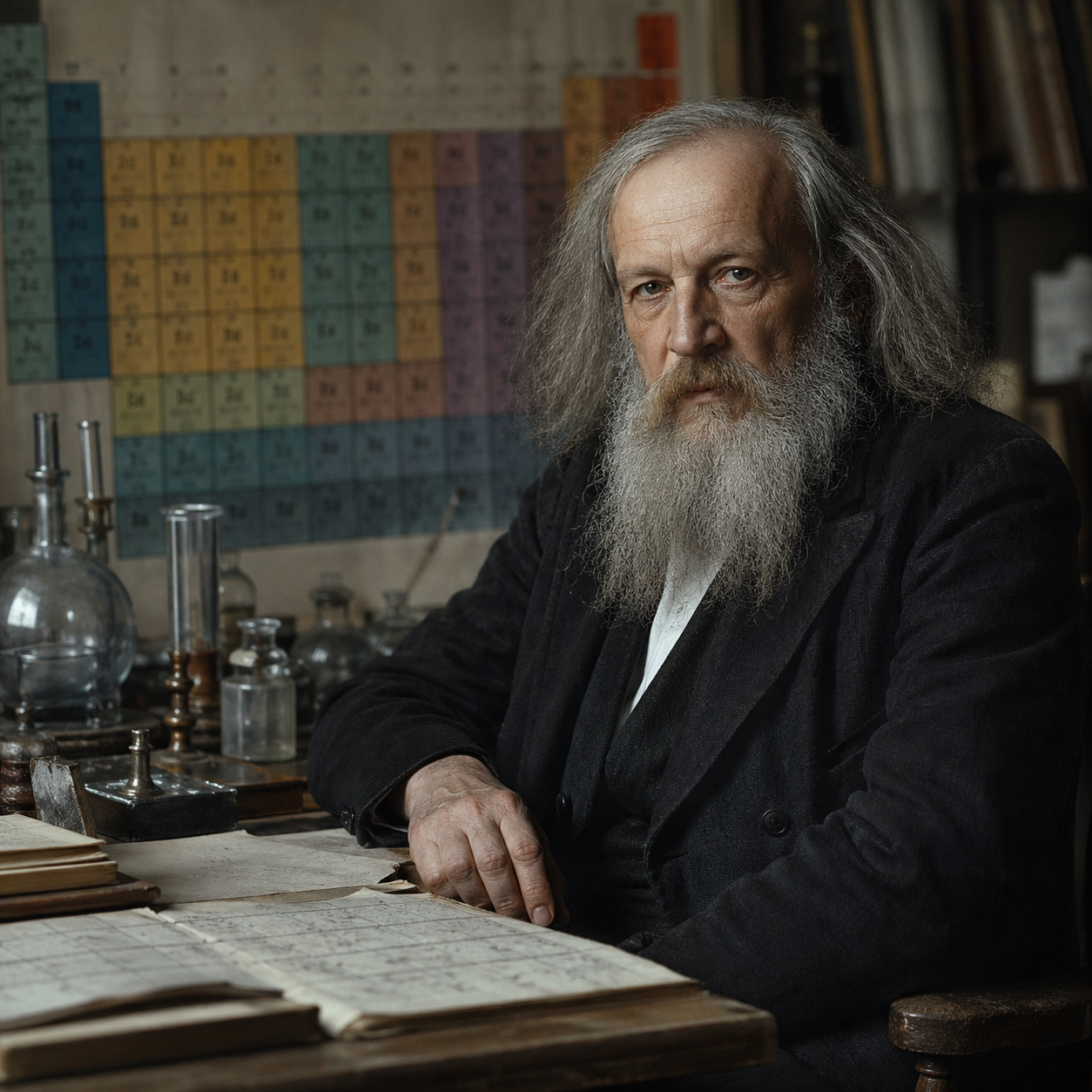
Mendeleev built the periodic table precisely by measuring atomic weights with obsessive precision and arranging elements by that number. He even predicted undiscovered elements like gallium and germanium by noting numerical gaps in his measured sequence. Beyond chemistry, he standardized Russian weights and measures, directed the national Bureau of Weights, and measured petroleum densities for industry. His entire career rested on trusting rigorous quantification over tradition or intuition, making this statement a direct summary of his working philosophy.
Mendeleev worked in late-19th-century Russia (1834-1907), when chemistry was transitioning from alchemical tradition into a rigorous quantitative science. European labs were refining atomic weights, Lord Kelvin was emphasizing measurement in physics, and industrialization demanded standardized units for trade and engineering. Russia was modernizing rapidly under the tsars, building railroads and oil fields that required reliable metrology. Against this backdrop, insisting that science itself begins with the ruler and balance was both a scientific creed and a nation-building project.
AI-generated insights based on extensive research and information for context. Factual errors? Email [email protected].
Your cart is empty