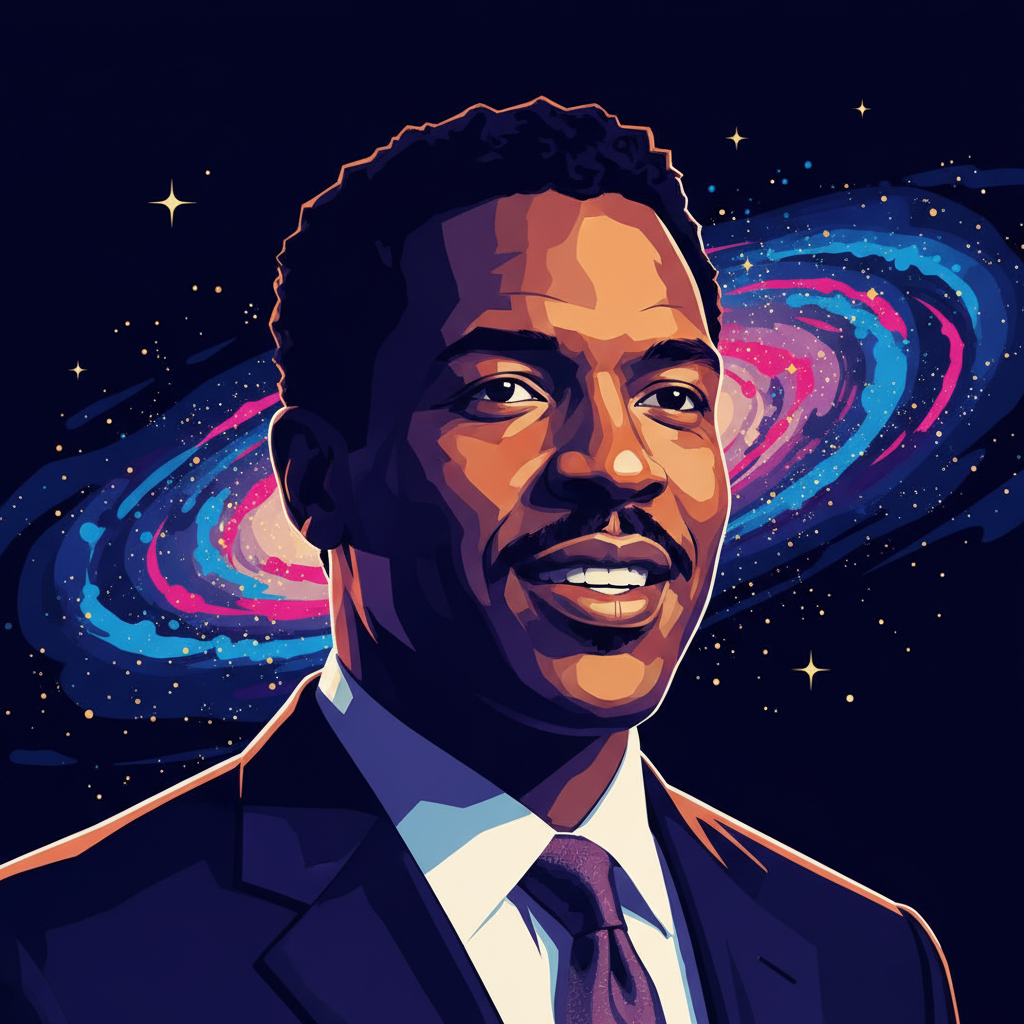
Neil deGrasse Tyson — "I don't want to live in a world where people don't understand science. That's a …"
I don't want to live in a world where people don't understand science. That's a world of darkness.
I don't want to live in a world where people don't understand science. That's a world of darkness.
Click any product to generate a realistic preview. Up to 3 at a time.
* Initial load can take up to 90 seconds — revising the preview in another color is nearly instant.
"I think it's important to remind people that we are all made of stardust. We are all connected to the cosmos."
"I don't care what you believe. I care what you can prove."
"I think it's important to have a sense of humor about the universe. It's a pretty absurd place, after all."
"I don't believe in magic. I believe in physics."
"The most important thing about the scientific method is that it's self-correcting. You don't have to trust anyone. You can verify everything for yourself."
American astrophysicist, Hayden Planetarium director, and Cosmos: A Spacetime Odyssey host who carries the Carl Sagan public-science mantle. Closely associated with Bill Nye (fellow science communicator) and Brian Greene (theoretical physicist and string-theory popularizer). For an intellectual contrast, see Ken Ham, founder of Answers in Genesis and the Creation Museum — Ham's career has been organized around defending biblical 6-day creationism — exactly the science-education position Tyson's mainstream-science communication is structured to refute.
Found in 1 providers: deepseek
1 source checked
Scientific literacy is not optional — it's the foundation of informed decision-making, public health, democracy, and technological progress. When people can't evaluate evidence, distinguish fact from fiction, or understand how the natural world works, they become vulnerable to manipulation, fear, and bad policy. Ignorance isn't neutral; it actively darkens individual lives and collective futures.
Tyson built his career not just doing astrophysics but relentlessly translating it for the public — hosting Cosmos, writing accessible books, appearing on podcasts and late-night TV. He believes science communication is a moral obligation. This quote captures his foundational conviction that an uninformed public is an existential threat to civilization, driving decades of tireless outreach.
Tyson speaks in an era of climate denial, vaccine hesitancy, flat-earth resurgence, and algorithmic misinformation — where scientific consensus is politically contested. Post-2000 social media amplified pseudoscience at scale. His warning about 'darkness' resonates against a backdrop where peer-reviewed evidence competes directly with viral conspiracy theories for public trust and policy influence.
AI-generated insights based on extensive research and information for context. Factual errors? Email [email protected].
Your cart is empty