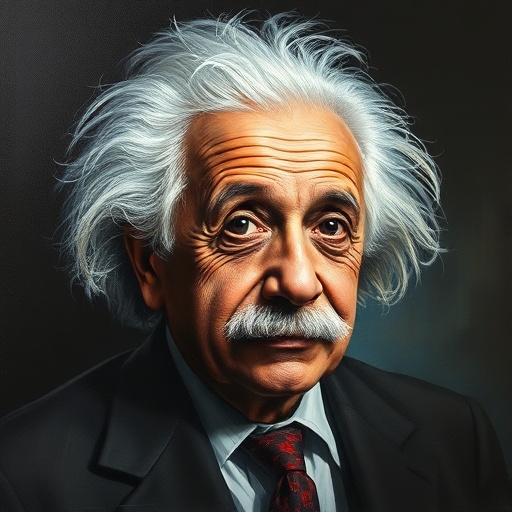
Albert Einstein — "Science without religion is lame, religion without science is blind."
Science without religion is lame, religion without science is blind.
Science without religion is lame, religion without science is blind.
Click any product to generate a realistic preview. Up to 3 at a time.
* Initial load can take up to 90 seconds — revising the preview in another color is nearly instant.
"The only way to escape the corrupting influence of praise is to go on working."
"I am enough of an artist to draw freely upon my imagination. Imagination is more important than knowledge. Knowledge is limited. Imagination encircles the world."
"The Chinese don't sit on benches while eating but squat like Europeans do when they relieve themselves out in the leafy woods."
"Technological progress is like an axe in the hands of a pathological criminal."
"If A is a success in life, then A equals x plus y plus z. Work is x; y is play; and z is keeping your mouth shut."
Found in 1 providers: grok
1 source checked
Neither pure reason nor pure faith alone is sufficient for understanding the world. Science needs a sense of ultimate purpose and moral grounding to guide its applications meaningfully. Religion needs empirical rigor to avoid superstition and dogma. Together they form a complete framework: science provides method and facts, while religion provides values and meaning. Each corrects the other's blind spots.
Einstein was a theoretical physicist who also held deep spiritual views, describing himself as religious in a cosmic sense inspired by Spinoza's God—not a personal deity but the rational order underlying nature. He resisted purely materialist science and equally rejected dogmatic theology. This quote emerged from his 1941 Science, Philosophy and Religion symposium, reflecting his lifelong effort to reconcile wonder with rigor.
In the early-to-mid 20th century, rapid scientific advances—quantum mechanics, atomic theory, relativity—created tension with traditional religious institutions. The rise of totalitarian ideologies exploiting both scientism and religious nationalism made the ethical grounding of science urgent. Einstein spoke during World War II's shadow, when unchecked technical power without moral compass was producing catastrophic consequences globally.
AI-generated insights based on extensive research and information for context. Factual errors? Email [email protected].
Your cart is empty