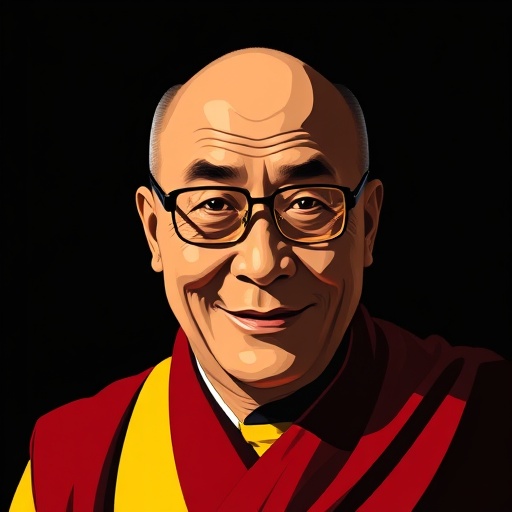
Dalai Lama (14th) — "Sometimes I joke that if I come back as a woman, I want to be a beautiful woman."
Sometimes I joke that if I come back as a woman, I want to be a beautiful woman.
Sometimes I joke that if I come back as a woman, I want to be a beautiful woman.
Click any product to generate a realistic preview. Up to 3 at a time.
* Initial load can take up to 90 seconds — revising the preview in another color is nearly instant.
"I think the most important thing is to be a good human being. That is the essence of all religions."
"I think humor is very important. Sometimes I tell jokes that are not very funny, but people laugh anyway because I am the Dalai Lama."
"The more time you spend thinking about yourself, the more suffering you will experience."
"I find that the great thing in this world is not so much where we stand, as in what direction we are moving."
"The more you are motivated by love, the more fearless and free your action will be."
Found in 1 providers: grok
1 source checked
The quote uses Buddhist reincarnation as a comedic setup—if reborn across genders, the speaker would choose beauty. The humor hinges on the assumption that physical attractiveness is a woman's most desirable trait, which many find reductive. Framed as lighthearted, the punchline nonetheless equates female value with appearance rather than intelligence, compassion, or capability. A casual remark that inadvertently reveals an underlying assumption about what makes a woman's life worthwhile.
Tenzin Gyatso (born 1935) is himself a recognized reincarnation—rebirth is not abstract theology but personal biography for him. Known globally for accessible humor and informal speech, he has made comparable remarks elsewhere, including stating a female Dalai Lama successor should be 'attractive.' These comments have drawn criticism even from admirers, complicating his image as a compassionate, progressive moral authority who otherwise champions human dignity and equality.
The contemporary era brought the #MeToo movement, global feminist discourse, and intensifying scrutiny of how public figures discuss women. The Dalai Lama gained secular moral authority far beyond Buddhism through his Tibetan exile (1959 onward) and Nobel Peace Prize (1989). His appearance-focused remarks about women, spanning decades, drew sharper criticism from the 2010s onward as audiences increasingly held even deeply revered spiritual figures accountable for gender-reductive language.
AI-generated insights based on extensive research and information for context. Factual errors? Email [email protected].
Your cart is empty