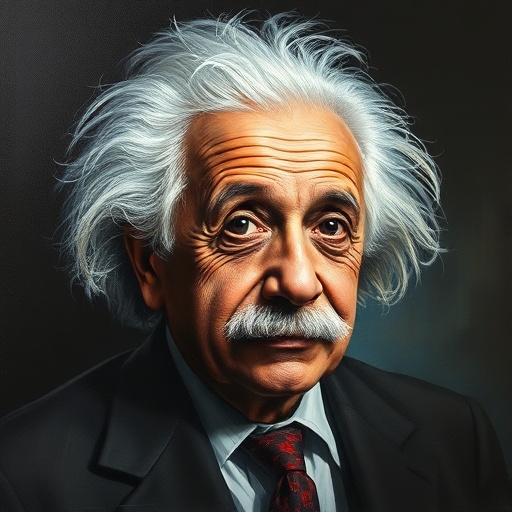
Albert Einstein — "Sometimes one has to look at the world from a distance to appreciate its beauty."
Sometimes one has to look at the world from a distance to appreciate its beauty.
Sometimes one has to look at the world from a distance to appreciate its beauty.
Click any product to generate a realistic preview. Up to 3 at a time.
* Initial load can take up to 90 seconds — revising the preview in another color is nearly instant.
"Imagination is the preview of life's coming attractions."
"Try not to become a man of success, but rather try to become a man of value."
"Compound interest is the eighth wonder of the world. He who understands it, earns it... he who doesn't... pays it."
"The more I learn, the more I realize how much I don't know."
"Weakness of attitude becomes weakness of character."
Found in 1 providers: grok
1 source checked
Distance—physical or mental—reveals patterns and beauty invisible up close. When we're immersed in daily noise, we miss the larger picture. Stepping back, literally or through reflection, lets us see wholeness: a landscape, a relationship, a life. The quote urges periodic detachment not as disengagement but as a clearer lens. Perspective reframes what felt mundane or overwhelming into something coherent and worth appreciating.
Einstein's greatest breakthroughs came from thought experiments—imagining himself riding a light beam, viewing gravity from outside everyday experience. Forced from Germany by Nazi persecution in 1933, literal exile gave him distance that sharpened his appreciation for freedom and human dignity. His lifelong sense of wonder at cosmic scale—described in his essays—reflected a mind that habitually stepped back from the immediate to grasp the profound.
Einstein's active years spanning 1905 to 1955 included catastrophic world wars, the Holocaust, Hiroshima, and the Cold War arms race—an era when industrial-scale destruction made beauty seem remote. Modernism and rapid urbanization disconnected millions from nature and contemplation. Amid scientific breakthroughs reshaping reality itself, pausing for perspective resonated as a humanist corrective to a century defined by speed, ideology, and unprecedented violence.
AI-generated insights based on extensive research and information for context. Factual errors? Email [email protected].
Your cart is empty