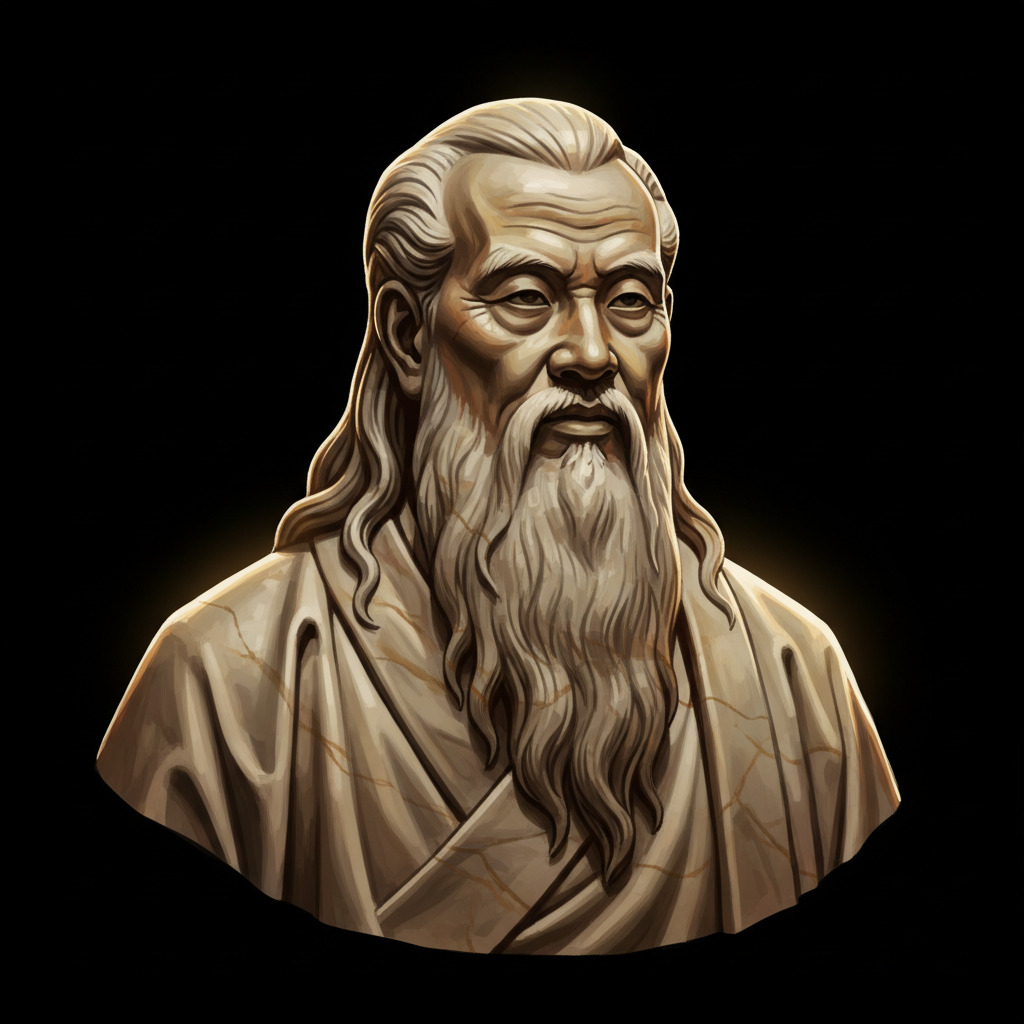
Laozi — "Anticipate the difficult by managing the easy."
Anticipate the difficult by managing the easy.
Anticipate the difficult by managing the easy.
Click any product to generate a realistic preview. Up to 3 at a time.
* Initial load can take up to 90 seconds — revising the preview in another color is nearly instant.
"A great nation is like a great man: When he makes a mistake, he realizes it. Having realized it, he admits it. Having admitted it, he corrects it. He considers those who point out his faults as his mo…"
"The great square has no corners. The great vessel takes a long time to complete. The great sound is faint. The great image has no form."
"The Tao is always at ease. It is still, yet it moves the world."
"The sage rules by emptying their minds and filling their bellies, by weakening their wills and strengthening their bones."
"The five colors blind the eye. The five notes deafen the ear. The five tastes dull the palate. Racing and hunting madden the mind. Precious goods keep their owners in fetters."
Reputed founder of Taoism and author of the Tao Te Ching, whose wu wei (effortless action) shaped East Asian philosophy. Closely associated with Zhuangzi (later Taoist who extended Laozi's framework). For an intellectual contrast, see Confucius, near-contemporary Chinese sage of social ritual and duty — Confucius systematized social order through ritual and hierarchy; Laozi argued that all such systems were the disease, not the cure — the two founding poles of Chinese moral philosophy.
Found in 1 providers: grok
1 source checked
Handle small problems before they grow into large ones. When something is still simple, manageable, and low-stakes, that is the moment to address it. Waiting until a situation becomes complicated, urgent, or overwhelming makes it far harder to fix. The advice is about foresight and timing: treat easy tasks as the raw material of future difficulties, and you avoid crises by acting early rather than reacting late.
Laozi, the legendary founder of Taoism, taught wu wei, effortless action aligned with the natural flow of things. A keeper of Zhou dynasty archives, he observed how rulers let minor issues fester into upheaval. His Tao Te Ching repeatedly urges leaders to act on matters while they are still small, seeing intervention at the root as the highest skill and large problems as evidence of neglected beginnings.
Laozi lived during the late Zhou period, an age of fracturing feudal order that slid into the Warring States era. Rival lords, collapsing rituals, and constant military escalation made Chinese thinkers search for stable principles of governance and personal conduct. Against that turbulence, counseling rulers to manage trouble while it was still easy was deeply practical advice, born from watching small court disputes and border frictions erupt into devastating, unmanageable wars across the kingdoms.
AI-generated insights based on extensive research and information for context. Factual errors? Email [email protected].
Your cart is empty