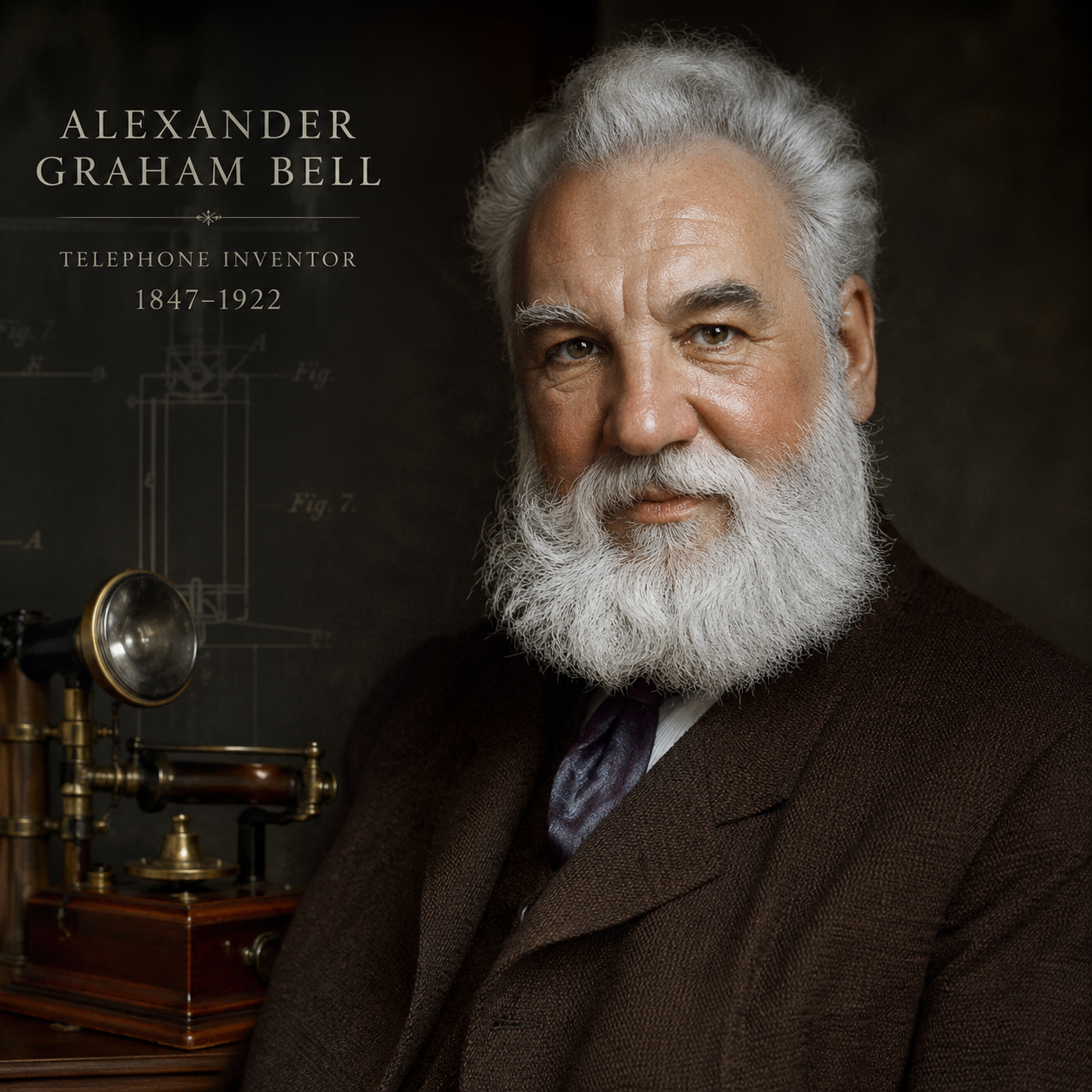
Alexander Graham Bell — "The achievement of one goal should be the starting point of another."
The achievement of one goal should be the starting point of another.
The achievement of one goal should be the starting point of another.
Click any product to generate a realistic preview. Up to 3 at a time.
* Initial load can take up to 90 seconds — revising the preview in another color is nearly instant.
"If it is not necessary, it is obviously not advisable, that deaf children should acquire, and use, as their ordinary and habitual means of communication — their vernacular in fact — a language that is…"
"Every man has a right to his own opinion, but no man has a right to be wrong in his facts."
"Before you can achieve anything, you must know what you want. And you must be prepared to sacrifice your comfort to get it."
"The day will come when the man at the telephone will be able to see the distant person to whom he is speaking."
"What this power is I cannot say; all I know is that it exists and it becomes available only when a man is in that state of mind in which he knows exactly what he wants and is fully determined not to g…"
Found in 1 providers: gemini
1 source checked
Completing a goal isn't an endpoint—it's a launchpad. Every success unlocks new questions, new possibilities, and higher ambitions. This mindset rejects complacency and treats achievement as momentum rather than a finish line. The most productive people don't stop after winning; they reframe the win as a new starting position, building continuously upward rather than resting on what they've already accomplished.
Bell invented the telephone in 1876 but never stopped there. He pursued flight research using tetrahedral kites, built hydrofoil boats, studied sheep genetics, and constructed a metal detector to locate the bullet in President Garfield. He co-founded the National Geographic Society. His deaf mother and deaf wife drove lifelong work on hearing and speech. Bell personally lived this philosophy—every breakthrough opened a new door rather than closing one.
Bell lived through the Second Industrial Revolution (1870s–1922), an era of explosive technological acceleration—electricity grids, railroads, telegraphs, automobiles, and early aviation all emerging within decades. Yesterday's miracle quickly became baseline infrastructure. Scientists and inventors faced constant pressure to innovate beyond their landmark achievements or risk irrelevance. The era rewarded relentless forward motion and punished those who treated a single invention as their complete life's work.
AI-generated insights based on extensive research and information for context. Factual errors? Email [email protected].
Your cart is empty