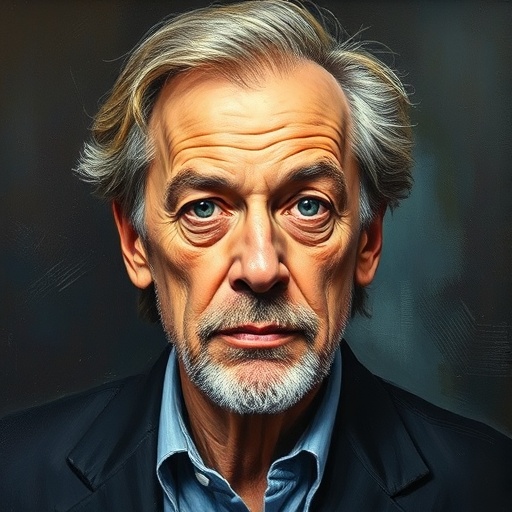
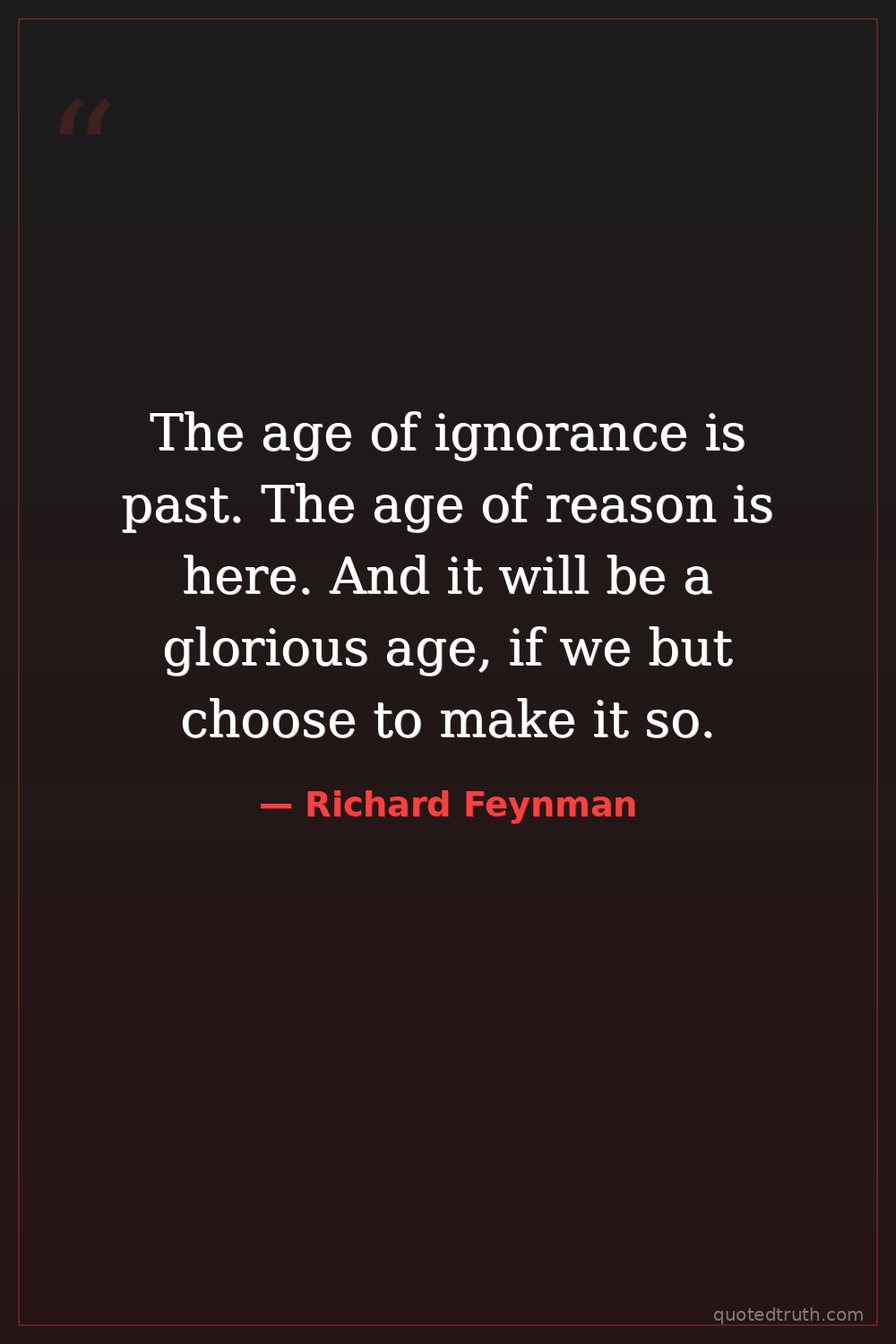
Richard Feynman — "The age of ignorance is past. The age of reason is here. And it will be a glorio…"
The age of ignorance is past. The age of reason is here. And it will be a glorious age, if we but choose to make it so.
The age of ignorance is past. The age of reason is here. And it will be a glorious age, if we but choose to make it so.
Click any product to generate a realistic preview. Up to 3 at a time.
* Initial load can take up to 90 seconds — revising the preview in another color is nearly instant.
"I have no respect for age. I have no respect for names. I have no respect for titles. I have respect for understanding."
"I am a man of the cloth, you might say, and my cloth is the universe."
"To every man is given the key to the gates of heaven; the same key opens the gates of hell."
"I'm not a serious fellow."
"I would rather have a world with five billion people that didn't know how to read than a world with five billion people that all knew how to read and all thought the same thing."
American theoretical physicist who shared the 1965 Nobel for QED, developed Feynman diagrams, and wrote the Feynman Lectures on Physics. Closely associated with Julian Schwinger (co-Nobelist for QED) and Murray Gell-Mann (Caltech rival and Eightfold-Way physicist). For an intellectual contrast, see Deepak Chopra, physician and quantum-mysticism author — Feynman's Caltech 'cargo cult science' commencement address is the precise template for what he saw as misuse of physics terminology — Chopra-style appropriation of quantum vocabulary for metaphysical claims is the canonical example of what Feynman called 'fooling yourself'.
Found in 1 providers: grok
1 source checked
Humanity has left behind superstition and ignorance, entering an era where rational inquiry and evidence-based thinking can guide decisions. But progress isn't automatic—it requires conscious choice. The 'glorious age' is conditional: available to us, but only if we collectively commit to reason over dogma, and critical thinking over blind belief. The optimism is earned, not assumed.
Feynman embodied reason as a way of life. His quantum electrodynamics work demanded rigorous evidence-driven thinking over intuition. He crusaded against 'cargo cult science,' warning self-deception was science's worst enemy. A Los Alamos physicist who later questioned nuclear development, he saw reason as moral responsibility. His Challenger investigation—cutting through NASA bureaucracy with a rubber band in ice water—showed reason as urgent, practical, and essential to human survival.
Feynman's career spanned the postwar scientific revolution—Manhattan Project through the Space Age and Reagan era. Nuclear weapons, vaccines, computing, and space exploration all emerged simultaneously, making science civilization's defining force. Yet Cold War paranoia, McCarthyism, and resurgent fundamentalism pushed back against rational inquiry. In that tension between unprecedented scientific power and persistent anti-intellectualism, declaring that reason had arrived—and must be actively chosen—carried real political and cultural urgency.
AI-generated insights based on extensive research and information for context. Factual errors? Email [email protected].
Your cart is empty