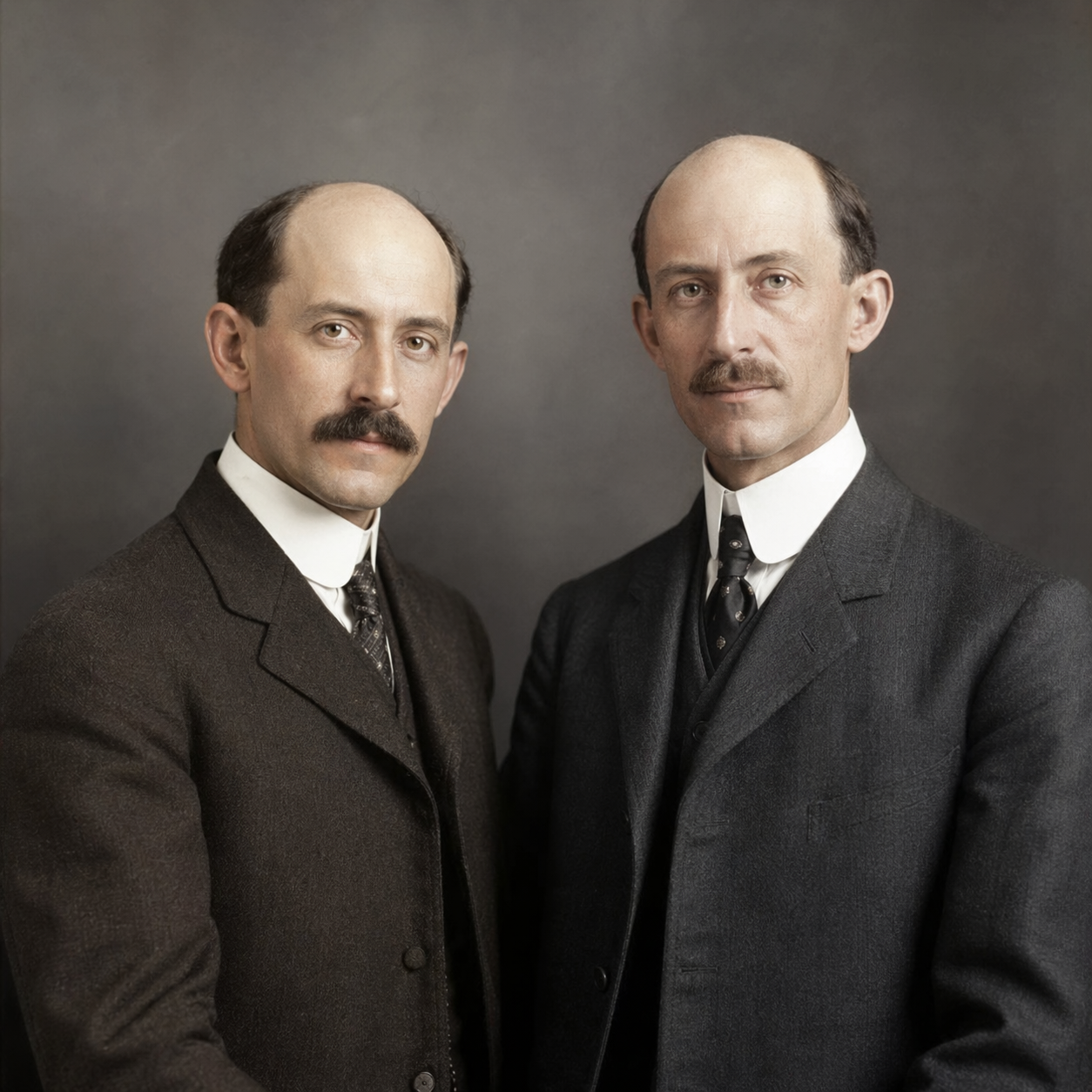
Wright Brothers (Orville & Wilbur) — "The age of the flying machine is at hand."
The age of the flying machine is at hand.
The age of the flying machine is at hand.
Click any product to generate a realistic preview. Up to 3 at a time.
* Initial load can take up to 90 seconds — revising the preview in another color is nearly instant.
"We have not been able to do much with the machine on account of the bad weather."
"If its engine stops, it must fall with deathly violence, for it can neither glide like the aeroplane or float like the balloon. The helicopter is much easier to design than the aeroplane, but is worth…"
"We could not understand why the calculation of Lilienthal and others were so much in error."
"The machine is now quite stable in the air and can be controlled with ease."
"We could hardly wait to get up in the morning."
American aviation pioneers who achieved the first sustained powered controlled airplane flight at Kitty Hawk, NC, on December 17, 1903. Closely associated with Octave Chanute (their gliding mentor and aeronautical correspondent). For an intellectual contrast, see Samuel Pierpont Langley, Smithsonian Institution Secretary and government-funded aviation researcher — Langley's Aerodrome crashed twice into the Potomac in October-December 1903 with $50,000 of War Department funding; the Wright Brothers' bicycle-shop empiricism beat Langley's institutional Big Science by 9 days. The most-cited example in engineering history of empirical-tinkerer beating institution-funded credentialism.
Found in 1 providers: grok
1 source checked
Human beings are about to conquer the sky. This quote declares that powered flight is no longer a dream but an approaching reality, standing at the threshold of a technological revolution. The speaker isn't speculating idly — they're announcing the arrival of something that will permanently alter how humanity moves, trades, fights, and perceives the world. A new era is not coming someday; it is arriving now.
The Wright Brothers didn't just predict the flying machine age — they launched it. Orville and Wilbur were self-taught bicycle mechanics from Dayton, Ohio, who studied flight systematically while better-funded rivals guessed. On December 17, 1903, at Kitty Hawk, their Flyer I made four powered flights, the longest 59 seconds. Their wind tunnel tests and wing-warping control system solved problems that had defeated government-backed researchers like Samuel Langley just weeks before.
In 1903, no human had ever flown under engine power. The Industrial Revolution had produced railroads, telegraphs, and steamships, but the sky remained unconquered. Otto Lilienthal's glider experiments in the 1890s proved controlled unpowered flight possible; his 1896 death showed the frontier's danger. The U.S. Army and the Smithsonian were funding rival programs to fly first. Within a decade of Kitty Hawk, aircraft appeared in military conflicts, making this declaration immediately and permanently prophetic.
AI-generated insights based on extensive research and information for context. Factual errors? Email [email protected].
Your cart is empty