Wright Brothers (Orville & Wilbur) — "The air, like the sea, is an untamed element."
The air, like the sea, is an untamed element.
The air, like the sea, is an untamed element.
Click any product to generate a realistic preview. Up to 3 at a time.
* Initial load can take up to 90 seconds — revising the preview in another color is nearly instant.
"We have not been able to do much with the machine on account of the bad weather."
"We are not content to walk upon the ground."
"I confess that in 1901 I said to my brother Orville that man would not fly for 50 years. Ever since I have distrusted myself and trusted him."
"In its campaign to discredit others in the flying art, the Smithsonian has issued scores of these false and misleading statements."
"The age of the flying machine is at hand."
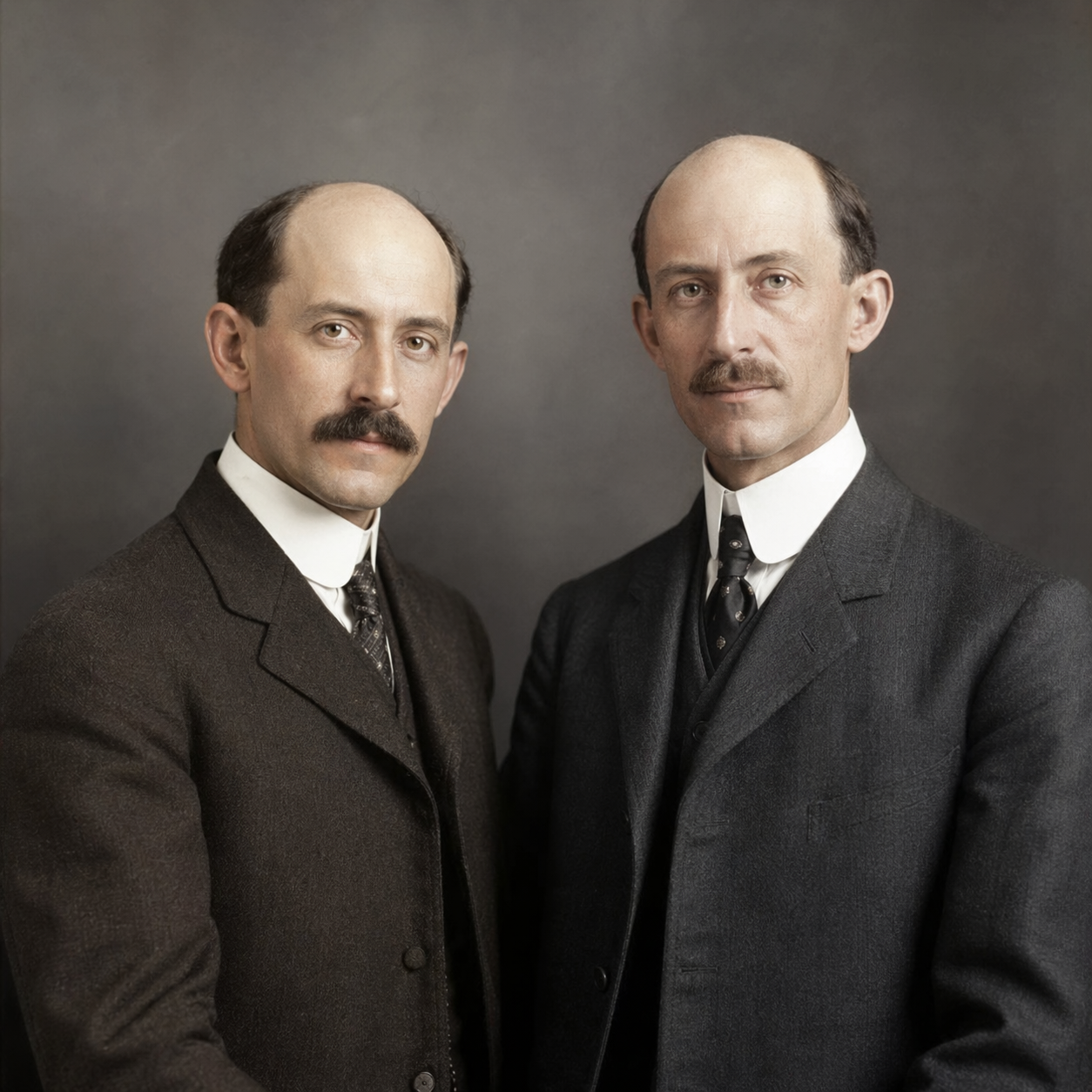
American aviation pioneers who achieved the first sustained powered controlled airplane flight at Kitty Hawk, NC, on December 17, 1903. Closely associated with Octave Chanute (their gliding mentor and aeronautical correspondent). For an intellectual contrast, see Samuel Pierpont Langley, Smithsonian Institution Secretary and government-funded aviation researcher — Langley's Aerodrome crashed twice into the Potomac in October-December 1903 with $50,000 of War Department funding; the Wright Brothers' bicycle-shop empiricism beat Langley's institutional Big Science by 9 days. The most-cited example in engineering history of empirical-tinkerer beating institution-funded credentialism.
Found in 1 providers: grok
1 source checked
Air and sea share fundamental wildness — both resist permanent human domination. Entering either medium demands respect for its inherent unpredictability. Wind shifts, turbulence, and atmospheric pressure behave according to natural laws humans can study but never fully override. Success in flight, like seamanship, comes from working with the element's nature rather than against it. Power and ingenuity matter, but the medium always holds final authority.
The Wright Brothers knew air's volatility firsthand. Between 1900 and 1903 they flew hundreds of glider tests at Kitty Hawk, repeatedly crashing as wind gusts overwhelmed their controls. Their three-axis control system — elevator, rudder, wing-warping — was engineered specifically to manage air's instability, not eliminate it. Their success came from disciplined study of the element's behavior, never from assuming it could be subdued or fully mastered.
In 1903 the world was still maritime-dominated: ocean liners, naval trade routes, and transatlantic cables defined global connectivity. Most scientists believed controlled flight was decades away. The Industrial Revolution had tamed steam and electricity but air remained beyond reach. The sea comparison grounded the concept in familiar danger — everyone understood oceanic unpredictability. Aviation's infancy made this humility essential; overconfidence had already killed early experimenters like Otto Lilienthal in 1896.
AI-generated insights based on extensive research and information for context. Factual errors? Email [email protected].
Your cart is empty