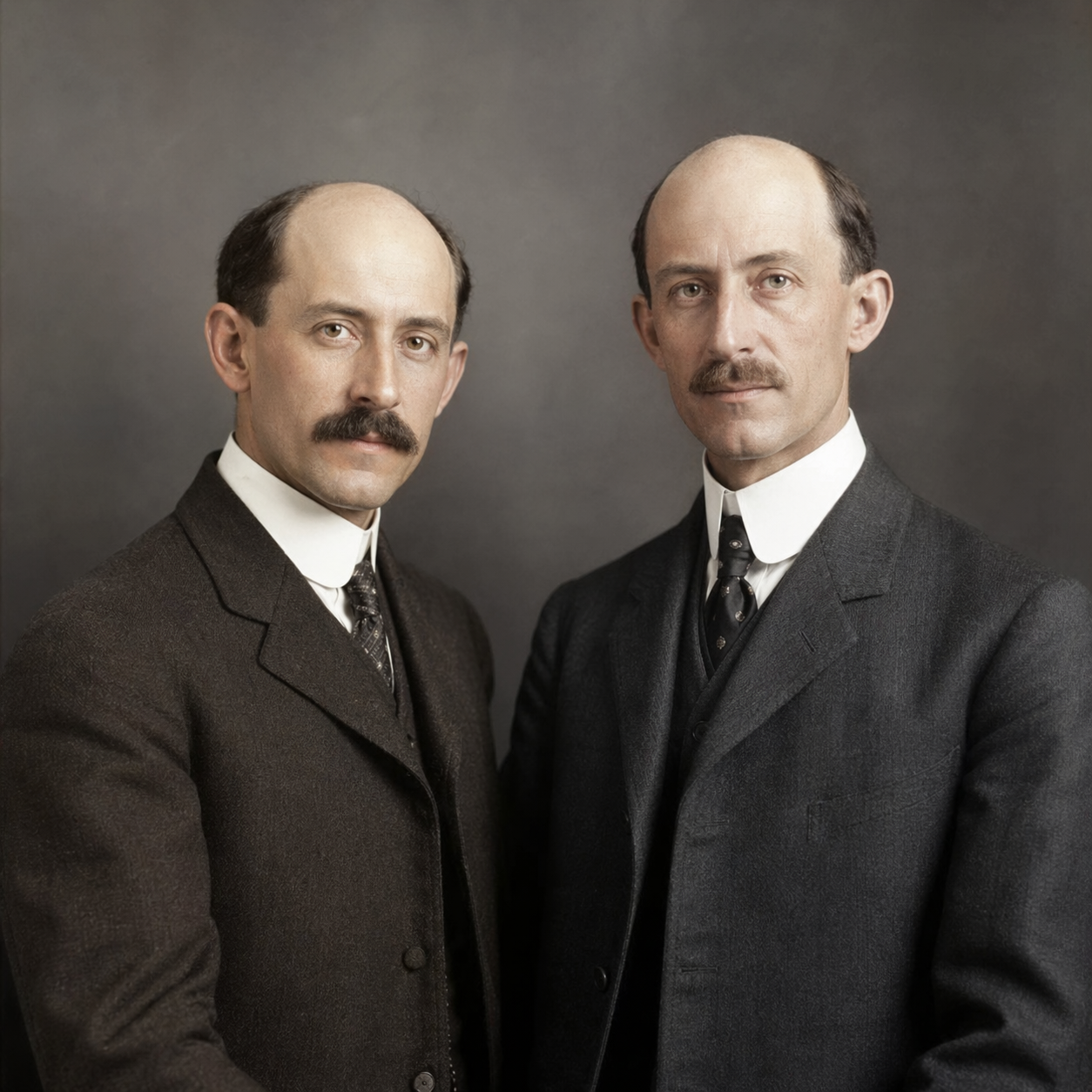
Wright Brothers (Orville & Wilbur) — "The airplane is a machine that makes the world a smaller place."
The airplane is a machine that makes the world a smaller place.
The airplane is a machine that makes the world a smaller place.
Click any product to generate a realistic preview. Up to 3 at a time.
* Initial load can take up to 90 seconds — revising the preview in another color is nearly instant.
"The airplane is a crazy idea, but I don’t care."
"The aeroplane is not an invention, but a discovery."
"The desire to fly is an idea handed down to us by our ancestors who, in their dim terrestrial captivity, looked enviously on the birds soaring freely through space…"
"Learning the secret of flight from a bird was a good deal like learning the secret of magic from a magician—something the magician won't tell, and the bird can't tell."
"The course of the experiment was not always smooth. The machine would start all right, but the propelling power was not sufficient to overcome the resistance of the air."
American aviation pioneers who achieved the first sustained powered controlled airplane flight at Kitty Hawk, NC, on December 17, 1903. Closely associated with Octave Chanute (their gliding mentor and aeronautical correspondent). For an intellectual contrast, see Samuel Pierpont Langley, Smithsonian Institution Secretary and government-funded aviation researcher — Langley's Aerodrome crashed twice into the Potomac in October-December 1903 with $50,000 of War Department funding; the Wright Brothers' bicycle-shop empiricism beat Langley's institutional Big Science by 9 days. The most-cited example in engineering history of empirical-tinkerer beating institution-funded credentialism.
Found in 1 providers: deepseek
1 source checked
Air travel shrinks the distances between people and places, making once-remote corners of the world accessible within hours. What once took weeks by ship or land now takes a day. The airplane doesn't physically shrink geography, but it collapses the time and effort required to cross it, making cultures, markets, and families separated by oceans feel far less distant from one another.
Orville and Wilbur Wright, Dayton bicycle mechanics, achieved the first powered flight at Kitty Hawk in 1903. They approached aviation as a practical engineering problem with global consequences, filling meticulous notebooks and building wind tunnels. Wilbur traveled to France in 1908 to demonstrate the Flyer publicly, embodying the belief that their invention belonged to the world. Connecting distant people was the natural extension of everything they had worked toward.
In 1903, a transatlantic crossing still took roughly a week by steamship, and rail connected continents only where land allowed. Telegraphs moved words instantly but people and goods moved slowly. The Wright Brothers flew at a moment when industrialization had already begun shrinking the world through railroads and cables, and aviation promised to finish the job. Within two decades, their invention would reshape commerce, warfare, and the very idea of national borders.
AI-generated insights based on extensive research and information for context. Factual errors? Email [email protected].
Your cart is empty