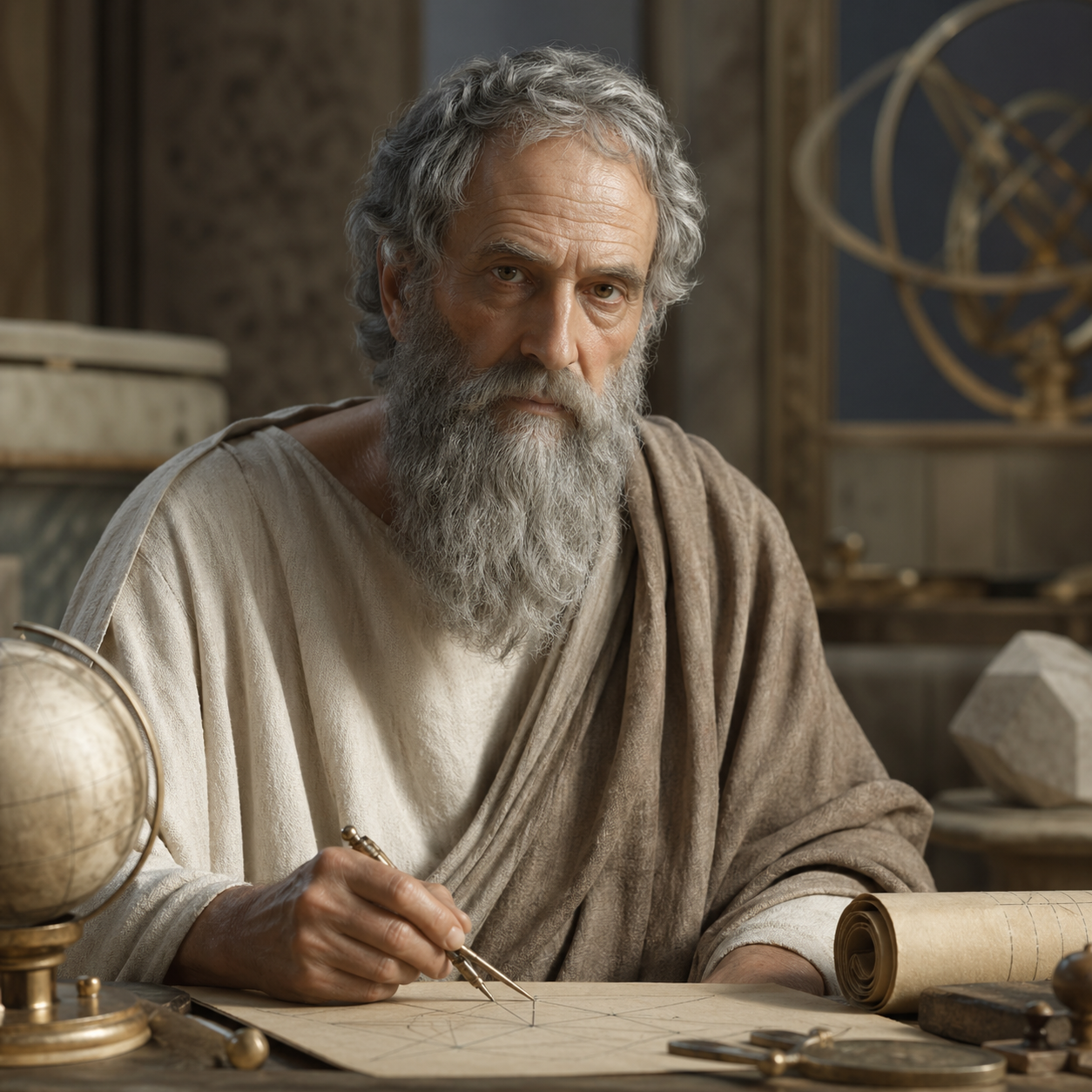
Euclid — "The angles in the same segment are equal to one another."
The angles in the same segment are equal to one another.
The angles in the same segment are equal to one another.
Click any product to generate a realistic preview. Up to 3 at a time.
* Initial load can take up to 90 seconds — revising the preview in another color is nearly instant.
"The only purpose of the 'Elements' is to demonstrate mathematically certain fundamental propositions."
"Of trilateral figures, an equilateral triangle is that which has its three sides equal, an isosceles triangle that which has only two of its sides equal, and a scalene triangle that which has its thre…"
"And the greater is a multiple of the less when it is measured by the less."
"A plane angle is the inclination of the lines to one another, when two lines meet one another, but are not in the same straight line."
"A semicircle is the figure contained by the diameter and the circumference cut off by it. And the center of the semicircle is the same as that of the circle."
Found in 1 providers: grok
1 source checked
Any two angles drawn from different points along the same arc of a circle will always be identical in measure. No matter where on that arc you position yourself, the angle subtended by the same chord stays constant. This is a universal, provable truth about circles — position shifts, but the angle does not. It underpins reliable geometric reasoning used in engineering, architecture, and navigation.
This theorem appears in Book III of Euclid's Elements, his 13-volume masterwork composed around 300 BCE at Alexandria. Euclid's defining contribution was not discovering every result himself, but constructing an airtight deductive system — each truth proven from prior truths, rooted in five simple axioms. This circle theorem exemplifies his method: precise, universal, irrefutable. His logical framework governed mathematical education for over two thousand years.
Around 300 BCE, Alexandria under Ptolemy I was becoming the Mediterranean's intellectual capital. Greek thinkers were transforming mathematics from Babylonian and Egyptian practical calculation into abstract proof-based reasoning. Plato's Academy had elevated geometry to philosophy; Euclid codified it as rigorous science. With no algebra or calculus yet available, geometry was the supreme language of truth — used to design temples, plan cities, and model the heavens.
AI-generated insights based on extensive research and information for context. Factual errors? Email [email protected].
Your cart is empty