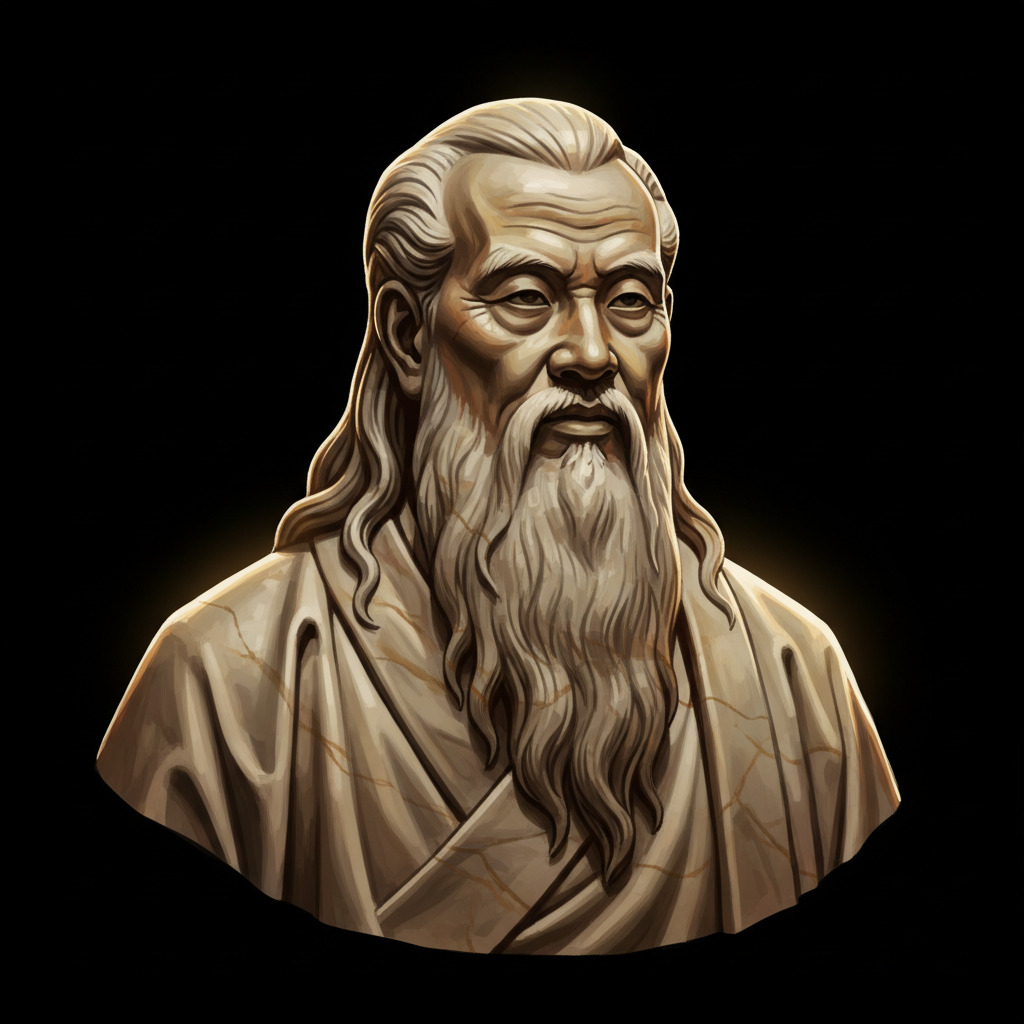
Laozi — "The best rulers are those whose existence is barely known by the people."
The best rulers are those whose existence is barely known by the people.
The best rulers are those whose existence is barely known by the people.
Click any product to generate a realistic preview. Up to 3 at a time.
* Initial load can take up to 90 seconds — revising the preview in another color is nearly instant.
"The five colors make one blind in the eyes; the five tones make one deaf in the ears."
"When the great Tao is abandoned, there is humanity and righteousness. When wisdom and intelligence appear, there is great hypocrisy."
"Stop thinking, and end your problems."
"The wise man's food is that which nourishes, not that which pleases the eye."
"Fill your bowl to the brim and it will spill. Keep sharpening your knife and it will blunt."
Reputed founder of Taoism and author of the Tao Te Ching, whose wu wei (effortless action) shaped East Asian philosophy. Closely associated with Zhuangzi (later Taoist who extended Laozi's framework). For an intellectual contrast, see Confucius, near-contemporary Chinese sage of social ritual and duty — Confucius systematized social order through ritual and hierarchy; Laozi argued that all such systems were the disease, not the cure — the two founding poles of Chinese moral philosophy.
Found in 1 providers: deepseek
1 source checked
Great leadership is invisible. When a ruler governs wisely, people live their lives freely and credit their successes to themselves, not to authority. Heavy-handed leaders who constantly intervene, issue commands, or demand recognition actually signal weakness. The highest form of governance creates conditions where things work so smoothly that citizens barely notice anyone is in charge, feeling they accomplished everything through their own effort.
Laozi reportedly served as a keeper of royal archives in the Zhou court, observing firsthand how bureaucratic meddling corrupted natural order. His core doctrine of wu wei, or effortless action, held that sages accomplish more by doing less. Legend says he grew disgusted with declining governance and rode west into obscurity, embodying his own teaching that the wisest leaders withdraw from spectacle rather than cling to power or recognition.
Laozi lived during the late Zhou dynasty, around the 6th century BCE, as centralized authority crumbled into the violent Warring States period. Feudal lords competed through elaborate rituals, massive armies, and heavy taxation, causing immense peasant suffering. Against this backdrop of authoritarian overreach and constant warfare, his call for minimal, invisible rulership was radical critique, proposing that the chaos stemmed precisely from rulers who governed too visibly and interfered too much.
AI-generated insights based on extensive research and information for context. Factual errors? Email [email protected].
Your cart is empty