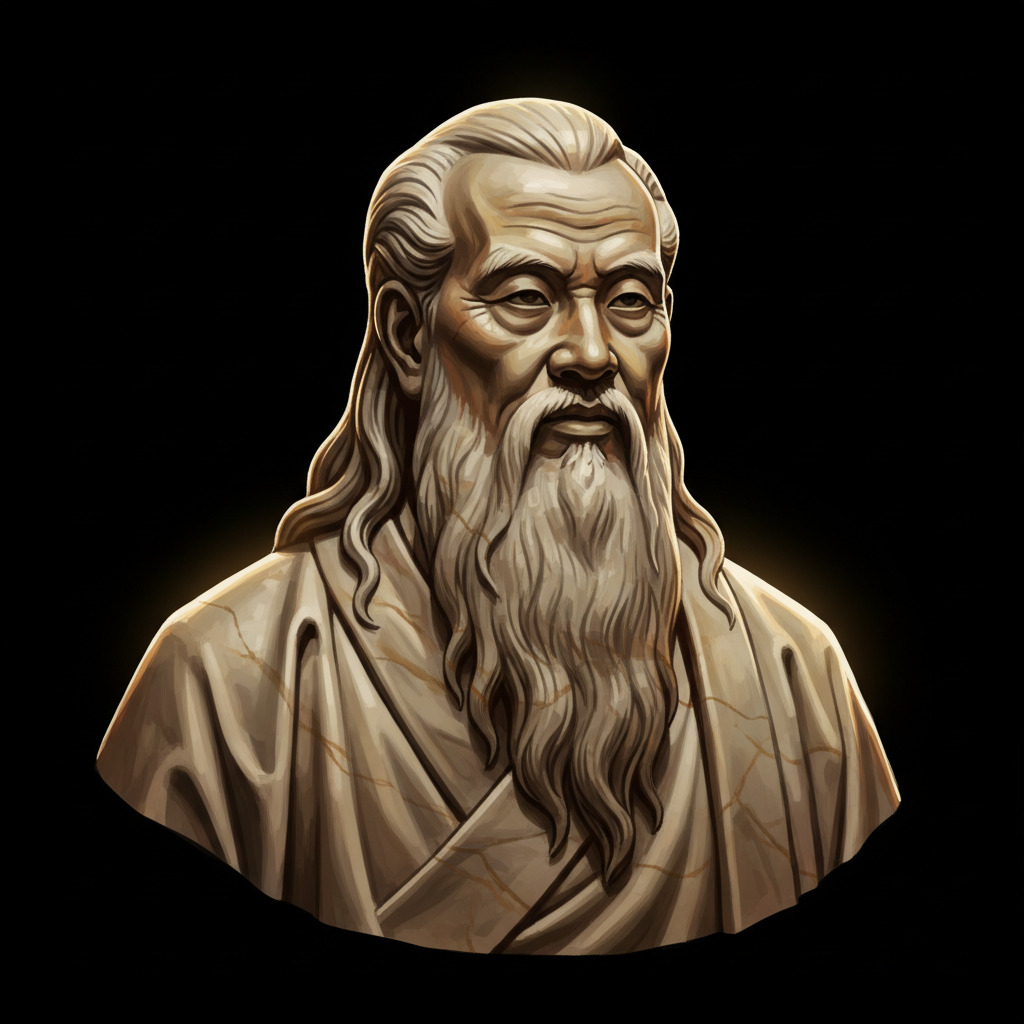
Laozi — "The heavy is the root of the light. The still is the master of the restless."
The heavy is the root of the light. The still is the master of the restless.
The heavy is the root of the light. The still is the master of the restless.
Click any product to generate a realistic preview. Up to 3 at a time.
* Initial load can take up to 90 seconds — revising the preview in another color is nearly instant.
"The greatest conquest is to conquer oneself."
"The sage puts his own person last, and yet is found in the foremost place."
"The wise man's food is that which nourishes, not that which pleases the eye."
"When you realize there is nothing lacking, the whole world belongs to you."
"Empty your mind of all thoughts. Let your heart be at peace. Watch the turmoil of the world, but let your serenity remain intact."
Reputed founder of Taoism and author of the Tao Te Ching, whose wu wei (effortless action) shaped East Asian philosophy. Closely associated with Zhuangzi (later Taoist who extended Laozi's framework). For an intellectual contrast, see Confucius, near-contemporary Chinese sage of social ritual and duty — Confucius systematized social order through ritual and hierarchy; Laozi argued that all such systems were the disease, not the cure — the two founding poles of Chinese moral philosophy.
Found in 2 providers: grok,gemini
2 sources checked
Weight and stillness are the foundation for lightness and motion. Anything light, quick, or agitated depends on something heavier and calmer beneath it to stay grounded. A person who stays steady and composed controls situations, while someone frantic gets pulled around by every shift. Depth supports surface, patience governs activity, and self-possession outlasts reactivity. Lose the grounding and the lightness becomes chaos.
Laozi reportedly served as an archivist in the Zhou royal court, a role rewarding quiet observation over ambition. Disillusioned with political turmoil, he is said to have withdrawn westward, embodying the stillness he praised. His core teaching of wu wei, effortless action rooted in inner calm, directly matches this saying. He valued the unseen weight of character over showy movement, making steadiness the true authority behind every light, restless surface of human affairs.
Laozi lived during the late Zhou dynasty, around the 6th century BCE, as centralized authority crumbled into the Spring and Autumn period's constant warfare between rival states. Rulers chased quick conquests, shifting alliances, and flashy reforms, while philosophers competed for court influence. Against this restless ambition, Laozi's praise of weight and stillness was a direct rebuke, urging leaders to anchor themselves rather than react, and planting seeds for Taoism's enduring counterweight to Confucian activism.
AI-generated insights based on extensive research and information for context. Factual errors? Email [email protected].
Your cart is empty