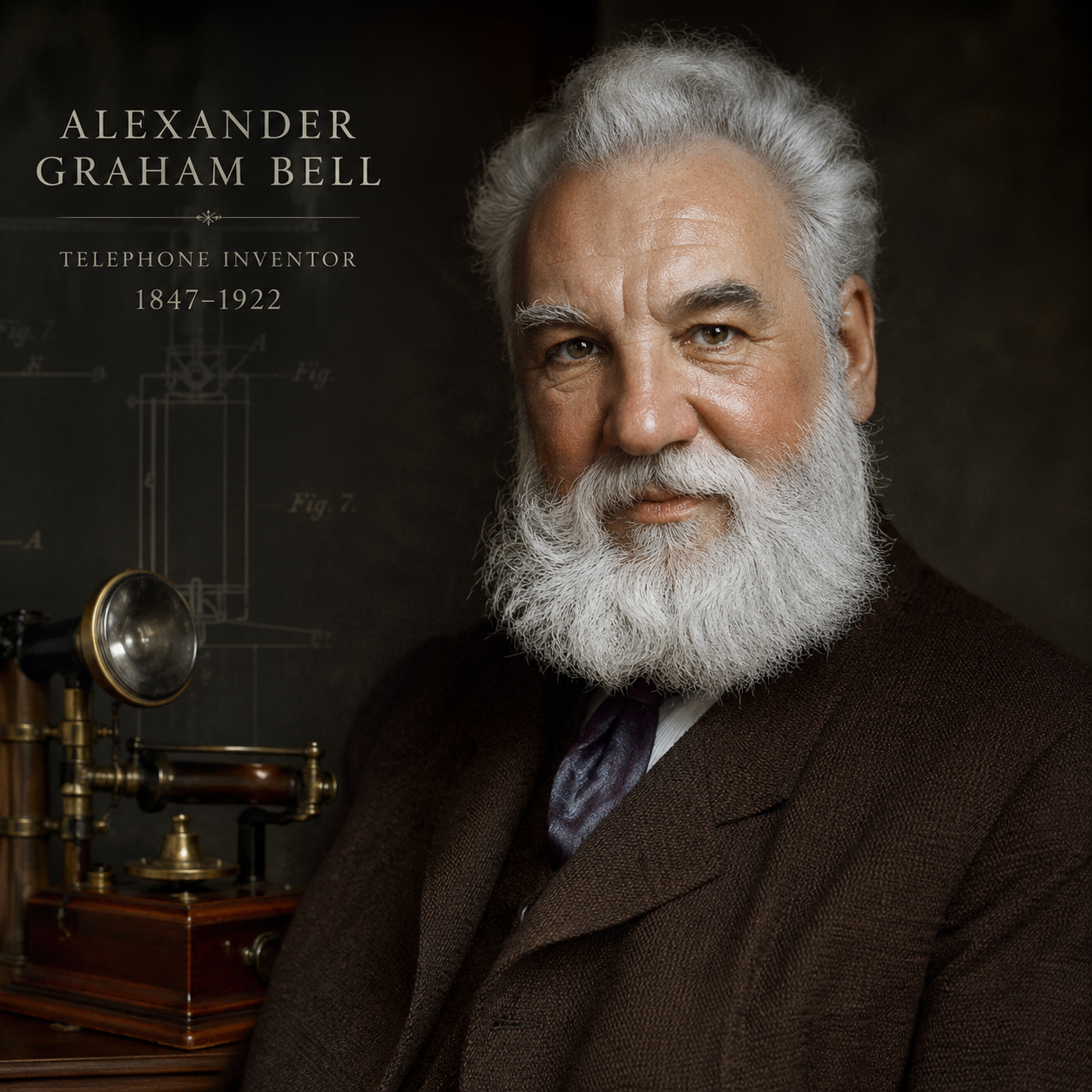
Alexander Graham Bell — "The best way to predict the future is to invent it."
The best way to predict the future is to invent it.
The best way to predict the future is to invent it.
Click any product to generate a realistic preview. Up to 3 at a time.
* Initial load can take up to 90 seconds — revising the preview in another color is nearly instant.
"Wherever you may find the inventor, you may give him wealth or you may take from him all that he has; and he will go on inventing. He can no more help inventing than he can help thinking or breathing."
"The main object of the education of the deaf is to fit them to live in the world of a hearing-speaking people."
"The telephone will revolutionize communication."
"I begin my work at about nine or ten o'clock in the evening and continue until four or five in the morning. Night is a more quiet time to work. It aids thought."
"Before anything else, preparation is the key to success."
This quote is famously attributed to Alan Kay, a computer scientist. It is frequently misattributed to Bell.
Date: 1971 (Kay)
GeneralFound in 1 providers: grok
1 source checked
Passive forecasting is a waste of effort. The most effective way to shape what comes next is to build it yourself. Rather than analyzing trends or waiting for change to arrive, those who act — who create tools, systems, and technologies — are the ones who determine what the future looks like. Agency beats prediction every time; the maker's hands are more powerful than the analyst's model.
Bell didn't predict a world connected by voice over wire — he constructed it. His 1876 telephone patent emerged from relentless lab experimentation while others merely theorized about electrical communication. Bell also founded research institutions, pursued aviation, hydrofoils, and hearing science late in life. His entire career was proof that the future belongs to those willing to physically build what they imagine, not those who forecast it from the sidelines.
Bell worked during the Second Industrial Revolution of the late 1800s, when Edison, Tesla, and Westinghouse were literally building modernity in real time. Patent races were fierce, world's fairs showcased civilization-reshaping inventions, and industrialization was reordering society. The cultural belief that human ingenuity could manufacture a better future was at its peak. Invention wasn't philosophical — it was the primary engine of national power and personal legacy in Gilded Age America.
AI-generated insights based on extensive research and information for context. Factual errors? Email [email protected].
Your cart is empty