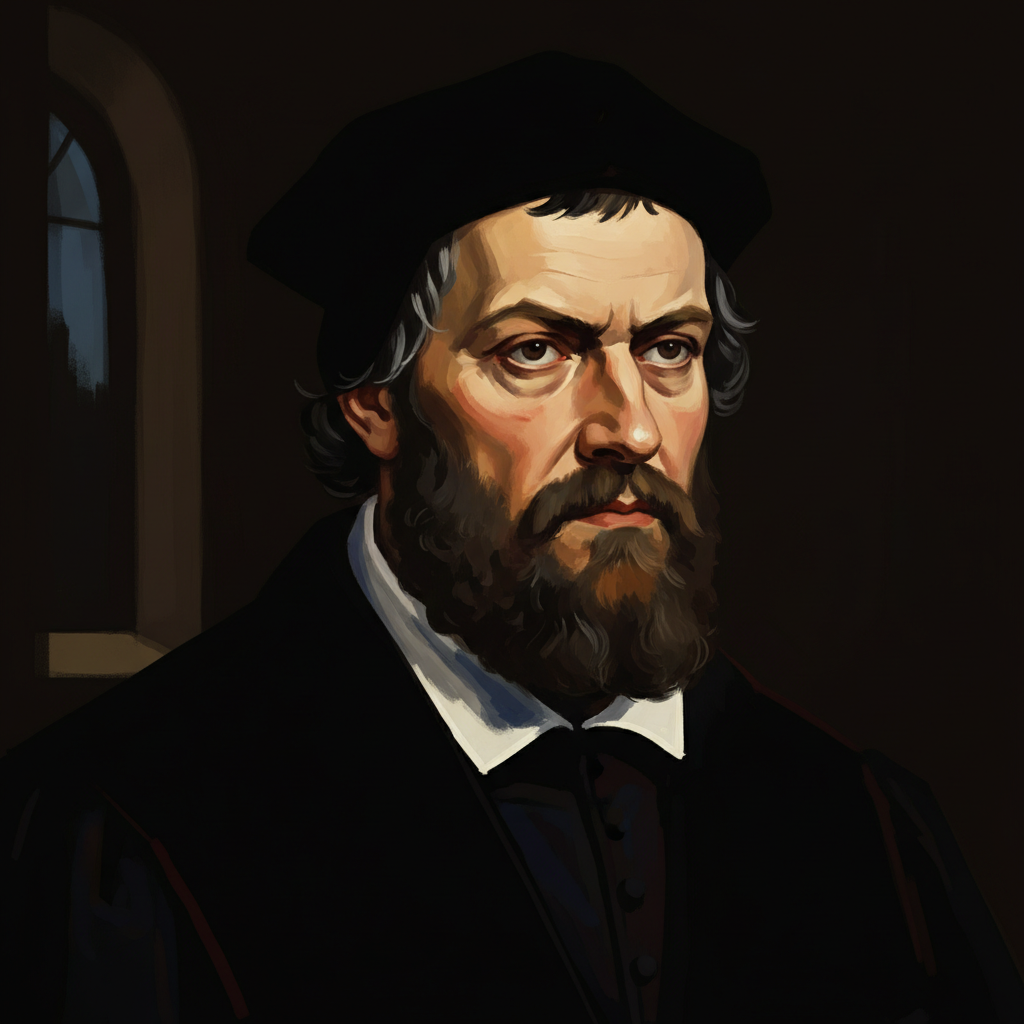
Martin Luther — "The Bible is the cradle wherein Christ is laid."
The Bible is the cradle wherein Christ is laid.
The Bible is the cradle wherein Christ is laid.
Click any product to generate a realistic preview. Up to 3 at a time.
* Initial load can take up to 90 seconds — revising the preview in another color is nearly instant.
"If I had to do it all over again, I would still burn the pope’s bull."
"For I know One who suffered and made satisfaction on my behalf. His name is Jesus Christ, Son of God, and where He is there I shall be also!"
"The pope, a nemesis, was his 'dearest little ass-pope.'"
"I am much afraid that schools will prove to be great gates of hell unless they diligently labor in explaining the Holy Scriptures, engraving them in the hearts of youth. I advise no one to place his c…"
"I would have all Christians educated enough to be able to read the Bible. It is not for priests alone, but for all."
German theologian whose 95 Theses (1517) launched the Protestant Reformation and broke the Catholic Church's monopoly on Western Christianity. Closely associated with Philipp Melanchthon (Lutheran systematizer) and John Calvin (later Reformer who built on Luther's break). For an intellectual contrast, see Pope Leo X, Renaissance pope (1513-1521) — Leo X's indulgence sales triggered Luther's break and Leo excommunicated him in 1521 — Luther's entire Reformation is structured as a direct answer to the indulgence-funded Vatican Leo represented.
Found in 2 providers: grok,deepseek
2 sources checked
Scripture's primary purpose is to hold and reveal Christ. Like a cradle that exists to carry a baby, the Bible's value lies not in itself but in what it contains. Every page, story, and law ultimately points to Jesus. Readers shouldn't worship the book or get lost in its details; they should look through it to find the person it was written to present.
Luther built his entire theology on Scripture alone (sola scriptura) while insisting Christ was its center. As a monk turned reformer, he translated the Bible into German so ordinary people could access it directly. He rejected medieval approaches that treated Scripture as a rulebook or mystical puzzle, arguing instead that every text must be read christologically. This quote captures his hermeneutic: the Bible matters because Jesus is in it.
In early modern Europe, the Catholic Church controlled Scripture's interpretation, keeping it in Latin and filtering it through tradition, saints, and papal authority. Printing presses were spreading rapidly after 1450, making vernacular Bibles possible for the first time. Luther's 1517 Ninety-Five Theses ignited debates about where religious authority actually resides. This saying challenged both literalists who worshipped the text and institutions that obscured its central figure behind ritual.
AI-generated insights based on extensive research and information for context. Factual errors? Email [email protected].
Your cart is empty