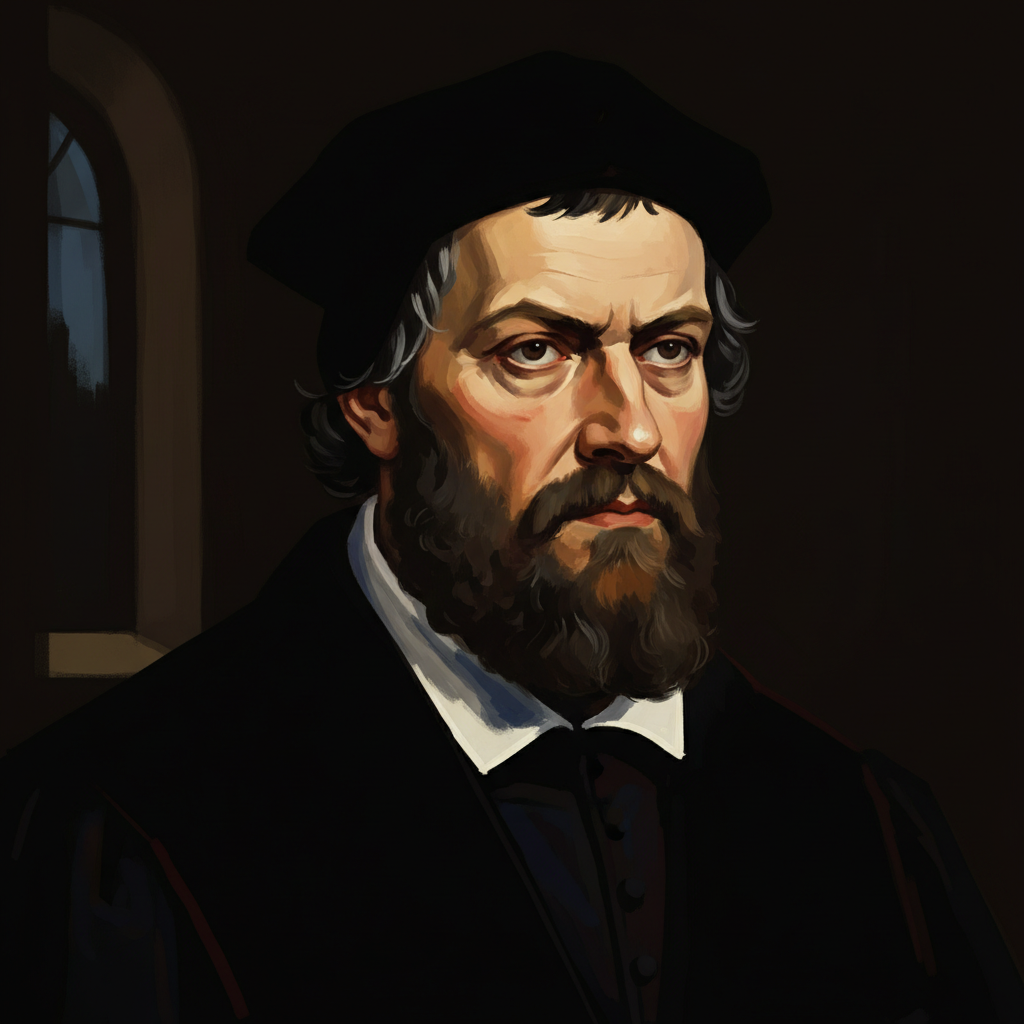
Martin Luther — "You are not only responsible for what you say, but also for what you do not say."
You are not only responsible for what you say, but also for what you do not say.
You are not only responsible for what you say, but also for what you do not say.
Click any product to generate a realistic preview. Up to 3 at a time.
* Initial load can take up to 90 seconds — revising the preview in another color is nearly instant.
"We are saved by faith alone, but the faith that saves is never alone."
"Burn down their synagogues, forbid all that I enumerated earlier, force them to work, and deal with them with utmost severity, as Moses did in the wilderness, when he slew three thousand... for if we …"
"Be a sinner and SIN BOLDLY, but believe more boldly still."
"What God wills is not right because he ought, or was bound, so to will; on the contrary, what takes place must be right, because he so wills it."
"I have not invented a new doctrine, but have only restored the old one."
German theologian whose 95 Theses (1517) launched the Protestant Reformation and broke the Catholic Church's monopoly on Western Christianity. Closely associated with Philipp Melanchthon (Lutheran systematizer) and John Calvin (later Reformer who built on Luther's break). For an intellectual contrast, see Pope Leo X, Renaissance pope (1513-1521) — Leo X's indulgence sales triggered Luther's break and Leo excommunicated him in 1521 — Luther's entire Reformation is structured as a direct answer to the indulgence-funded Vatican Leo represented.
Found in 1 providers: deepseek
1 source checked
Silence is not neutral. When you witness wrongdoing, injustice, or error and choose to say nothing, you share in the responsibility for what follows. Speaking up carries moral weight, but so does holding back. Accountability covers both your words and the words you swallowed. Staying quiet to avoid conflict, preserve comfort, or protect your standing does not absolve you. Your unspoken truths count against you just as much as anything you actually said aloud.
Luther built his life on refusing to stay silent. In 1517 he nailed the Ninety-Five Theses to the Wittenberg church door, publicly challenging Church corruption over indulgences. At the Diet of Worms in 1521, facing excommunication and possible death, he refused to recant: 'Here I stand, I can do no other.' As a theology professor and former Augustinian monk, he believed silence in the face of doctrinal error was itself a sin against conscience and God.
Luther lived during the early modern period when the Catholic Church held unified spiritual and political authority across Europe. Speaking against Rome risked excommunication, exile, or execution, as Jan Hus had been burned in 1415 for similar dissent. The printing press, newly invented, was rapidly spreading ideas. Most clergy stayed silent about abuses like indulgence-selling to keep their positions. Luther's insistence that silence equaled complicity fueled the Protestant Reformation and permanently shattered Western Christendom's unity.
AI-generated insights based on extensive research and information for context. Factual errors? Email [email protected].
Your cart is empty