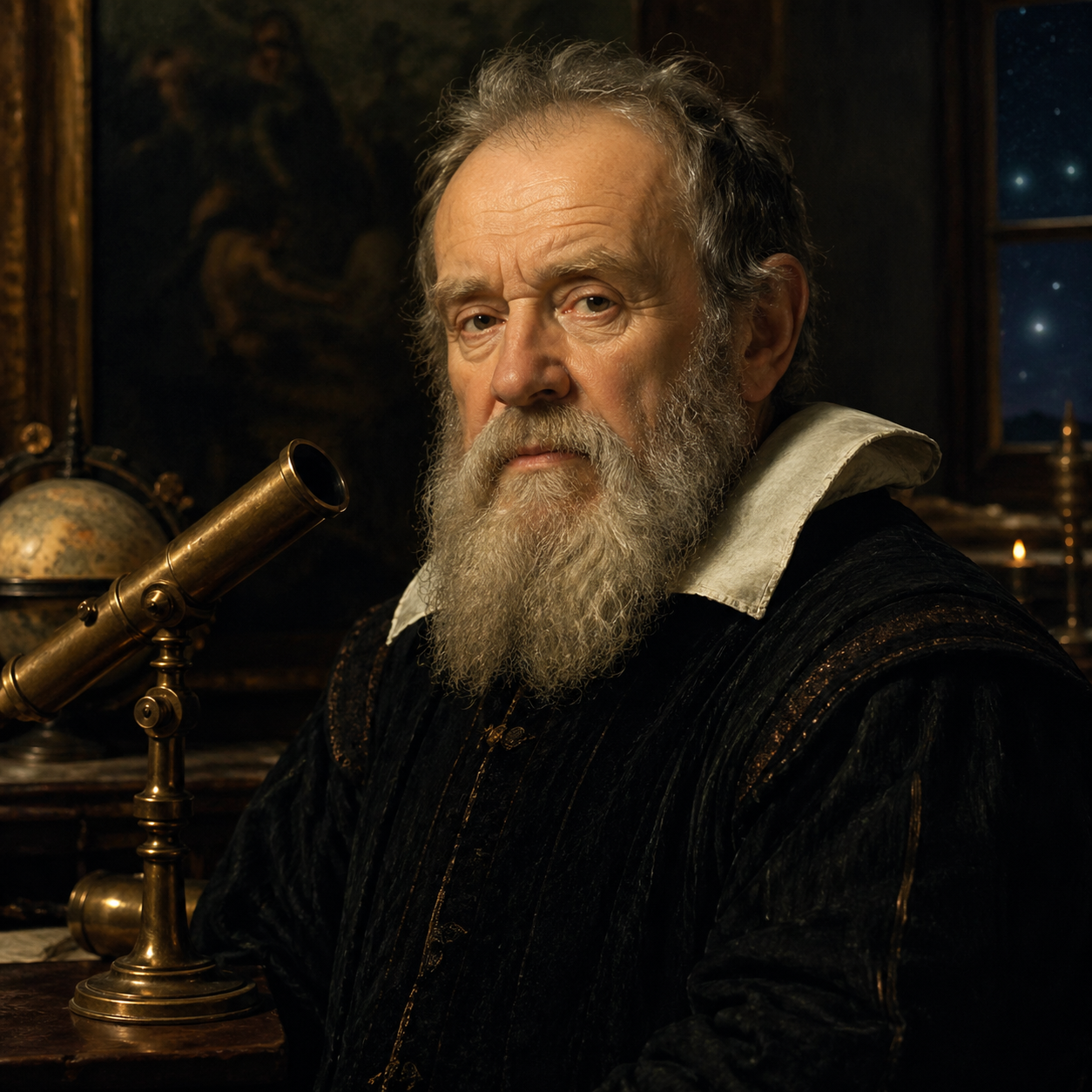
Galileo Galilei — "The Bible shows the way to go to heaven, not the way the heavens go."
The Bible shows the way to go to heaven, not the way the heavens go.
The Bible shows the way to go to heaven, not the way the heavens go.
Click any product to generate a realistic preview. Up to 3 at a time.
* Initial load can take up to 90 seconds — revising the preview in another color is nearly instant.
"I think that in the discussion of natural problems we ought not to begin at the authority of places of Scripture, but at sensible experiments and necessary demonstrations."
"The great book of nature is written in mathematical symbols."
"The error of the senses is not less, but rather greater, if we try to correct them by reason without experience."
"To deny one's senses and reason is to deny God's gifts."
"What is important is to understand the language of nature, not to impose on it our own prejudices."
Found in 2 providers: grok,deepseek
2 sources checked
Scripture guides moral and spiritual life, not scientific inquiry. Religion and science operate in separate domains: faith answers questions of salvation and purpose, while observation and reason answer questions about how the physical universe actually functions. Forcing religious texts to serve as astronomy manuals misreads their purpose and produces bad theology alongside bad science.
Galileo championed heliocentrism despite Church opposition, facing inquisition for his Copernican writings. This quote, drawn from his Letter to Castelli, defended his telescopic discoveries by arguing scripture was never meant to describe planetary motion. He sought to protect both scientific truth and religious integrity by separating their proper jurisdictions.
During the early 1600s, the Catholic Church wielded enormous authority over intellectual life. Galileo's heliocentric findings directly challenged geocentric doctrine endorsed by clergy interpreting Psalms and Joshua literally. The Inquisition actively prosecuted heresy, and Copernicus's works were banned in 1616. Reconciling new empirical astronomy with entrenched biblical literalism was genuinely dangerous, career-ending, and potentially lethal.
AI-generated insights based on extensive research and information for context. Factual errors? Email [email protected].
Your cart is empty