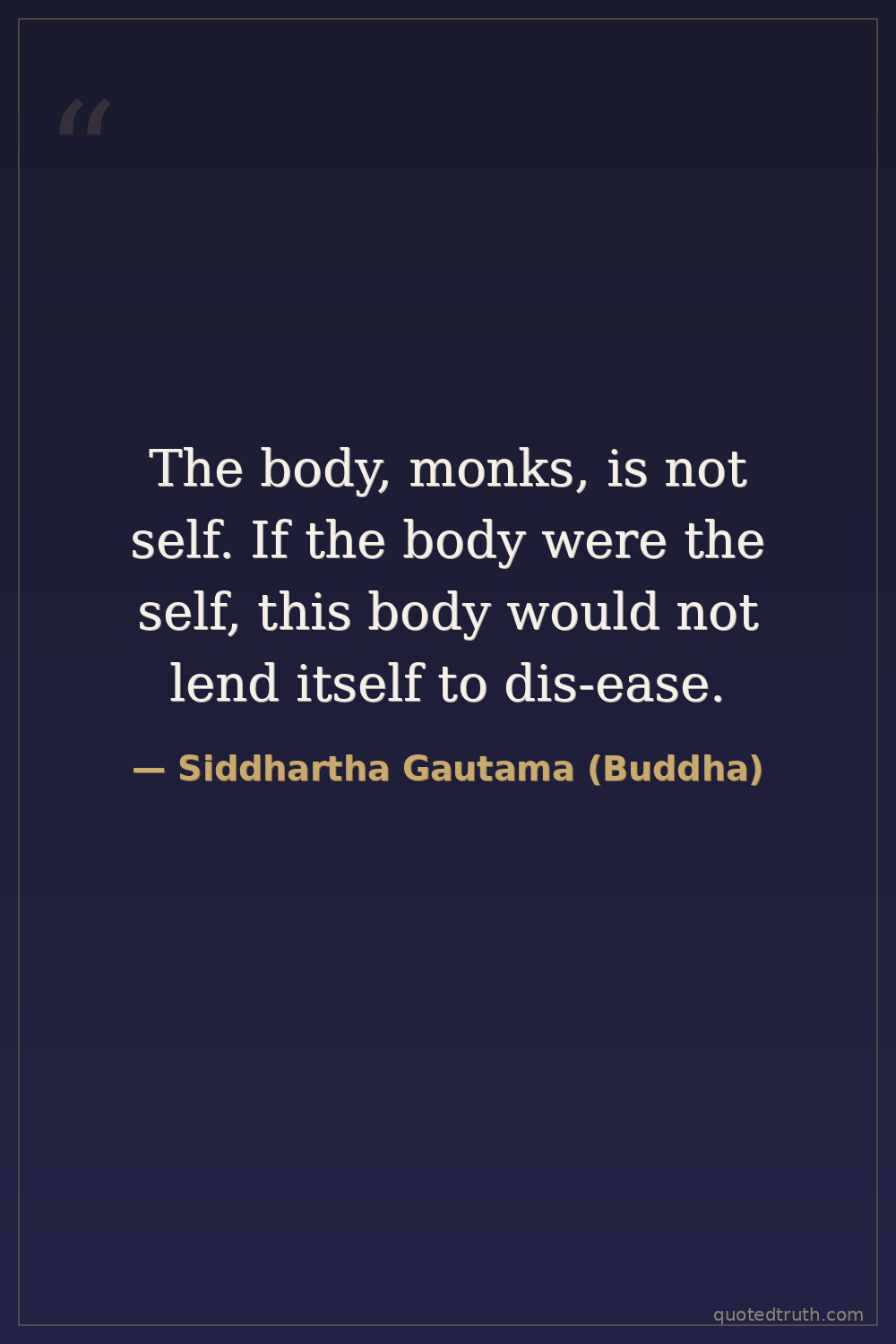
Siddhartha Gautama (Buddha) — "The body, monks, is not self. If the body were the self, this body would not len…"
The body, monks, is not self. If the body were the self, this body would not lend itself to dis-ease.
The body, monks, is not self. If the body were the self, this body would not lend itself to dis-ease.
Click any product to generate a realistic preview. Up to 3 at a time.
* Initial load can take up to 90 seconds — revising the preview in another color is nearly instant.
"Hatred does not cease by hatred, but only by love; this is the eternal rule."
"However many holy words you read, however many you speak, what good will they do you if you do not act on upon them?"
"By oneself is evil done; by oneself is one defiled. By oneself is evil left undone; by oneself is one made pure. Purity and impurity depend on oneself; no one can purify another."
"You are what you think. All that you are arises from your thoughts. With your thoughts, you make your world."
"It is a man's own mind, not his enemy or foe, that lures him to evil ways."
From the Anattalakkhana Sutta (Samyutta Nikaya XXII, 59), a teaching on non-self
Date: c. 5th-6th Century BCE
PhilosophicalFound in 1 providers: gemini
1 source checked
The quote argues that your body cannot be your true self, because if it were, you would control it completely and it would never get sick, age, or fall apart against your wishes. Since the body does break down and cause suffering without your permission, it must not be the essential 'you.' It's a thing you experience, not what you fundamentally are.
Siddhartha left his palace after seeing sickness, old age, and death, which shattered his assumption that the body could be a reliable home for identity. This teaching, part of his Anatta (non-self) doctrine delivered to his first five monks at Sarnath, reflects his core insight that clinging to the body as 'me' or 'mine' is the root of suffering, and letting go of that identification is liberation.
In 5th-century BCE India, Brahmanic tradition taught that every person had an eternal atman (soul) identical with Brahman, and bodily rituals preserved cosmic order. Rival ascetics punished the body to free the soul. The Buddha rejected both camps, teaching that no permanent self exists anywhere, including the body. This was radical in a society built on caste identity and soul-based metaphysics, reframing spiritual life around observation rather than inherited doctrine.
AI-generated insights based on extensive research and information for context. Factual errors? Email [email protected].
Your cart is empty