Gregor Mendel — "The characters which are transmitted from the parents to the offspring are const…"
The characters which are transmitted from the parents to the offspring are constant and definite.
The characters which are transmitted from the parents to the offspring are constant and definite.
Click any product to generate a realistic preview. Up to 3 at a time.
* Initial load can take up to 90 seconds — revising the preview in another color is nearly instant.
"My scientific studies have afforded me great gratification; and I am convinced that it will not be long before the scientific world will become acquainted with the results of my experiments."
"My experiments with single traits all lead to the same result: that from the seeds of hybrids, plants are obtained half of which in turn carry the hybrid trait (Aa), the other half, however, receive t…"
"The value of the experiment as a means of solving questions of evolution must not be underestimated."
"The value and utility of any experiment are determined by the fitness of the material to the purpose for which it is used, and thus in the case before us it cannot be immaterial what plants are subjec…"
"I hope that my experiments will furnish a new basis for the study of the history of the organic forms."
Found in 1 providers: grok
1 source checked
Traits passed from parents to children follow predictable, unchanging rules rather than blending randomly or disappearing. Inheritance is not chaotic or arbitrary — specific characteristics are transmitted with consistency across generations, meaning you can observe patterns and make reliable predictions about what offspring will look like or how they will behave.
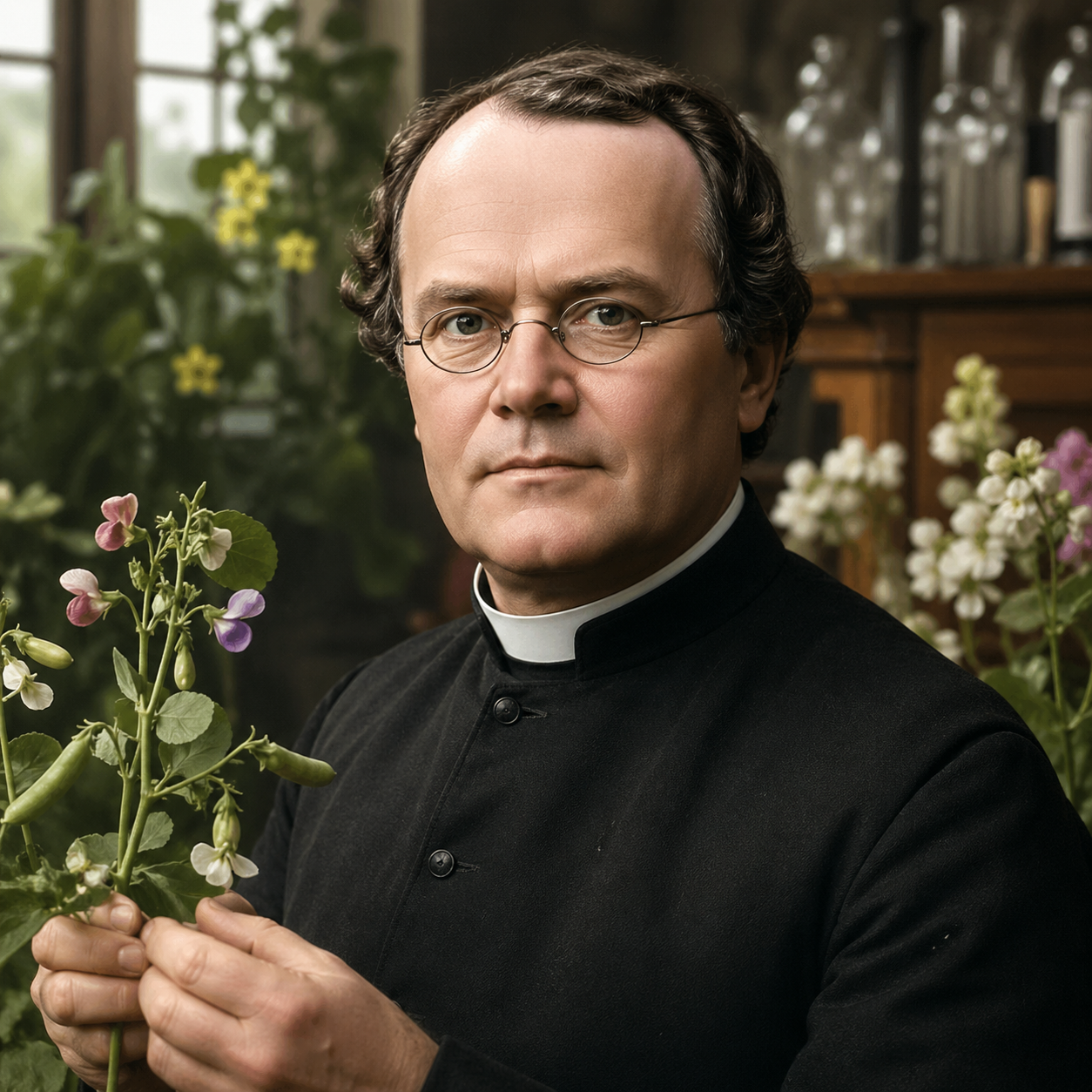
Mendel spent eight years meticulously breeding pea plants in his monastery garden, tracking seven distinct traits across tens of thousands of plants. This statement distills his core discovery: hereditary units — what we now call genes — behave as discrete, stable particles. His monk's discipline for careful observation and record-keeping gave him the patience to see the patterns others had missed.
In mid-19th century Europe, Darwin's evolution theory was reshaping biology, but nobody understood the mechanism of inheritance. The prevailing blending theory assumed parental traits merged like paint. Mendel's 1865 paper, presented to the Natural History Society of Brünn, contradicted this consensus but was largely ignored until 1900, when three scientists independently rediscovered his work and launched modern genetics.
AI-generated insights based on extensive research and information for context. Factual errors? Email [email protected].
Your cart is empty