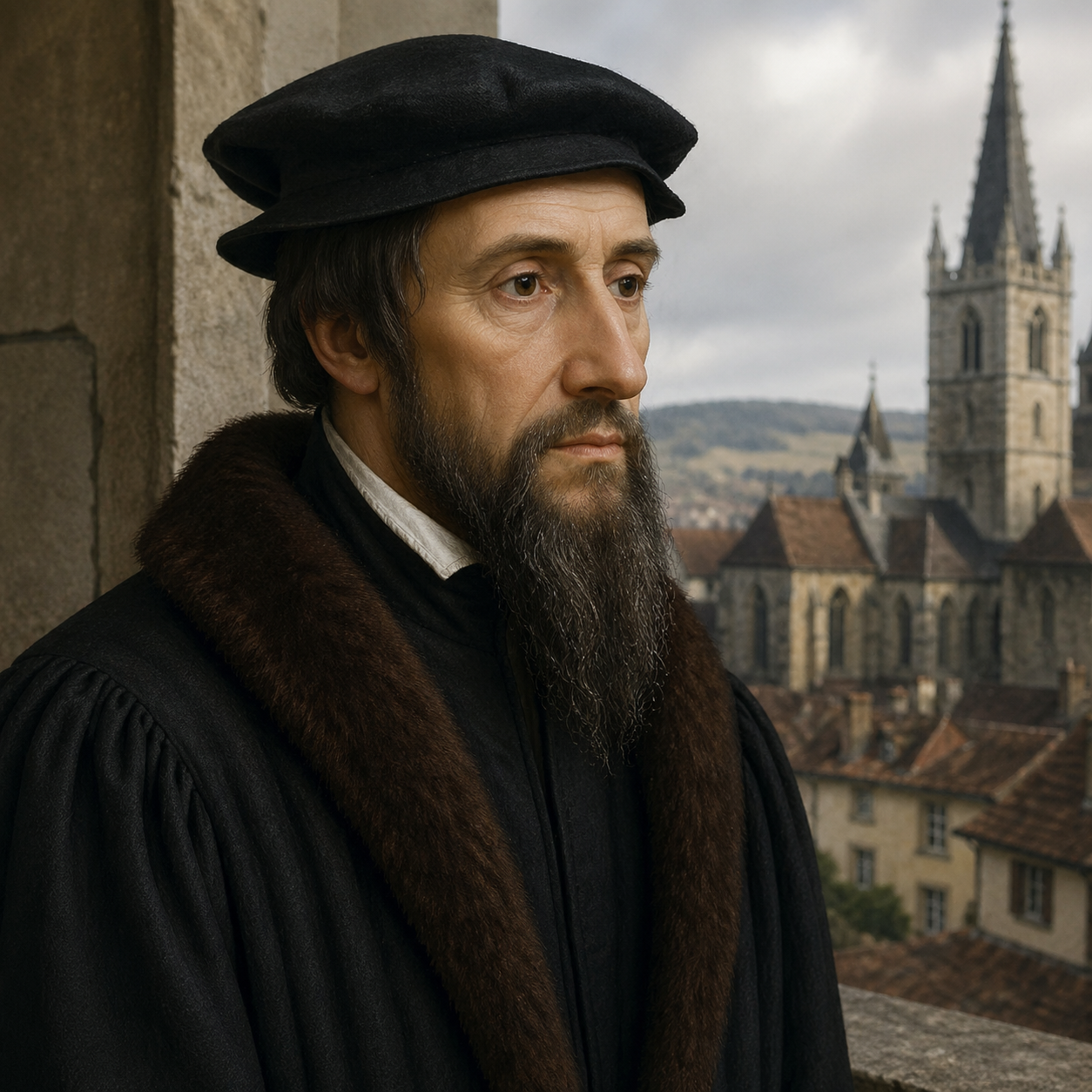
John Calvin — "The church is the mother of all the godly."
The church is the mother of all the godly.
The church is the mother of all the godly.
Click any product to generate a realistic preview. Up to 3 at a time.
* Initial load can take up to 90 seconds — revising the preview in another color is nearly instant.
"The fact that infants who die before baptism are damned is a dreadful decree, but no one can deny that God foreknew what end man was to have before he created him."
"For we do not say that man is dragged unwillingly into sinning, but that because his will is corrupt he is held captive under the yoke of sin and therefore of necessity wills in an evil way."
"I consider looseness with words no less of a defect than looseness of the bowels."
"The best way to overcome evil is to do good."
"We are never so much ourselves as when we are in Christ."
French theologian whose Institutes of the Christian Religion (1536) systematized Protestant Reformed doctrine, including predestination. Closely associated with Martin Luther (Reformation founder, Calvin's predecessor). For an intellectual contrast, see Jacobus Arminius, Dutch Reformed theologian (1560-1609) — Arminius's rejection of strict double-predestination founded Arminianism — the theological tradition modern Methodism, most evangelicalism, and Pentecostalism descend from. The Calvinist-Arminian debate has divided Protestantism for 400 years.
Found in 1 providers: grok
1 source checked
The Christian church is the spiritual parent of every believer — it births, nurtures, and sustains faith the way a mother raises children. Without the church's teaching, sacraments, and community, individuals cannot grow in genuine godliness. This is a claim that belonging to the church is not optional for Christians but essential: true faith is formed and maintained inside a living, structured congregation, not in isolation.
Calvin spent his life constructing the church in Geneva as a disciplined governing institution. His Institutes of the Christian Religion devoted an entire book to ecclesiology, arguing salvation cannot be separated from church membership, preaching, and sacraments. His Geneva consistory — elders enforcing doctrine and morality — embodied this maternal role. For Calvin, the church did not merely announce the gospel; it actively formed believers into godly people through ongoing oversight and worship.
The sixteenth-century Reformation shattered medieval Christendom's unified church authority. Radical Anabaptists rejected institutional religion entirely, while competing Protestant factions and Catholic apologists all disputed what the true church was. Calvin wrote amid this fragmentation, insisting a properly ordered congregation with correct preaching and sacraments remained indispensable. The printing press accelerated doctrinal chaos, making the question of ecclesial necessity politically explosive and theologically urgent across every European territory.
AI-generated insights based on extensive research and information for context. Factual errors? Email [email protected].
Your cart is empty