Pope Francis — "The Church sometimes has locked itself up in small things, in small-minded rules…"
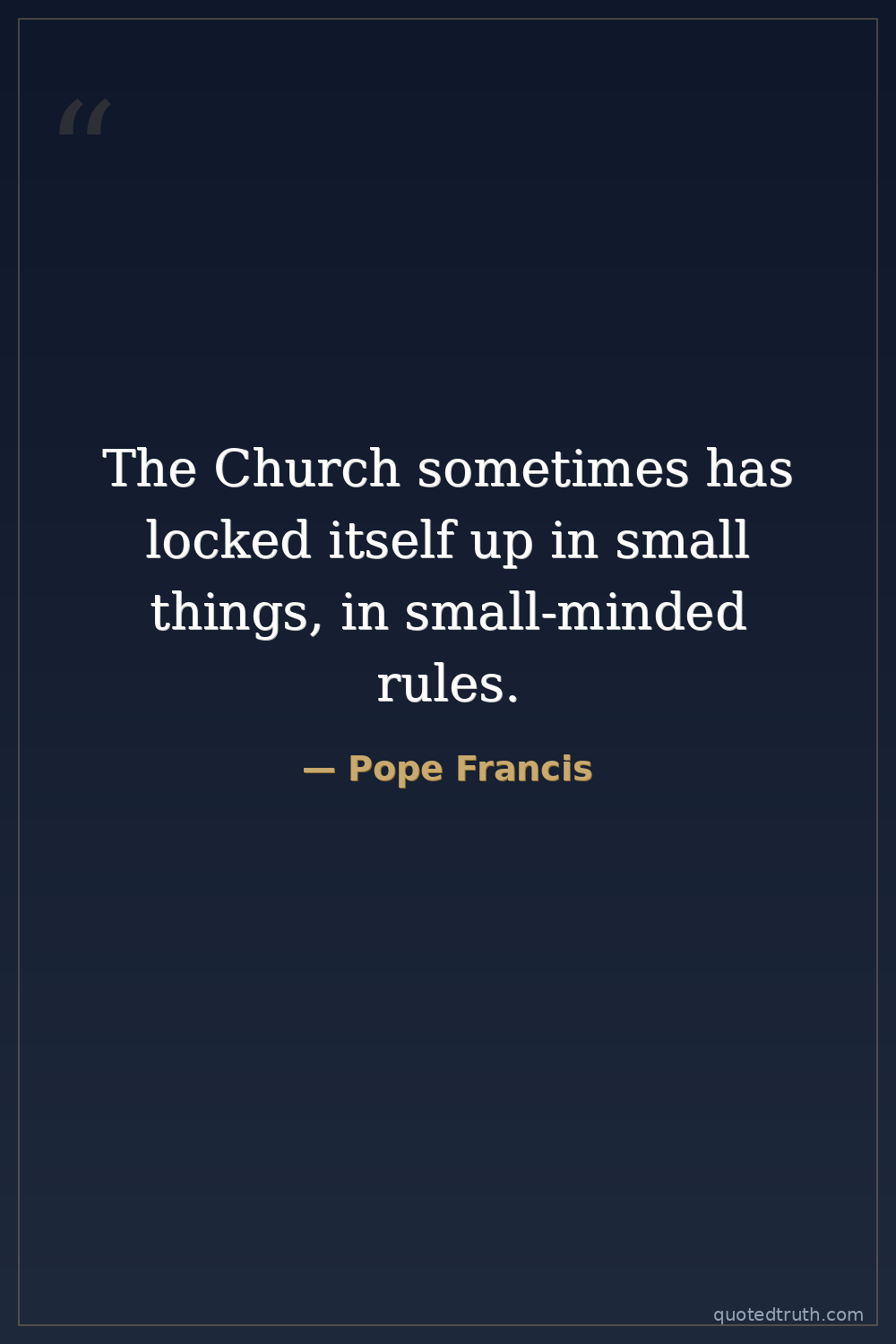
The Church sometimes has locked itself up in small things, in small-minded rules.
The Church sometimes has locked itself up in small things, in small-minded rules.
Click any product to generate a realistic preview. Up to 3 at a time.
* Initial load can take up to 90 seconds — revising the preview in another color is nearly instant.
"I believe in God, not in a Catholic God."
"I am not a super-Pope."
"The Church must ask forgiveness for the scandals committed by its members."
"Sometimes when I see a clericalist, I suddenly become anticlerical."
"An economic system that has as its center the god of money needs to be denounced, because it is a system that kills."
First Latin American and Jesuit pope (2013-), who has steered the Catholic Church toward pastoral inclusion on LGBTQ pastoral care, divorced Catholics, and climate. Closely associated with Pope John XXIII (the Vatican II reformer pope) and Cardinal Walter Kasper (his theological ally on pastoral reform). For an intellectual contrast, see Cardinal Raymond Burke, American traditionalist cardinal, former head of the Vatican Apostolic Signatura — Burke is the public face of Catholic traditionalism that views Francis's pastoral approach as doctrinally dangerous — he has formally challenged Amoris Laetitia and other Francis reforms.
Found in 1 providers: deepseek
1 source checked
Religious institutions can become so preoccupied with enforcing minor doctrinal rules and internal procedures that they lose sight of their core purpose — compassion, service, and spiritual growth. The word 'locked' suggests self-imposed imprisonment: the Church traps itself rather than being constrained from outside. 'Small-minded' implies these rules reflect narrow thinking, not divine wisdom. The critique is internal, from a leader urging his own institution to broaden its focus beyond procedural gatekeeping.
Jorge Mario Bergoglio, the first Jesuit pope and first from Latin America, built his papacy around pastoral mercy over doctrinal enforcement. He chose a simple guesthouse over papal apartments, washed prisoners' feet on Holy Thursday, and issued Amoris Laetitia — allowing pastoral flexibility for divorced Catholics. He described the Church as a 'field hospital' that heals wounds first and asks questions later. This quote is the philosophical foundation of his entire reform agenda, articulating why rigid rule-following contradicts the Gospel's spirit.
Francis became pope in 2013 as the Church reeled from the clergy sexual abuse scandal — a crisis exposing how institutional self-protection had overridden pastoral duty for decades. Church attendance was collapsing across Europe and Latin America. Younger generations viewed Catholicism as judgmental and irrelevant. Simultaneously, global debates over LGBTQ+ rights and gender equality were reshaping expectations of religious bodies. In this climate, a sitting pope publicly naming the Church's own legalism as a spiritual failure was a historically significant departure from institutional defensiveness.
AI-generated insights based on extensive research and information for context. Factual errors? Email [email protected].
Your cart is empty