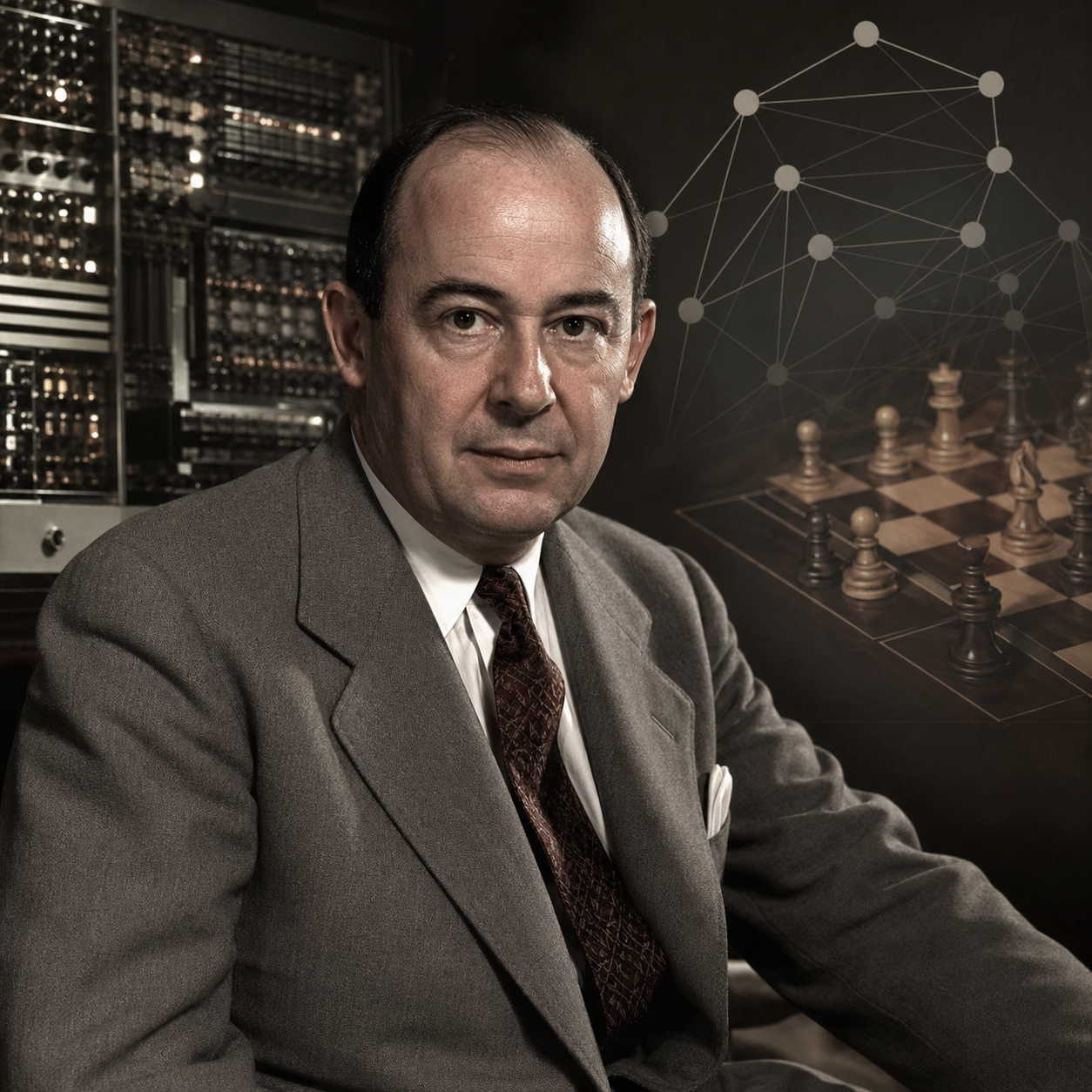
John von Neumann — "The computer is a universal machine. It can do anything that can be described al…"
The computer is a universal machine. It can do anything that can be described algorithmically.
The computer is a universal machine. It can do anything that can be described algorithmically.
Click any product to generate a realistic preview. Up to 3 at a time.
* Initial load can take up to 90 seconds — revising the preview in another color is nearly instant.
"I think that a good deal of the 'mathematical thinking' that goes on in our heads is not mathematics at all, but rather thinking about physical analogies."
"Mathematics is a game played according to certain simple rules with meaningless marks on paper."
"It would appear that we have reached the limits of what it is possible to achieve with computer technology, although one should be careful with such statements, as they tend to sound pretty silly in 5…"
"The world is so complicated that it cannot be described in any other way than by itself."
"The sciences do not try to explain, they hardly even try to interpret, they mainly make models. By a model is meant a mathematical construct which, with the addition of some verbal interpretations, de…"
Found in 1 providers: grok
1 source checked
Any task that can be broken into step-by-step instructions can be executed by a computer. The machine is not specialized for one purpose — it is universal, capable of simulating any computable process. This idea underpins everything from spreadsheets to AI: the same physical hardware runs entirely different programs because computation itself is general. The limit is not the machine but whether a problem can be precisely described.
Von Neumann designed the stored-program architecture — the EDVAC blueprint — that made modern computers programmable rather than hardwired. He saw computation not as arithmetic but as a universal logical framework applicable to physics, economics, and warfare. He applied this belief at Los Alamos running nuclear simulations, and in game theory modeling strategic decisions mathematically. His architecture meant one machine could serve every purpose, embodying the universality he articulated.
In the 1940s and 50s, computers were room-sized machines built for specific tasks — ballistics tables, census data, codebreaking. Most engineers saw them as glorified calculators. Von Neumann's era was also shaped by the Cold War arms race, driving computation toward nuclear weapons and missile guidance. His insight that one architecture could tackle any algorithmic problem transformed computers from specialized instruments into the general-purpose foundation of modern civilization.
AI-generated insights based on extensive research and information for context. Factual errors? Email [email protected].
Your cart is empty