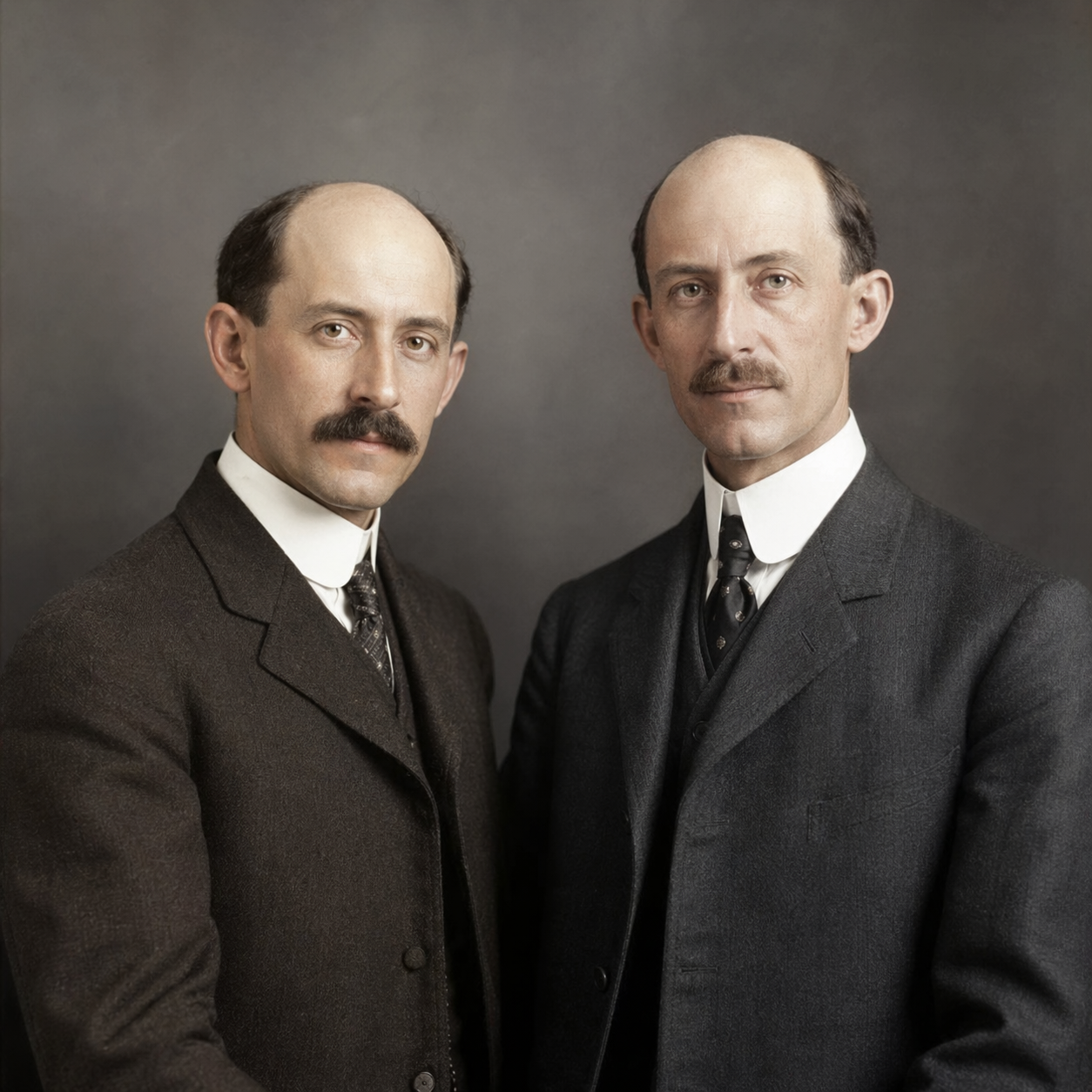
Wright Brothers (Orville & Wilbur) — "The course of the experiment was not exactly according to calculations, but was …"
The course of the experiment was not exactly according to calculations, but was a success nevertheless.
The course of the experiment was not exactly according to calculations, but was a success nevertheless.
Click any product to generate a realistic preview. Up to 3 at a time.
* Initial load can take up to 90 seconds — revising the preview in another color is nearly instant.
"We have been making flights at an altitude of about 50 feet."
"We learn much by tribulation, and by adversity our hearts are made better."
"The machine is a success and we are well pleased with it."
"No flights of any kind were made except those of our own machine, which, strange to say, did not become a public amusement."
"We could not understand how it was that the best scientists could not fly a machine. We thought that they must be working on the wrong principle."
American aviation pioneers who achieved the first sustained powered controlled airplane flight at Kitty Hawk, NC, on December 17, 1903. Closely associated with Octave Chanute (their gliding mentor and aeronautical correspondent). For an intellectual contrast, see Samuel Pierpont Langley, Smithsonian Institution Secretary and government-funded aviation researcher — Langley's Aerodrome crashed twice into the Potomac in October-December 1903 with $50,000 of War Department funding; the Wright Brothers' bicycle-shop empiricism beat Langley's institutional Big Science by 9 days. The most-cited example in engineering history of empirical-tinkerer beating institution-funded credentialism.
Found in 1 providers: grok
1 source checked
Plans rarely survive contact with reality unchanged. This quote acknowledges that experiments unfold differently than predicted — numbers don't always match the outcome — yet success still arrives. It's a pragmatist's creed: what matters is achieving the goal, not whether the path matched the blueprint. Real progress often happens through adaptive execution rather than rigid adherence to pre-set calculations. The result justifies the deviation.
The Wright Brothers were self-taught bicycle mechanics who built their own wind tunnel after discovering existing aeronautical data was wrong. Their December 17, 1903 flight at Kitty Hawk covered only 120 feet in 12 seconds — imperfect by any calculation — yet it was the first sustained powered flight in history. They embraced empirical iteration over theoretical purity, constantly revising designs based on real-world tests rather than waiting for perfect predictions.
In 1903, powered flight seemed nearly impossible. Well-funded rivals like Samuel Langley — backed by $50,000 in government grants — had just crashed publicly into the Potomac. Scientific orthodoxy doubted heavier-than-air machines could work at all. The Industrial Revolution conditioned society to expect breakthroughs from formal institutions, not garage inventors. The Wright Brothers' Kitty Hawk success shattered that assumption and launched the aviation age from a windswept North Carolina beach.
AI-generated insights based on extensive research and information for context. Factual errors? Email [email protected].
Your cart is empty