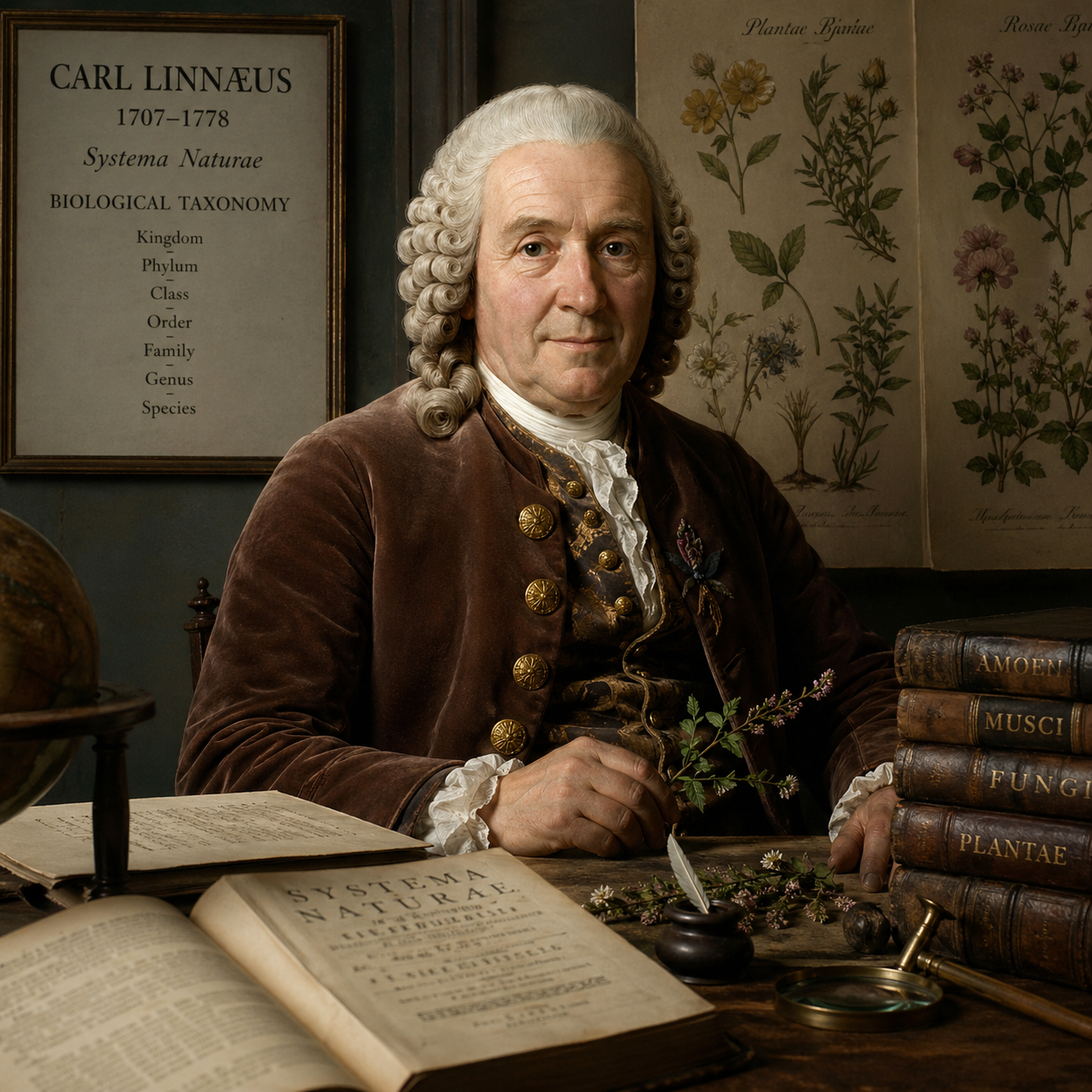
Carl Linnaeus — "The Creator's hand is visible in every part of creation."
The Creator's hand is visible in every part of creation.
The Creator's hand is visible in every part of creation.
Click any product to generate a realistic preview. Up to 3 at a time.
* Initial load can take up to 90 seconds — revising the preview in another color is nearly instant.
"The highest good is to know God and His works."
"The greatest pleasure in life is to be able to do what you love."
"I have been as happy as a king, and happier."
"In natural science the principles of truth ought to be confirmed by observation."
"My life has been dedicated to the service of nature."
Swedish botanist and the father of modern taxonomy whose Systema Naturae (1735) introduced binomial nomenclature for naming all species. Closely associated with Joseph Banks (British naturalist who carried Linnaean classification on Cook's voyages). For an intellectual contrast, see Comte de Buffon, French naturalist and Histoire Naturelle author (1749-1788) — Buffon explicitly attacked Linnaean fixed-categories taxonomy as artificial and rejected the binomial system; his gradualist, environment-shaped natural history was the explicit alternative. Anticipates the fixed-species-vs-evolution debate Darwin would later resolve.
Found in 1 providers: grok
1 source checked
God's design and intentionality can be seen throughout the natural world — in every organism, structure, and pattern. Nature isn't random or chaotic; it reflects deliberate craftsmanship. Every living thing, examined closely enough, reveals order, purpose, and intelligence behind its construction. Understanding nature is therefore a form of understanding its maker.
Linnaeus spent his life cataloguing thousands of plant and animal species, developing binomial nomenclature to impose order on biological diversity. He was devoutly religious and explicitly framed taxonomy as revealing divine order. His Systema Naturae was as much theological project as scientific one — classifying creation was, for him, reading God's blueprint.
In the 18th-century Enlightenment, natural theology flourished alongside empirical science. Thinkers like Linnaeus saw no tension between faith and observation — studying nature was studying God's handiwork. This was decades before Darwin; species were considered fixed, specially created. Natural philosophers were expected to find evidence of divine design, making Linnaeus's taxonomy both scientific and devotional work.
AI-generated insights based on extensive research and information for context. Factual errors? Email [email protected].
Your cart is empty