Carl Linnaeus — "The species are as numerous as the different forms which the Infinite Being prod…"
The species are as numerous as the different forms which the Infinite Being produced in the beginning.
The species are as numerous as the different forms which the Infinite Being produced in the beginning.
Click any product to generate a realistic preview. Up to 3 at a time.
* Initial load can take up to 90 seconds — revising the preview in another color is nearly instant.
"The first step in wisdom is to know the things themselves; this notion consists in having a true idea of the objects; objects are distinguished and known by classifying them methodically and giving th…"
"It is not wealth or ancestry, but rather the spirit of the age, which has raised me to the highest pinnacle of fame."
"The greatest happiness is to be able to contemplate nature."
"I am not ashamed to confess that I am a man who loves flowers."
"The earth is the theatre of God's glory."
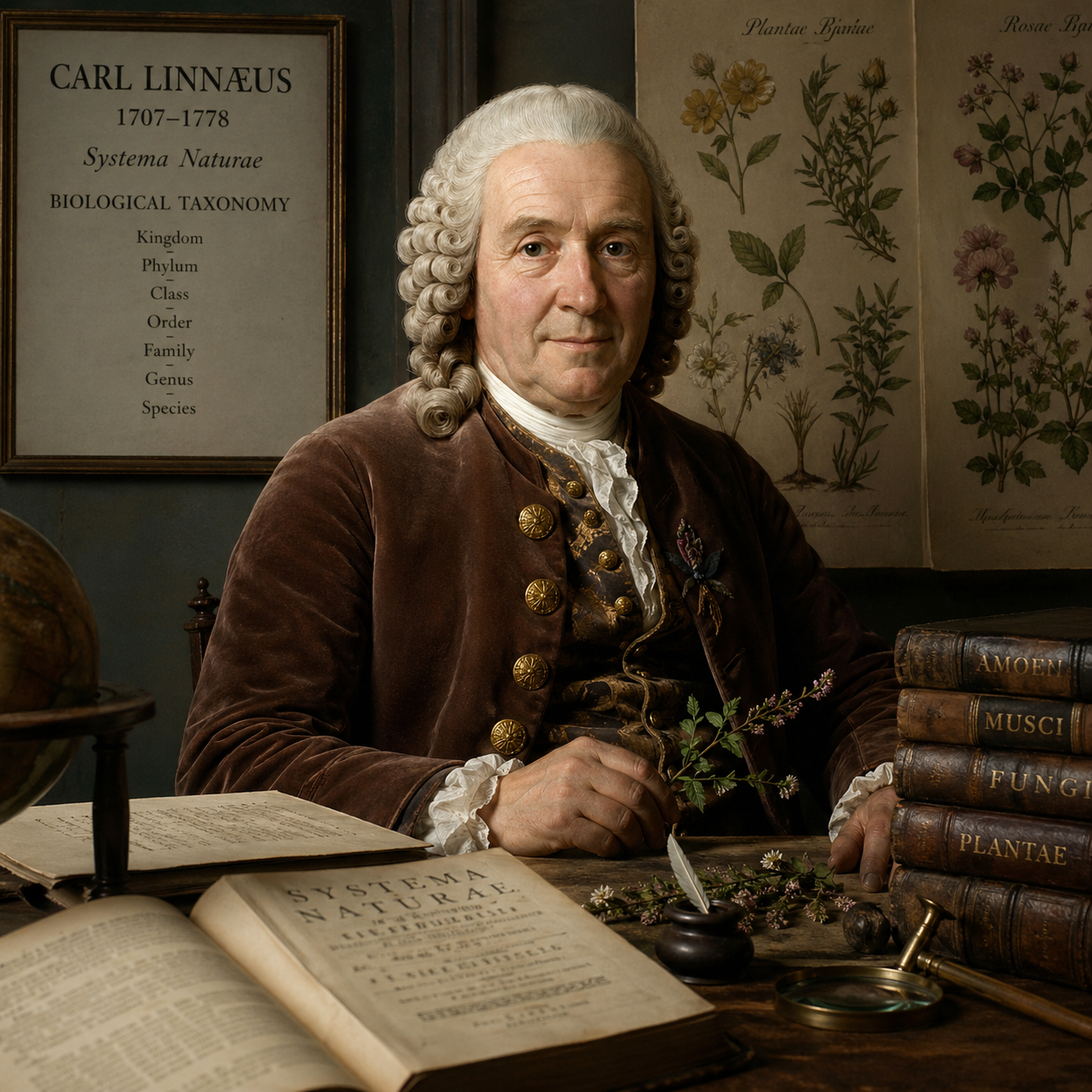
Swedish botanist and the father of modern taxonomy whose Systema Naturae (1735) introduced binomial nomenclature for naming all species. Closely associated with Joseph Banks (British naturalist who carried Linnaean classification on Cook's voyages). For an intellectual contrast, see Comte de Buffon, French naturalist and Histoire Naturelle author (1749-1788) — Buffon explicitly attacked Linnaean fixed-categories taxonomy as artificial and rejected the binomial system; his gradualist, environment-shaped natural history was the explicit alternative. Anticipates the fixed-species-vs-evolution debate Darwin would later resolve.
From 'Philosophia Botanica', expressing his belief in the fixity of species.
Date: 1751
ShockingFound in 1 providers: grok
1 source checked
Nature contains exactly as many species as God created at the origin of life — no more have appeared, none have been lost. Each species is a permanent, distinct divine creation. The biological diversity we observe represents a complete original inventory. This idea, known as species fixism, frames living variety as a sacred, finished catalog rather than something dynamic or accumulating over time.
Linnaeus devoted his career to systematically naming every known organism using binomial nomenclature, believing this work completed God's catalog of creation. A devout Lutheran, he saw each newly classified species as uncovering a piece of divine architecture. His conviction that species were fixed and immutable drove his taxonomic mission entirely — this quote is the theological foundation beneath his lifelong scientific obsession with order and completeness.
In the 18th century, naturalists were racing to catalog organisms flooding in from colonial expeditions across the Americas, Asia, and Africa. Natural theology — the doctrine that nature's design proves God's existence — dominated scientific culture. Species fixism was the unchallenged consensus, decades before Darwin proposed evolution. Linnaeus worked where cataloging creation was simultaneously scientific and religious duty, making divine authorship of species the bedrock assumption of all natural history.
AI-generated insights based on extensive research and information for context. Factual errors? Email [email protected].
Your cart is empty