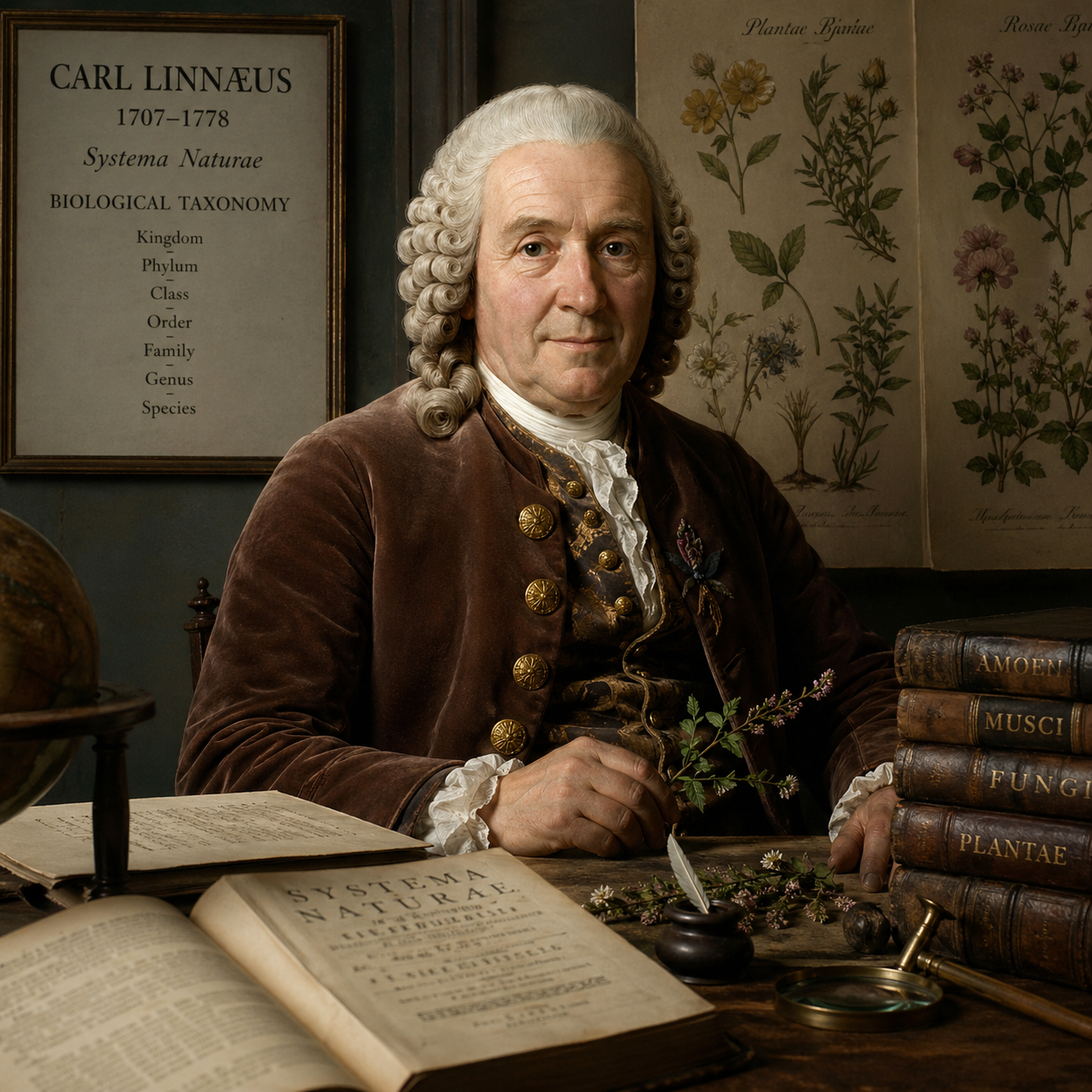
Carl Linnaeus — "The distinctions of sex are evident in plants, as in animals."
The distinctions of sex are evident in plants, as in animals.
The distinctions of sex are evident in plants, as in animals.
Click any product to generate a realistic preview. Up to 3 at a time.
* Initial load can take up to 90 seconds — revising the preview in another color is nearly instant.
"I have been called the Prince of Botanists."
"The whole system of nature is nothing but a system of sexual generation."
"Blessed be the Lord for the beauty of summer and spring, for the air, the water, the verdure, and the song of birds."
"To live by medicine is to live horribly."
"I have spent my life in the company of plants, and they have taught me more than men."
Swedish botanist and the father of modern taxonomy whose Systema Naturae (1735) introduced binomial nomenclature for naming all species. Closely associated with Joseph Banks (British naturalist who carried Linnaean classification on Cook's voyages). For an intellectual contrast, see Comte de Buffon, French naturalist and Histoire Naturelle author (1749-1788) — Buffon explicitly attacked Linnaean fixed-categories taxonomy as artificial and rejected the binomial system; his gradualist, environment-shaped natural history was the explicit alternative. Anticipates the fixed-species-vs-evolution debate Darwin would later resolve.
His revolutionary 'sexual system' of plant classification, which was considered scandalous by some for its explicit language.
Date: 1735
ShockingFound in 1 providers: grok
1 source checked
Plants, like animals, have distinct male and female reproductive structures and functions. Sexual reproduction is not unique to animals but is a fundamental biological principle visible across the living world. Recognizing this challenges assumptions that sexuality is exclusively an animal trait, revealing reproduction as a universal mechanism woven into the fabric of life itself.
Linnaeus built his entire classification system—Species Plantarum and Systema Naturae—around plant sexuality, using stamens and pistils to organize species. His sexual system of plant taxonomy was revolutionary and controversial. He genuinely believed plants had marriages and families, writing poetically about floral reproduction, making this observation the cornerstone of his scientific identity.
In the 18th century, applying the concept of biological sex to plants was scandalous—critics called it obscene and unsuitable for young minds. Linnaeus worked during the Enlightenment, when systematic natural observation was transforming science, yet social mores resisted sexualizing the botanical world. His insistence on plant sexuality challenged both religious sensibilities and established botanical traditions simultaneously.
AI-generated insights based on extensive research and information for context. Factual errors? Email [email protected].
Your cart is empty