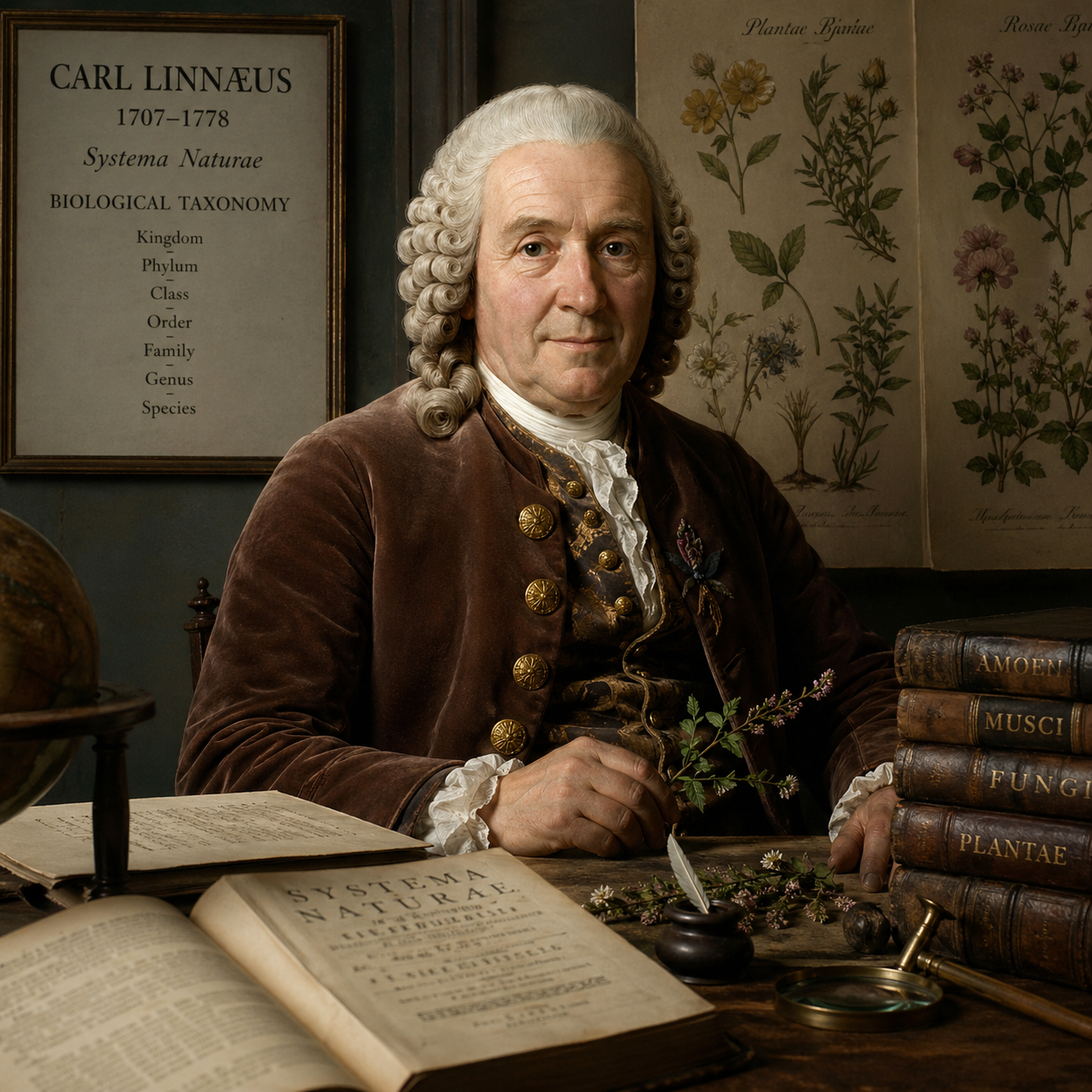
Carl Linnaeus — "Deus creavit, Linnaeus disposuit. (God created, Linnaeus arranged.)"
Deus creavit, Linnaeus disposuit. (God created, Linnaeus arranged.)
Deus creavit, Linnaeus disposuit. (God created, Linnaeus arranged.)
Click any product to generate a realistic preview. Up to 3 at a time.
* Initial load can take up to 90 seconds — revising the preview in another color is nearly instant.
"The more I study nature, the more I am amazed at the Creator."
"The flower's leaves...serve as bridal beds which the Creator has so gloriously prepared, adorned with such noble bed curtains, and perfumed with so many sweet scents to induce the young bridegroom to …"
"Every country has its own plants, and every plant has its own country."
"Nature is never exhausted; she has always new wonders for our admiration."
"The calyx is the marriage bed, the corolla the bed-curtains, the filaments the spermatic vessels, the anthers the testes, the pollen the semen, the pistil the vagina, the ovary the uterus, the ovules …"
Swedish botanist and the father of modern taxonomy whose Systema Naturae (1735) introduced binomial nomenclature for naming all species. Closely associated with Joseph Banks (British naturalist who carried Linnaean classification on Cook's voyages). For an intellectual contrast, see Comte de Buffon, French naturalist and Histoire Naturelle author (1749-1788) — Buffon explicitly attacked Linnaean fixed-categories taxonomy as artificial and rejected the binomial system; his gradualist, environment-shaped natural history was the explicit alternative. Anticipates the fixed-species-vs-evolution debate Darwin would later resolve.
A proud declaration of his role in systematizing nature, reflecting his belief in his divine mission.
Date: c. 1735-1778
ShockingFound in 1 providers: grok
1 source checked
The quote draws a sharp line between creation and classification. God brought all living things into existence; Linnaeus gave them order, names, and a system of relationships. It asserts that organizing nature into a coherent hierarchy is itself a monumental intellectual act—nearly as significant as creation itself. In modern terms: anyone can observe chaos, but it takes genius to impose a structure so elegant that the entire scientific world adopts it permanently.
Linnaeus spent his life building Systema Naturae, a hierarchical classification of all known organisms, revised through twelve editions. He devised binomial nomenclature—still the global standard. He genuinely believed taxonomy was a religious duty: decoding God's blueprint for creation. The quote, which he or his admirers coined, perfectly captures his dual personality—devout humility toward God as creator, and supreme confidence in his own intellect as nature's supreme organizer and namer.
Linnaeus worked during the 18th-century Enlightenment, when European explorers were flooding natural history collections with thousands of previously unknown species. Without a universal naming system, scientific communication was collapsing under regional synonyms and Latin descriptions of arbitrary length. Natural theology—the belief that studying creation reveals the Creator—dominated intellectual life, making rigorous classification both scientifically urgent and spiritually meaningful. Linnaeus arrived precisely when the world needed exactly what he offered.
AI-generated insights based on extensive research and information for context. Factual errors? Email [email protected].
Your cart is empty