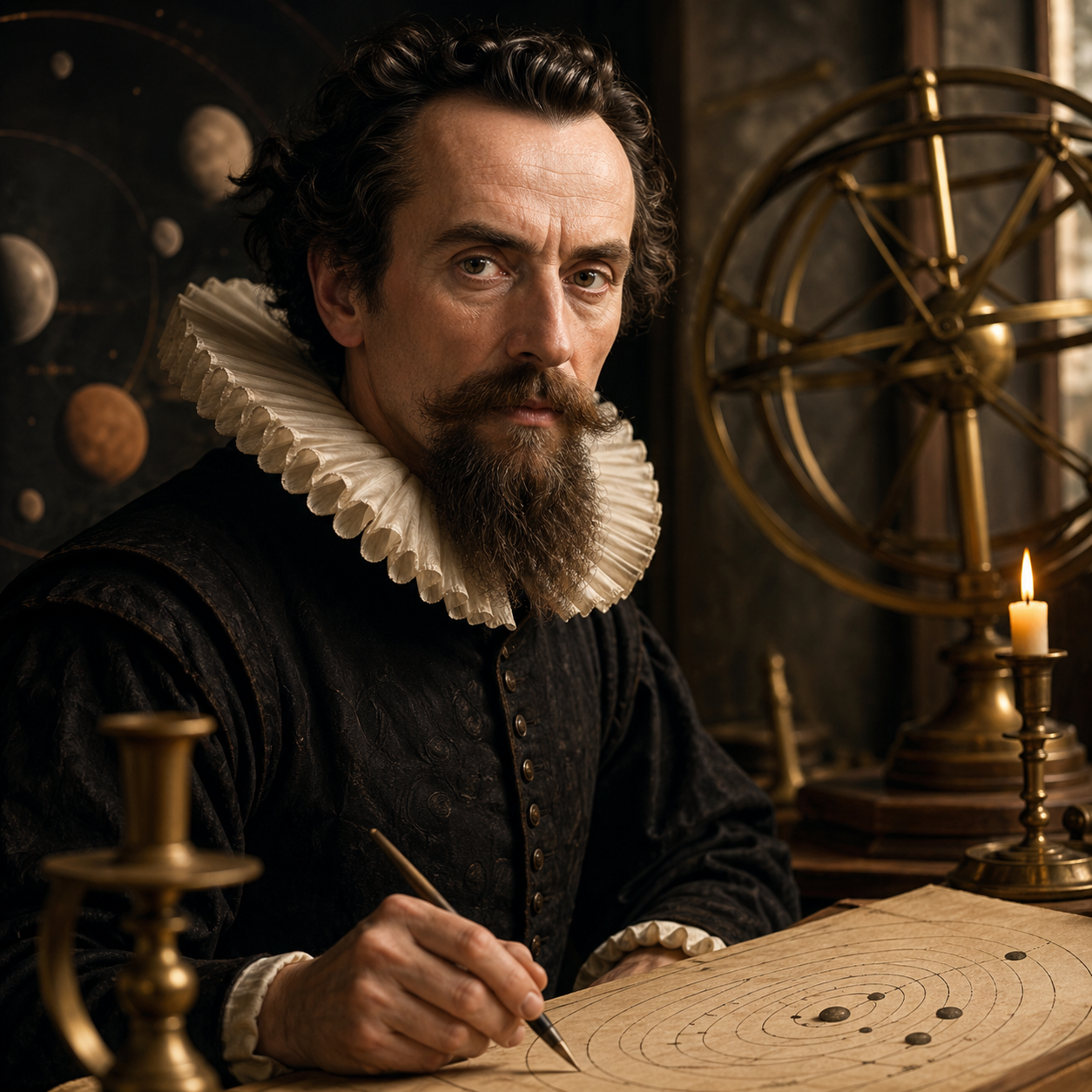
Johannes Kepler — "The Earth too wants to have a soul, and the sky wants to rule over it."
The Earth too wants to have a soul, and the sky wants to rule over it.
The Earth too wants to have a soul, and the sky wants to rule over it.
Click any product to generate a realistic preview. Up to 3 at a time.
* Initial load can take up to 90 seconds — revising the preview in another color is nearly instant.
"I have often tried to grasp that which I have found."
"I am stealing the golden vessels of the Egyptians to build a tabernacle to my God from them, far far away from the boundaries of Egypt. If you forgive me, I shall rejoice; if you are enraged with me, …"
"I have been a father, and I have rejoiced in my children."
"The works of God are beautiful and great; let us, therefore, with all our might, strive to know them."
"Mathematics is the alphabet with which God has written the universe."
Found in 1 providers: deepseek
1 source checked
Kepler suggests the Earth is not a dead rock but has an animating spirit or soul, while the heavens hold authority over it. He imagines a living cosmos where planets and sky share a vital, almost personal relationship. The saying claims nature is ensouled and that celestial forces genuinely govern terrestrial matter, linking what happens above with what unfolds below in a unified, purposeful order.
Kepler fused rigorous mathematics with mystical conviction that the cosmos was alive and divinely ordered. While deriving his three laws of planetary motion, he wrote of an anima terrae, an Earth-soul driving tides and weather, and believed planets responded to solar influence almost vitally. His mother Katharina was tried for witchcraft, yet he never abandoned the view that mathematical harmony revealed a living, God-infused universe.
In early-modern Europe around 1600, natural philosophy blended emerging astronomy with Renaissance hermeticism, astrology, and Christian theology. Copernicus had displaced Earth from center, Galileo was turning telescopes skyward, and the Thirty Years' War loomed. Scholars still accepted a living cosmos where celestial bodies influenced earthly events. Mechanical philosophy had not yet won; speaking of Earth having a soul and heavens ruling over it fit respectable scientific discourse.
AI-generated insights based on extensive research and information for context. Factual errors? Email [email protected].
Your cart is empty