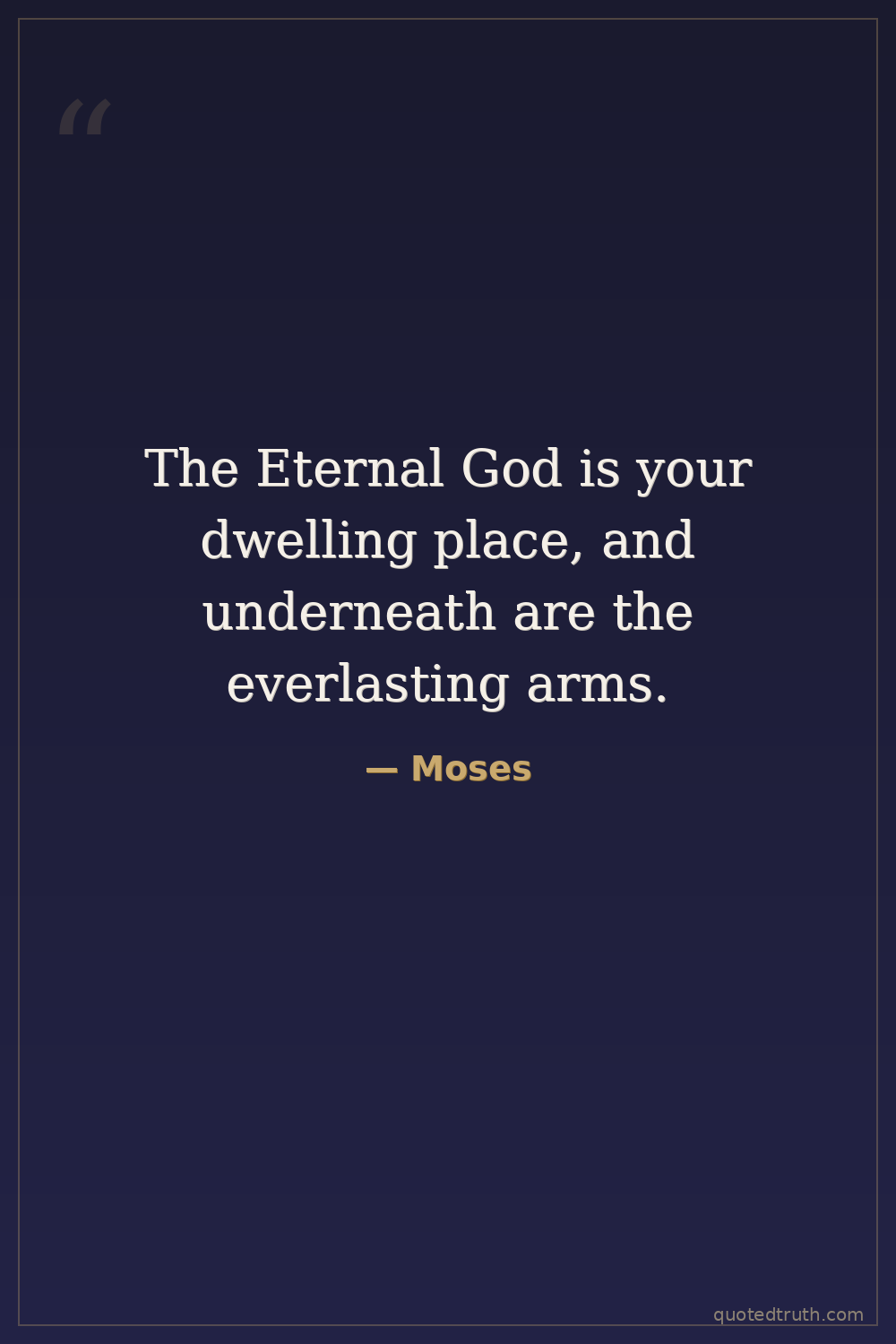
Moses — "The Eternal God is your dwelling place, and underneath are the everlasting arms."
The Eternal God is your dwelling place, and underneath are the everlasting arms.
The Eternal God is your dwelling place, and underneath are the everlasting arms.
Click any product to generate a realistic preview. Up to 3 at a time.
* Initial load can take up to 90 seconds — revising the preview in another color is nearly instant.
"Justice, and only justice, you shall pursue."
"But as truly as I live, all the earth shall be filled with the glory of the Lord."
"You shall not murder."
"If a man is found lying with a woman married to a husband, then both of them shall die."
"As ye have spoken in mine ears, so will I do to you:"
From Moses' blessing to the tribes of Israel (Deuteronomy 33:27).
Date: c. 13th Century BCE (Traditional)
PhilosophicalFound in 2 providers: grok,gemini
2 sources checked
This saying promises that a permanent, timeless divine presence serves as a person's true home, and that invisible support holds them up from below even when circumstances feel like collapse. It pairs two images: a dwelling you live inside and arms that catch you when you fall. The message is that security does not come from geography, wealth, or strength, but from reliance on something enduring beneath every moment of life.
Moses spent forty years leading former slaves through a wilderness with no homeland, no walls, and no army, so framing God as a dwelling place spoke directly to refugees who owned nothing permanent. Having survived infancy in a basket, exile in Midian, and repeated near-rebellions, he knew what unseen support felt like. He delivered this line in his farewell blessing, handing the people the only shelter he could guarantee beyond his own death.
In the late Bronze Age, identity was tied to tribal land, local temples, and physical fortresses, and gods were usually bound to specific territories. A wandering people without a country were considered abandoned by heaven. Declaring that the deity himself was the dwelling radically broke this geography-based theology, letting a stateless nation carry its sanctuary with it. Surrounding cultures, from Egypt to Canaan, built massive stone shrines; Moses offered portable, relational refuge instead.
AI-generated insights based on extensive research and information for context. Factual errors? Email [email protected].
Your cart is empty