Euclid — "The extremities of a surface are lines."
The extremities of a surface are lines.
The extremities of a surface are lines.
Click any product to generate a realistic preview. Up to 3 at a time.
* Initial load can take up to 90 seconds — revising the preview in another color is nearly instant.
"If four magnitudes be proportional, the rectangle contained by the extremes is equal to the rectangle contained by the means."
"The greatest common divisor of two numbers can be found by successive division."
"Things which coincide with one another are equal to one another."
"Let it be granted that a straight line may be drawn from any one point to any other point."
"A diameter of the circle is any straight line drawn through the center and terminated in both directions by the circumference of the circle, and such a straight line also bisects the circle."
Found in 2 providers: deepseek,grok
2 sources checked
A surface — any flat or curved 2D shape — ends at its edges, and those edges are lines. It's a precise geometric definition establishing that dimensions nest within each other: points bound lines, lines bound surfaces. If you draw a rectangle, its four sides are the lines marking where the surface stops. This hierarchical principle defines how shapes are constructed and bounded, forming a logical foundation for all geometric reasoning that follows.
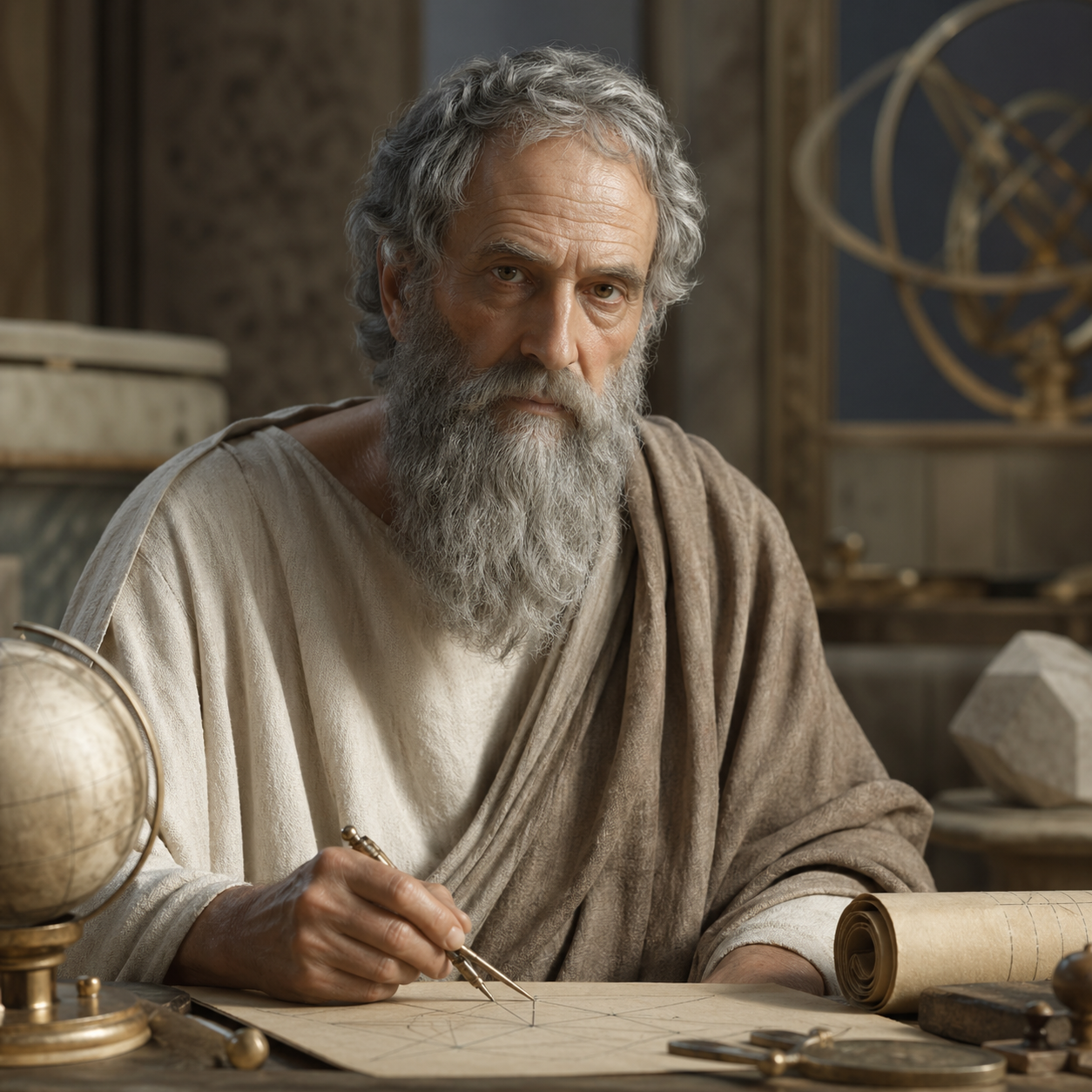
This is Definition 6 from Euclid's Elements (~300 BCE), the axiomatic treatise that systematized all Greek geometry. Working in Alexandria, Euclid built every theorem from explicit definitions and postulates, allowing zero unstated assumptions. His career was dedicated precisely to this hierarchical decomposition — understanding complex shapes by reducing them to simpler elements. That surfaces terminate in lines reflects his core method: rigorous, incremental logical structure. His famous reply to Ptolemy — there is no royal road to geometry — shows how seriously he took this foundational discipline.
Euclid worked around 300 BCE in Alexandria during the early Hellenistic period, when Ptolemy I was transforming the city into the Mediterranean's intellectual center and the Great Library was being established. Greek mathematics was shifting from Egyptian practical land-measurement toward abstract, proof-based systems. Plato's Academy had elevated geometry to philosophical status, but no unified text existed. Euclid filled that void, synthesizing predecessors like Eudoxus and Theaetetus. Precise definitions like this one were revolutionary — they replaced intuitive assumption with formal, unambiguous foundations.
AI-generated insights based on extensive research and information for context. Factual errors? Email [email protected].
Your cart is empty