Euclid — "And when the lines containing the angle are straight, the angle is called rectil…"
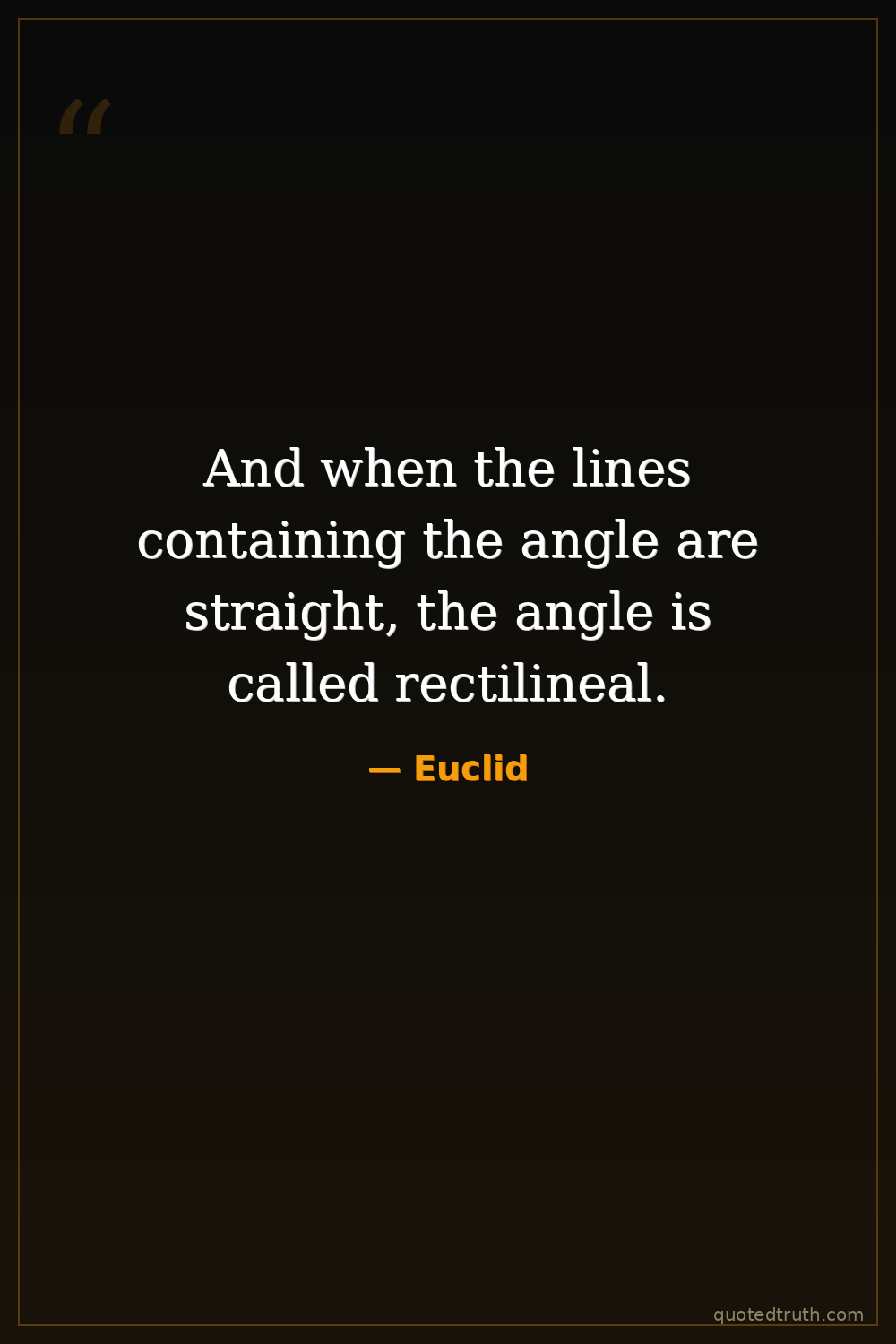
And when the lines containing the angle are straight, the angle is called rectilineal.
And when the lines containing the angle are straight, the angle is called rectilineal.
Click any product to generate a realistic preview. Up to 3 at a time.
* Initial load can take up to 90 seconds — revising the preview in another color is nearly instant.
"What advantage shall I get by learning these things?"
"Give him threepence, since he must make a gain out of what he learns."
"If a number be the least that is measured by any prime numbers, it will not be measured by any other prime number except those originally measuring it."
"To construct a regular pentagon in a given circle."
"The prime numbers are more than any assigned multitude of prime numbers."
Found in 1 providers: grok
1 source checked
When two straight lines meet at a point, the space between them forms what geometry calls a rectilineal angle. This distinguishes angles made by straight lines from those made by curves. It's a foundational definition: before proving anything about angles, you must agree on what an angle is. The term 'rectilineal' simply means 'bounded by straight lines' — a precise label that prevents ambiguity in all subsequent geometric reasoning.
Euclid's entire legacy rests on the rigor of his definitions. The Elements opens with 23 definitions before stating a single postulate or theorem — a deliberate architecture. This quote is Definition 9 from Book I, exemplifying his method: distinguish every concept precisely before using it in proof. Euclid taught in Alexandria, likely at the Mouseion, and believed mathematics required an unshakeable logical foundation built entirely from agreed-upon terms.
Around 300 BC, Greek mathematics was formalizing its break from Babylonian and Egyptian empiricism, where geometry served land surveying and construction. Plato's Academy had elevated geometry to philosophical ideal. Euclid wrote during Alexandria's early Ptolemaic era, when the city was becoming a center of scholarship. Defining terms precisely responded to earlier mathematical disputes — Greek thinkers had discovered that intuitive assumptions led to paradoxes, making rigorous definitions essential for trustworthy knowledge.
AI-generated insights based on extensive research and information for context. Factual errors? Email [email protected].
Your cart is empty