Charles Darwin — "The fact that I can't remember anything from the first three years of my life is…"
The fact that I can't remember anything from the first three years of my life is no proof that I wasn't an embryo then.
The fact that I can't remember anything from the first three years of my life is no proof that I wasn't an embryo then.
Click any product to generate a realistic preview. Up to 3 at a time.
* Initial load can take up to 90 seconds — revising the preview in another color is nearly instant.
"If it could be demonstrated that any complex organ existed, which could not possibly have been formed by numerous, successive, slight modifications, my theory would absolutely break down."
"I feel most deeply that the whole subject is too profound for the human intellect. A dog might as well speculate on the mind of Newton."
"A scientific man ought to have no wishes, no affections – a mere heart of stone."
"I have tried to be a good boy, and I have done my best."
"I have just finished my 'Origin,' and am now going to be a hermit for the rest of my life."
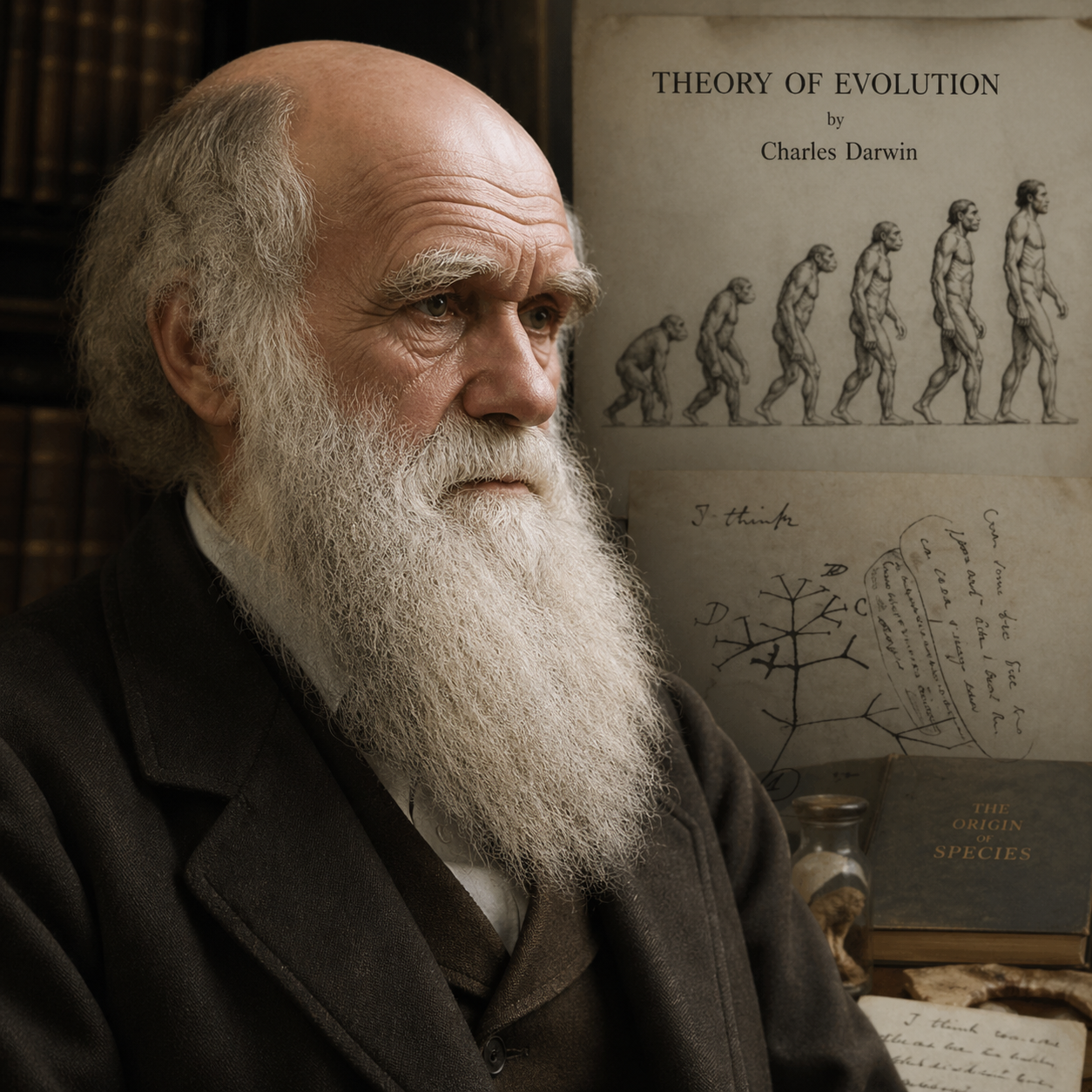
British naturalist whose On the Origin of Species (1859) established evolution by natural selection — the unifying theory of modern biology. Closely associated with Thomas Henry Huxley (his 'bulldog' public defender) and Alfred Russel Wallace (independent co-discoverer of natural selection). For an intellectual contrast, see William Paley, Anglican theologian and Natural Theology author (1743-1805) — Origin of Species is structurally a 400-page reply to Paley — Darwin admired Paley's watchmaker-argument as an undergraduate at Cambridge and then spent 20 years building the empirical machinery to displace him. The cleanest 'design argument vs natural selection' founding rebuttal in science.
The standard scholarly entry points to Charles Darwin's work: Janet Browne (Harvard, history of science) — Charles Darwin: Voyaging (1995) and The Power of Place (2002); Adrian Desmond (UCL, biographer) — Darwin: The Life of a Tormented Evolutionist (1991, with James Moore). These are the works graduate seminars cite when teaching Charles Darwin.
A humorous, self-deprecating analogy, possibly from a private letter or conversation, though hard to pinpoint exact source.
Date: c. 1870s
Life & AgingFound in 1 providers: grok
1 source checked
The absence of memory doesn't disprove an earlier state of existence. The speaker uses personal amnesia about infancy as a stand-in for a broader logical point: we can't dismiss the reality of something simply because we have no conscious recollection of it. Existence precedes awareness. Memory is an unreliable and incomplete witness to our own history — a point as relevant to personal development as to scientific inquiry.
Darwin spent decades building arguments from indirect evidence — fossils, morphology, embryology — to prove evolution without anyone witnessing speciation directly. His work in On the Origin of Species heavily relied on embryological similarities across species as proof of common descent. This quote mirrors that logic: absence of direct observation doesn't negate a fact. It reflects Darwin's core intellectual habit of reasoning confidently from evidence others dismissed as insufficient.
Darwin published On the Origin of Species in 1859, igniting fierce debate about human origins and developmental biology. Embryology was central to Victorian science — Ernst Haeckel's ontogeny recapitulates phylogeny argued embryos replay evolutionary history. Questions about when life begins and what memory proves were intensely contested in science, theology, and philosophy. Darwin's era forced thinkers to confront the limits of personal testimony as valid scientific evidence.
AI-generated insights based on extensive research and information for context. Factual errors? Email [email protected].
Your cart is empty