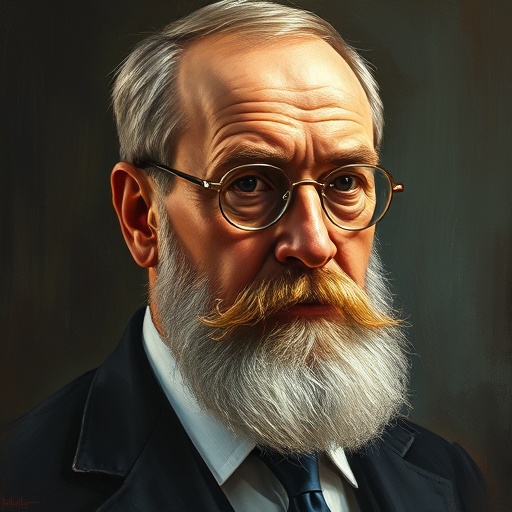
Robert Koch — "The field of bacteriology is still in its infancy, but its potential is immense."
The field of bacteriology is still in its infancy, but its potential is immense.
The field of bacteriology is still in its infancy, but its potential is immense.
Click any product to generate a realistic preview. Up to 3 at a time.
* Initial load can take up to 90 seconds — revising the preview in another color is nearly instant.
"The development of solid culture media was a turning point in bacteriology."
"The existence of microorganisms as a cause of disease is no longer a matter of theory, but a demonstrated fact."
"My work has shown that specific microorganisms cause specific diseases."
"The experimental method is the foundation of all scientific progress."
"The microscope is our most important tool in the fight against disease."
Found in 1 providers: grok
1 source checked
The quote says that studying bacteria to understand disease is a young science, barely developed yet holding enormous promise. It acknowledges how little is currently known while expressing firm confidence that systematic investigation of microorganisms will transform medicine — unlocking how diseases spread, how infections develop, and ultimately how to prevent and cure illnesses that have long devastated humanity.
Koch had already identified the anthrax bacillus in 1876 and the tuberculosis bacterium in 1882, proving specific microbes cause specific diseases. Yet he recognized these were early milestones. His development of pure-culture techniques and rigorous diagnostic postulates gave bacteriology its methodological foundation. He spent subsequent decades pursuing cholera, sleeping sickness, and other pathogens, driven by conviction that far more remained to discover.
In the 1880s, germ theory had only recently displaced miasma theory, which blamed bad air for disease. Tuberculosis killed roughly one in seven Europeans; cholera epidemics repeatedly devastated cities. No antibiotics existed, and even reliable staining methods were newly invented. Koch's laboratory was building the discipline's tools in real time. The gap between identifying a pathogen and treating patients remained vast, making his optimism both bold and prescient.
AI-generated insights based on extensive research and information for context. Factual errors? Email [email protected].
Your cart is empty