Erwin Schrodinger — "The fundamental laws of physics are statistical. They do not determine precisely…"
The fundamental laws of physics are statistical. They do not determine precisely what will happen, but only the probability of what will happen.
The fundamental laws of physics are statistical. They do not determine precisely what will happen, but only the probability of what will happen.
Click any product to generate a realistic preview. Up to 3 at a time.
* Initial load can take up to 90 seconds — revising the preview in another color is nearly instant.
"What is life? The answer to this question is not what one expects."
"The human mind is not capable of grasping the universe. We are like a little child entering a huge library. The walls are covered to the ceilings with books in many different tongues. The child knows …"
"The more deeply we penetrate into nature, the more we find that it is full of mysteries."
"The world is a canvas, and we are the artists."
"The human mind is a universe in itself."
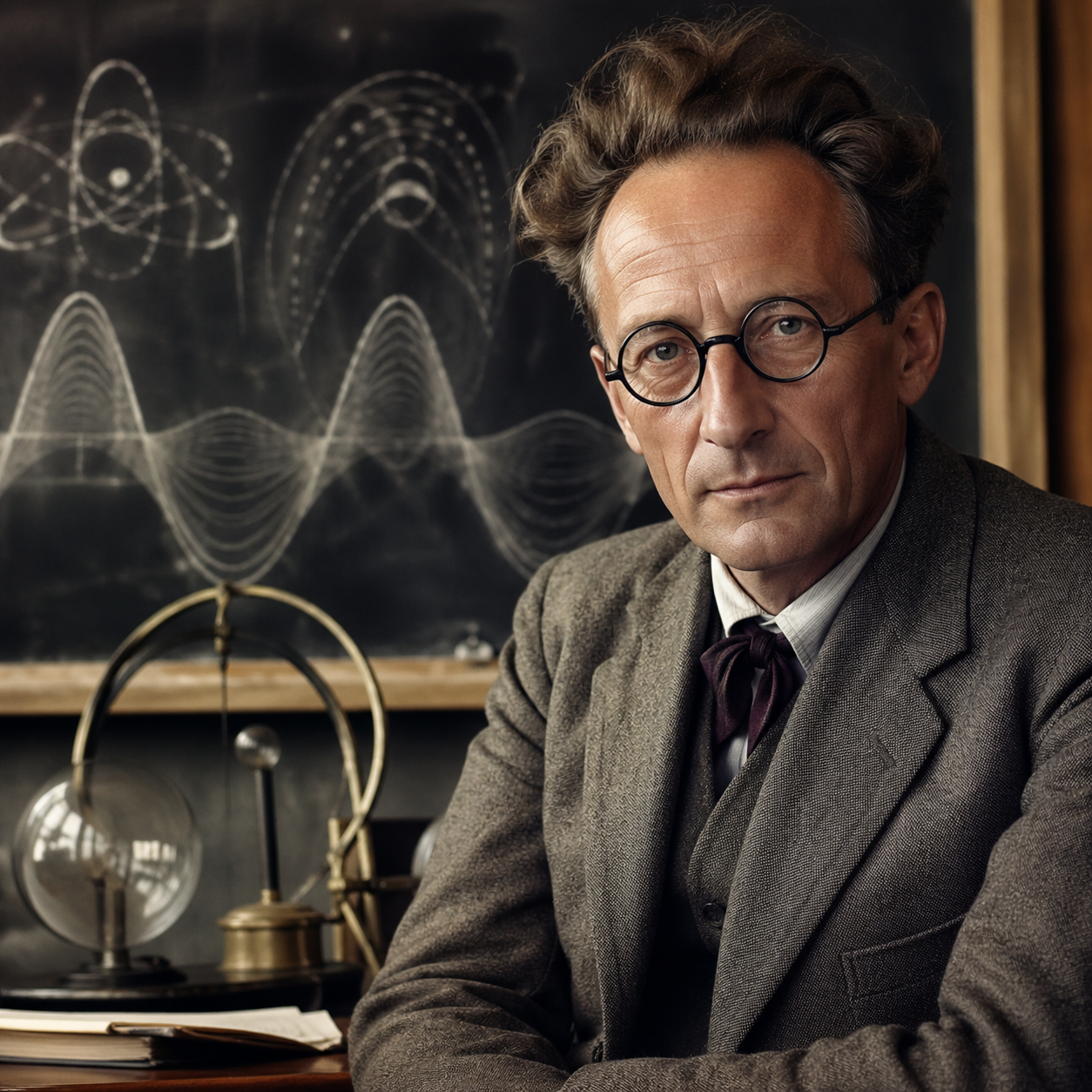
Austrian physicist who shared the 1933 Nobel for the wave equation that bears his name and the famous cat thought-experiment. Closely associated with Werner Heisenberg (matrix-mechanics rival who reached the same physics by different math) and Albert Einstein (his pen-pal on quantum interpretation). For an intellectual contrast, see Niels Bohr, Danish physicist and architect of the Copenhagen interpretation — Schrödinger's cat thought-experiment was specifically designed to ridicule Bohr's 'observer-dependent reality' reading of quantum mechanics — Schrödinger thought the Copenhagen interpretation was absurd; the cat was meant as reductio ad absurdum.
Found in 1 providers: grok
1 source checked
Physical reality at its deepest level doesn't follow rigid, predetermined rules. Instead, nature operates through probabilities — we can calculate the likelihood of outcomes but never guarantee exactly what will occur. Certainty is an illusion; the universe speaks in chances. This fundamentally overturns the classical idea that knowing all conditions means knowing all future events with absolute precision.
Schrödinger developed wave mechanics in 1926, mathematically describing quantum particles as probability waves rather than definite objects. His famous cat thought experiment directly confronted this statistical indeterminacy — a cat simultaneously alive and dead until observed. He built his career wrestling with what probability-based physics means for reality, debating Einstein and Bohr about whether God truly 'plays dice' with the universe.
The 1920s-30s saw quantum mechanics overturn centuries of Newtonian determinism. Einstein's relativity had already shaken physics, but quantum theory went further — suggesting nature itself is irreducibly probabilistic. This era's uncertainty principle, wave-particle duality, and Copenhagen interpretation sparked fierce philosophical debates about causality, free will, and whether objective reality exists independent of observation.
AI-generated insights based on extensive research and information for context. Factual errors? Email [email protected].
Your cart is empty