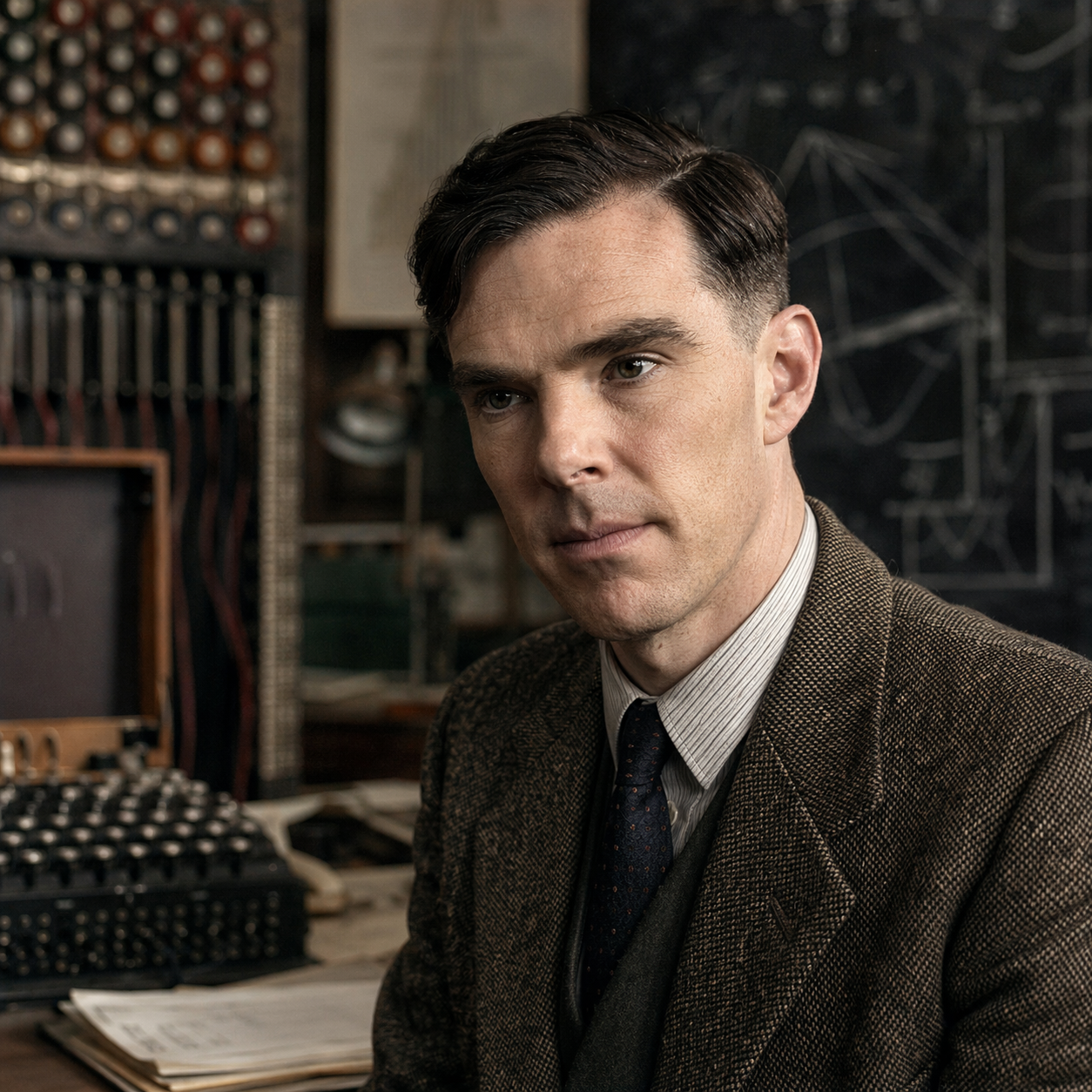
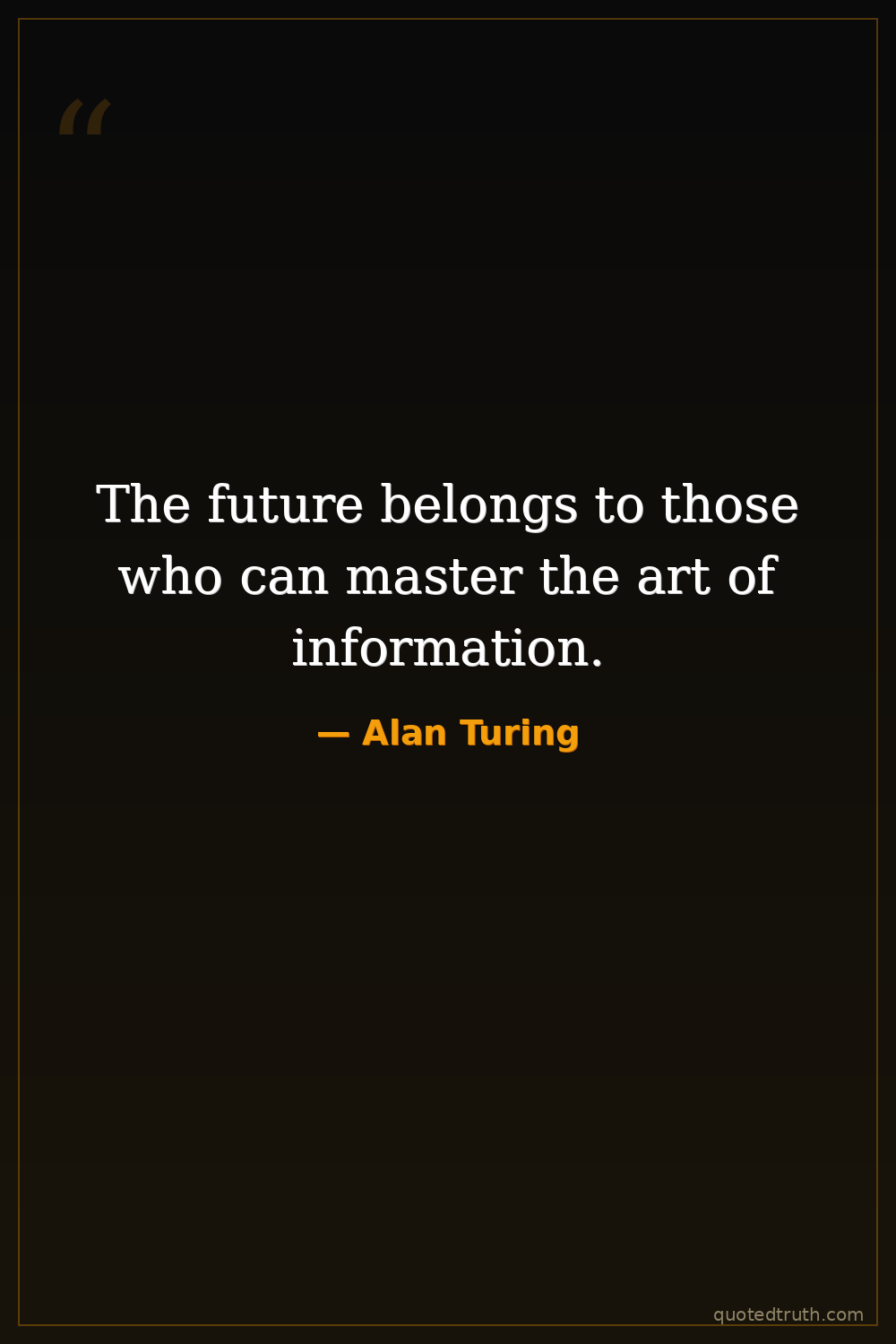
Alan Turing — "The future belongs to those who can master the art of information."
The future belongs to those who can master the art of information.
The future belongs to those who can master the art of information.
Click any product to generate a realistic preview. Up to 3 at a time.
* Initial load can take up to 90 seconds — revising the preview in another color is nearly instant.
"The whole problem can be reduced to the question: Can machines think?"
"The isolated man does not develop any intellectual power. It is necessary for him to be immersed in an environment of other men, whose techniques he absorbs during the first twenty years of his life. …"
"Programming is a skill best acquired by practice and example rather than from books."
"No, I'm not interested in developing a powerful brain. All I'm interested in is a moderately trained brain. The kind that would be useful in daily life."
"Up to a point, it is better to just let the snags [bugs] be there than to spend such time in design that there are none."
Attributed, but precise source and wording are difficult to pin down. Reflects general themes.
Date: Unknown
ShockingFound in 1 providers: grok
1 source checked
Power and success will increasingly flow to those who can gather, process, and leverage information effectively. In an age of data, algorithms, and digital networks, the ability to understand, interpret, and act on information—rather than raw physical or financial strength alone—determines who leads, who innovates, and who ultimately shapes civilization. The ability to turn raw data into insight and action is the defining competitive advantage of the modern world.
Turing spent his career proving this thesis through action. At Bletchley Park, breaking Nazi Enigma ciphers—by building machines that processed encrypted information faster than any human team—helped shorten World War II. His theoretical Turing Machine defined computation itself as information processing. His landmark 1950 paper on machine intelligence asked whether a computer could manipulate information indistinguishably from a human mind, anticipating the entire AI field.
Turing lived through the 1940s–50s, when Claude Shannon formalized information theory in 1948, ENIAC and UNIVAC launched the computer age, and the Cold War made signals intelligence existentially urgent. Nations were rapidly discovering that whoever controlled communications—decrypting enemy messages while protecting their own—held decisive military and geopolitical power. The entire postwar world order was being reorganized around who could master, process, and protect information most effectively.
AI-generated insights based on extensive research and information for context. Factual errors? Email [email protected].
Your cart is empty