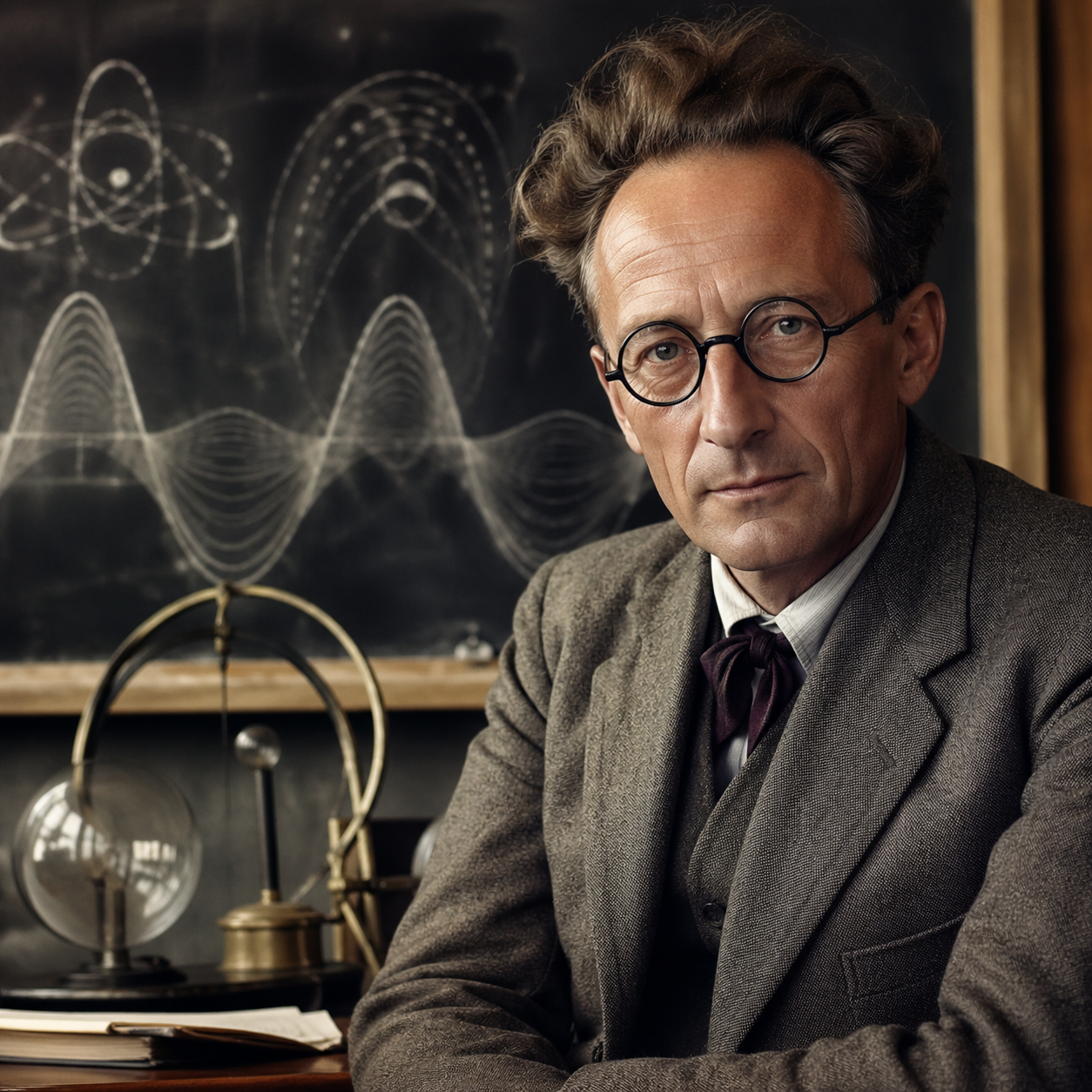
Erwin Schrodinger — "The future is not predetermined, but is open to our choices and actions."
The future is not predetermined, but is open to our choices and actions.
The future is not predetermined, but is open to our choices and actions.
Click any product to generate a realistic preview. Up to 3 at a time.
* Initial load can take up to 90 seconds — revising the preview in another color is nearly instant.
"The world is a song, and we are the singers."
"The path to knowledge is paved with doubt."
"Our body is not a thing, but a process."
"The idea that consciousness is a phenomenon of the brain is an illusion. Consciousness is a fundamental property of the universe, and the brain is merely an antenna that tunes into it."
"I am very astonished that the scientific picture of the real world around me is very deficient. It gives a lot of factual information, puts all our experience in a magnificently consistent order, but …"
Austrian physicist who shared the 1933 Nobel for the wave equation that bears his name and the famous cat thought-experiment. Closely associated with Werner Heisenberg (matrix-mechanics rival who reached the same physics by different math) and Albert Einstein (his pen-pal on quantum interpretation). For an intellectual contrast, see Niels Bohr, Danish physicist and architect of the Copenhagen interpretation — Schrödinger's cat thought-experiment was specifically designed to ridicule Bohr's 'observer-dependent reality' reading of quantum mechanics — Schrödinger thought the Copenhagen interpretation was absurd; the cat was meant as reductio ad absurdum.
Found in 1 providers: grok
1 source checked
The path ahead isn't fixed by fate or rigid causality. Human decisions and deliberate actions genuinely shape what comes next. The universe leaves room for agency — our choices matter and carry real consequences. This rejects fatalism and determinism, insisting that the present moment holds genuine power to alter what tomorrow looks like, rather than simply playing out a script already written.
Schrödinger's wave mechanics replaced classical deterministic particle trajectories with probability amplitudes — the electron isn't 'here' until measured. His famous cat paradox dramatized how quantum superposition keeps multiple futures genuinely open until observation collapses them. A physicist who spent his career proving nature resists determinism at its deepest level would naturally conclude the future remains unwritten and responsive to intervention.
Schrödinger worked through two World Wars, the collapse of European empires, and the atomic age's dawn. Classical Newtonian determinism — the idea that the universe runs like clockwork — was being dismantled by quantum theory in the 1920s–30s. Einstein's relativity and quantum mechanics together shattered the 19th-century certainty that all events are mechanically predetermined, making free will and open futures scientifically respectable again.
AI-generated insights based on extensive research and information for context. Factual errors? Email [email protected].
Your cart is empty