Erwin Schrodinger — "A theoretical science, if it is to be healthy, must be able to hold its own agai…"
A theoretical science, if it is to be healthy, must be able to hold its own against the practical application of its theories.
A theoretical science, if it is to be healthy, must be able to hold its own against the practical application of its theories.
Click any product to generate a realistic preview. Up to 3 at a time.
* Initial load can take up to 90 seconds — revising the preview in another color is nearly instant.
"The universe is a grand illusion. But it is a very persistent one."
"I insist upon the view that 'all is waves'."
"If we are to be honest, we must admit that the present state of physics offers no hope of a satisfactory picture of the world."
"I am no friend of probability theory, I have hated it from the first moment when our dear friend Max Born gave it birth. For it could be seen how easy and simple it made everything, in principle, ever…"
"The human mind is a universe in itself."
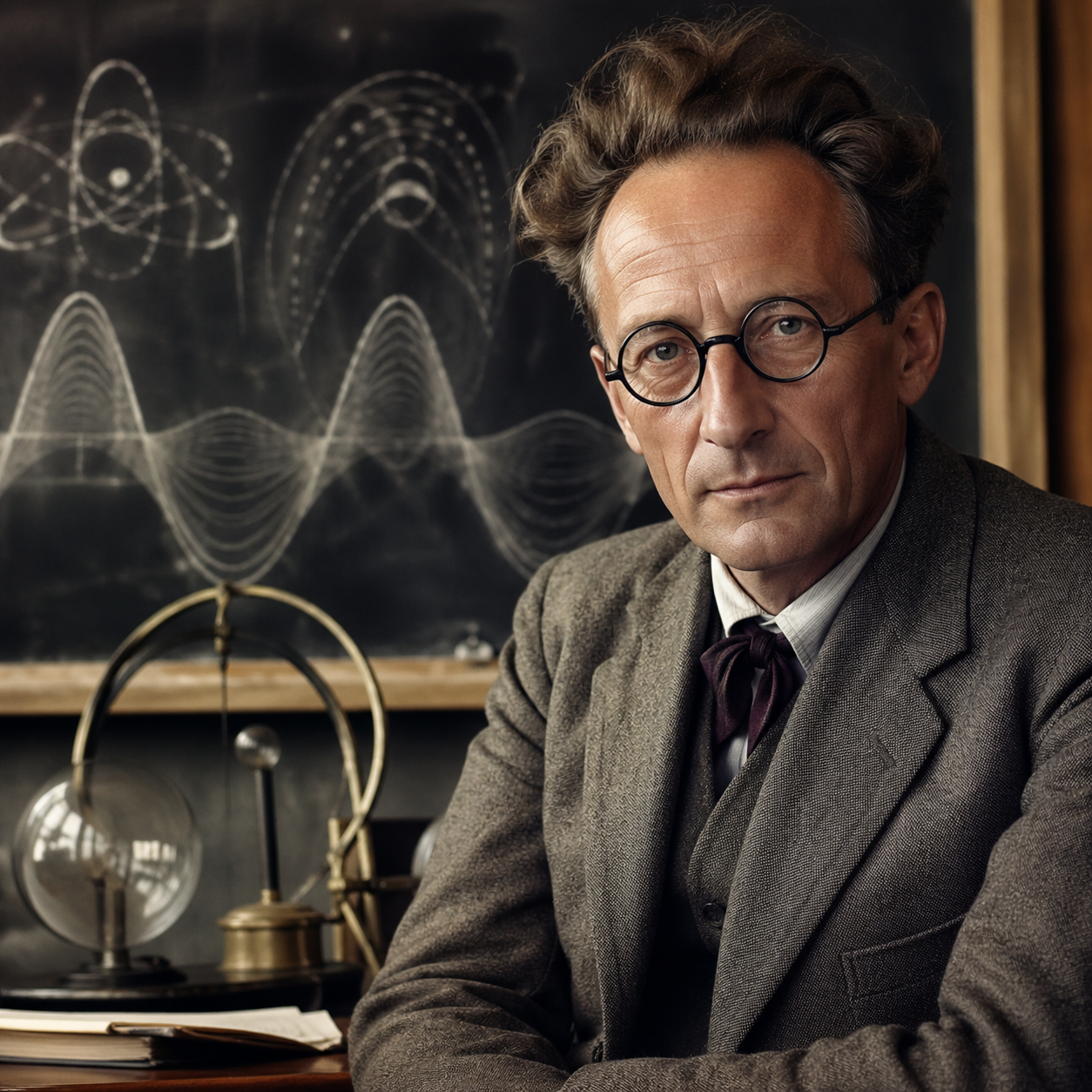
Austrian physicist who shared the 1933 Nobel for the wave equation that bears his name and the famous cat thought-experiment. Closely associated with Werner Heisenberg (matrix-mechanics rival who reached the same physics by different math) and Albert Einstein (his pen-pal on quantum interpretation). For an intellectual contrast, see Niels Bohr, Danish physicist and architect of the Copenhagen interpretation — Schrödinger's cat thought-experiment was specifically designed to ridicule Bohr's 'observer-dependent reality' reading of quantum mechanics — Schrödinger thought the Copenhagen interpretation was absurd; the cat was meant as reductio ad absurdum.
Found in 1 providers: grok
1 source checked
Theoretical science should maintain its rigor and independence even when its ideas get tested through real-world application. Theory shouldn't bend or collapse under pressure from practical results — instead, it should be robust enough to survive that confrontation intact. A science that abandons its theoretical foundations whenever applications get difficult or inconvenient is intellectually weak. Strong theory and practical application should challenge each other productively, not with theory simply yielding to utility.
Schrödinger developed wave mechanics in 1926 — pure mathematical formalism describing quantum behavior — yet watched it immediately get pressed into practical use in chemistry and atomic physics. He resisted interpretations like Copenhagen's that sacrificed theoretical coherence for calculational convenience, famously devising the cat paradox to expose that compromise. Throughout his career he insisted on rigorous theoretical foundations, writing extensively on the philosophy of science and refusing to let practical pressures distort quantum theory's deeper meaning.
Schrödinger worked through quantum mechanics' explosive rise in the 1920s-30s, followed by WWII's Manhattan Project transforming theoretical physics into weapons engineering. Post-war, governments poured funding into applied science — transistors, nuclear reactors, radar — while pure theorists faced institutional pressure to justify work through utility. The Cold War arms race accelerated this trend dramatically. Schrödinger's insistence that healthy theory must stand independently of its applications was a direct response to this commercialization and militarization of scientific inquiry.
AI-generated insights based on extensive research and information for context. Factual errors? Email [email protected].
Your cart is empty