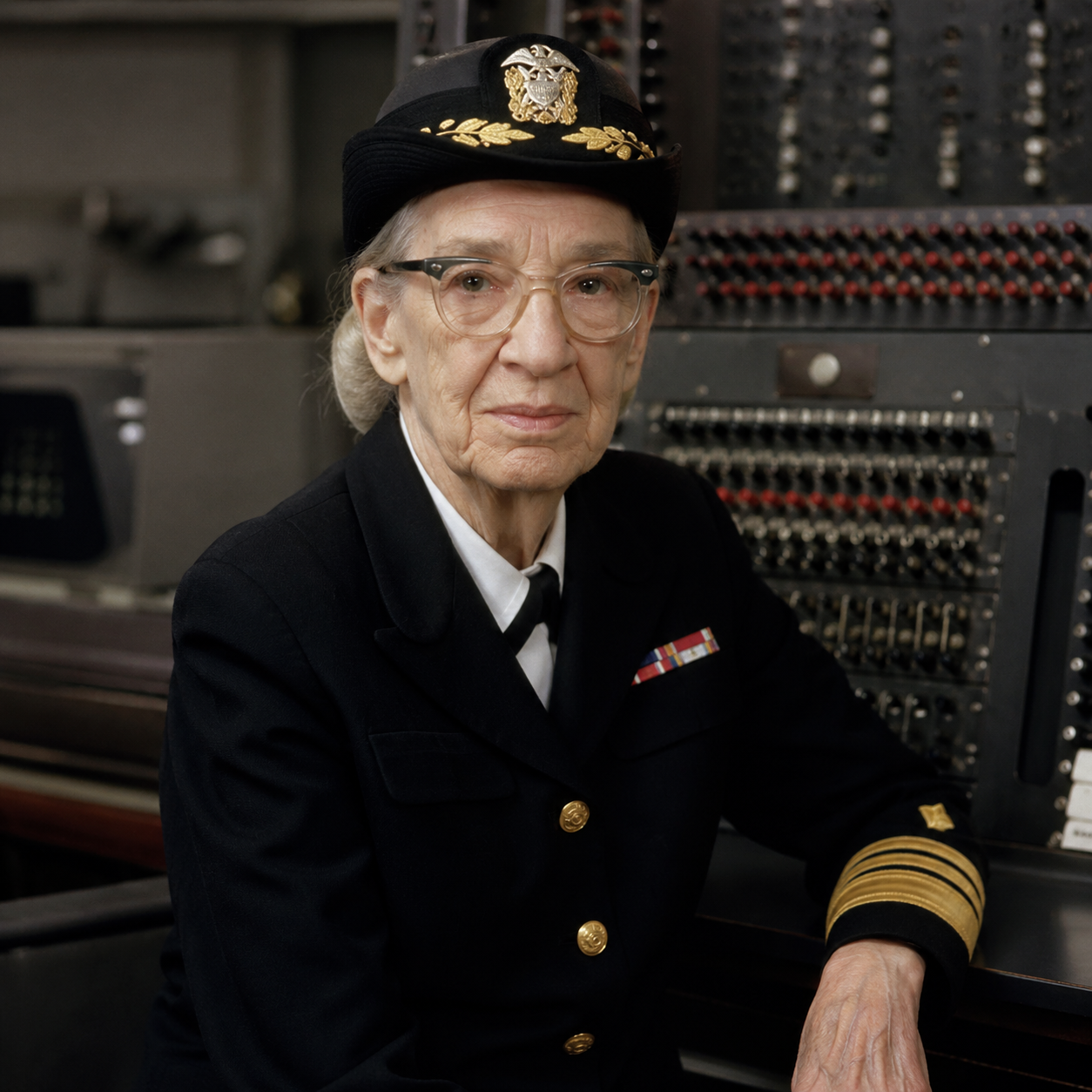
Grace Hopper — "The glass is neither half empty nor half full. It's simply larger than it needs …"
The glass is neither half empty nor half full. It's simply larger than it needs to be.
The glass is neither half empty nor half full. It's simply larger than it needs to be.
Click any product to generate a realistic preview. Up to 3 at a time.
* Initial load can take up to 90 seconds — revising the preview in another color is nearly instant.
"Never, never, never take the first no. There are a certain number of people in business, industry, and government who always say no the first time you suggest something new, because they're lazy... Bu…"
"No computer is ever going to ask a new, reasonable question. It takes trained people to do that."
"In pioneer days they used oxen for heavy pulling, and when one ox couldn't budge a log, they didn't try to grow a larger ox. We shouldn't be trying for bigger computers, but for more systems of comput…"
"I love to teach. I love to talk to young people."
"The only phrase I've ever disliked is, 'Why, we've always done it that way.' I always tell young people, 'Go ahead and do it. You can always apologize later.'"
A humorous and pragmatic reinterpretation of the common idiom about optimism/pessimism.
Date: Unknown
GeneralFound in 1 providers: gemini
1 source checked
Rather than debating optimism versus pessimism, this quote dismisses the entire framing as a waste of energy. The real issue isn't perception — it's that the container was poorly designed to begin with. Stop arguing about attitude and fix the structural inefficiency. It's a pragmatist's move: question the premise, identify the root problem, eliminate unnecessary complexity, and the debate dissolves entirely.
Hopper embodied this logic throughout her career. She invented the first compiler and championed COBOL precisely because existing systems were needlessly complex — too large for the task. Her famous nanosecond wire cut through abstraction to expose real constraints. She battled military bureaucracy her entire career, famously noting it's easier to ask forgiveness than permission. She never debated framing when the structure itself was the problem.
Hopper worked from the 1940s through the 1980s, when computing meant room-sized mainframes costing millions, and military culture rewarded over-engineering. Bigger hardware implied more power; bloated systems were a status symbol. Programming required machine-level thinking inaccessible to most. Hopper's whole career fought that excess — pushing readable languages and modular code when institutional inertia treated complexity as virtue and efficiency as an afterthought.
AI-generated insights based on extensive research and information for context. Factual errors? Email [email protected].
Your cart is empty