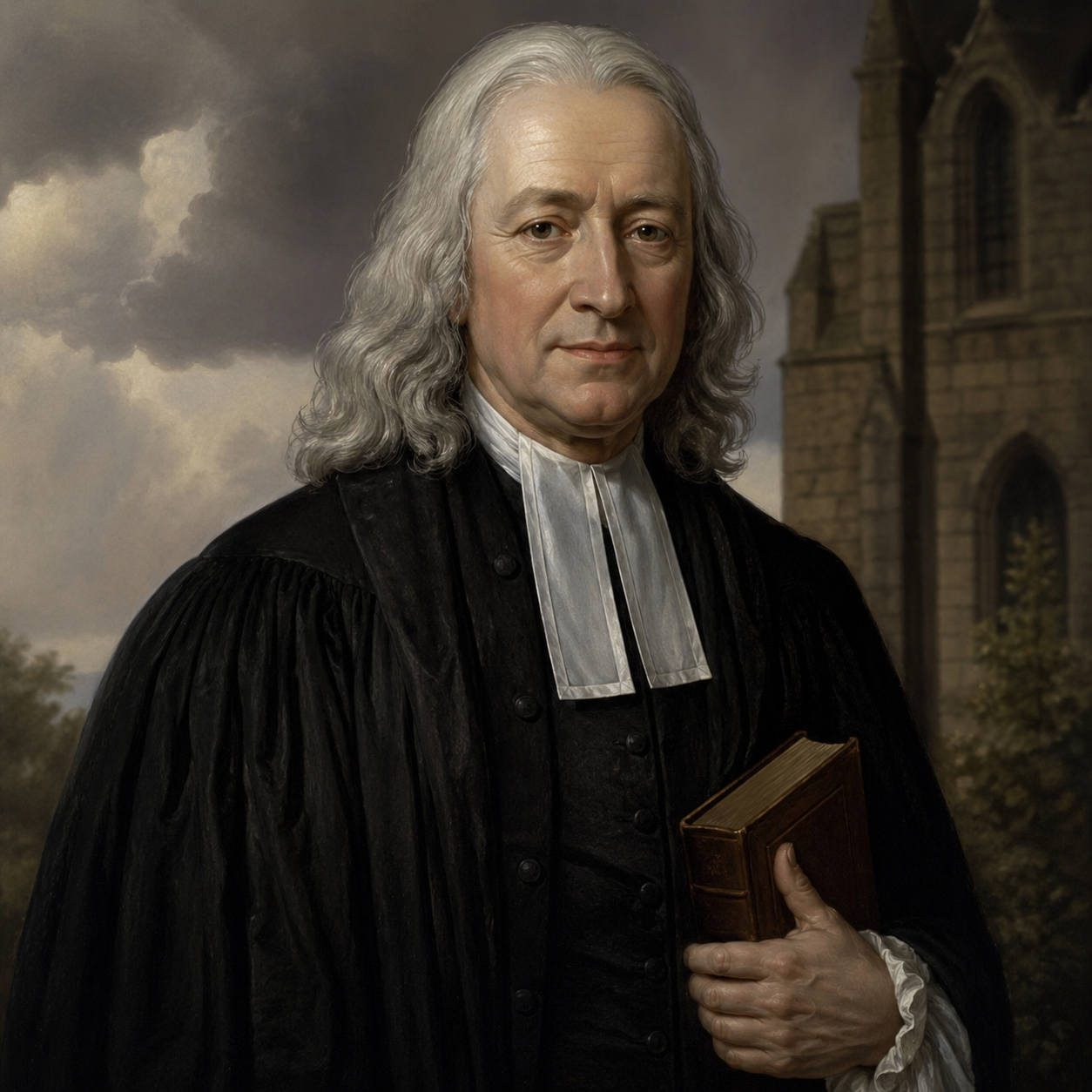
John Wesley — "The Gospel of Christ knows of no religion but social; no holiness but social hol…"
The Gospel of Christ knows of no religion but social; no holiness but social holiness.
The Gospel of Christ knows of no religion but social; no holiness but social holiness.
Click any product to generate a realistic preview. Up to 3 at a time.
* Initial load can take up to 90 seconds — revising the preview in another color is nearly instant.
"I have often thought, that if I were to choose a companion to travel with, it should be one that would talk little."
"I have often wished, that all the books in the world were burnt, except the Bible."
"To candid, reasonable men, I am not afraid to lay open what has been the course of my life."
"I have often thought, that if I were to choose a place of abode, it should be in a country where there were no rich people."
"I know no other book in the world, that contains so many strong and clear proofs of the being and perfections of God, and of the truth of our holy religion, as the Bible."
English Anglican cleric and founder of Methodism, whose open-air preaching and class-meeting structure created the largest 18th-century evangelical revival. Closely associated with Charles Wesley (his hymn-writing brother) and George Whitefield (early co-revivalist, later doctrinal opponent). For an intellectual contrast, see George Whitefield, Calvinist evangelical revivalist — Whitefield's predestinarian Calvinism vs Wesley's free-grace Arminian theology split the early Methodist movement permanently in the 1739-41 break. The founding evangelical Calvinist-Arminian schism — the two parallel evangelical traditions American Christianity descends from.
Found in 1 providers: grok
1 source checked
This quote argues that authentic Christianity cannot exist as a purely private affair. True faith demands communal practice—lived out alongside others in mutual accountability, shared worship, and service to society. Personal piety divorced from social engagement is, for Wesley, not genuine holiness at all. Real religion transforms how people relate to one another and the world, not merely one's inner spiritual condition.
Wesley built Methodism around small 'class meetings'—weekly accountability groups where members examined each other's spiritual lives and practical conduct. He preached outdoors to miners and factory workers excluded by the established church, organized relief funds, visited prisons, and founded schools for the poor. His entire ministry embodied social holiness: faith expressed through community discipline, mutual care, and direct engagement with society's most vulnerable people.
18th-century Britain faced explosive industrialization and urban poverty, with masses of displaced workers crowding into squalid cities. The Church of England largely ministered to the propertied classes, ignoring the laboring poor. Simultaneously, Enlightenment philosophy promoted religion as a private, rational matter of individual conscience. Wesley's insistence on social holiness pushed back against both clerical neglect of the poor and an individualism that stripped faith of communal and moral obligation.
AI-generated insights based on extensive research and information for context. Factual errors? Email [email protected].
Your cart is empty