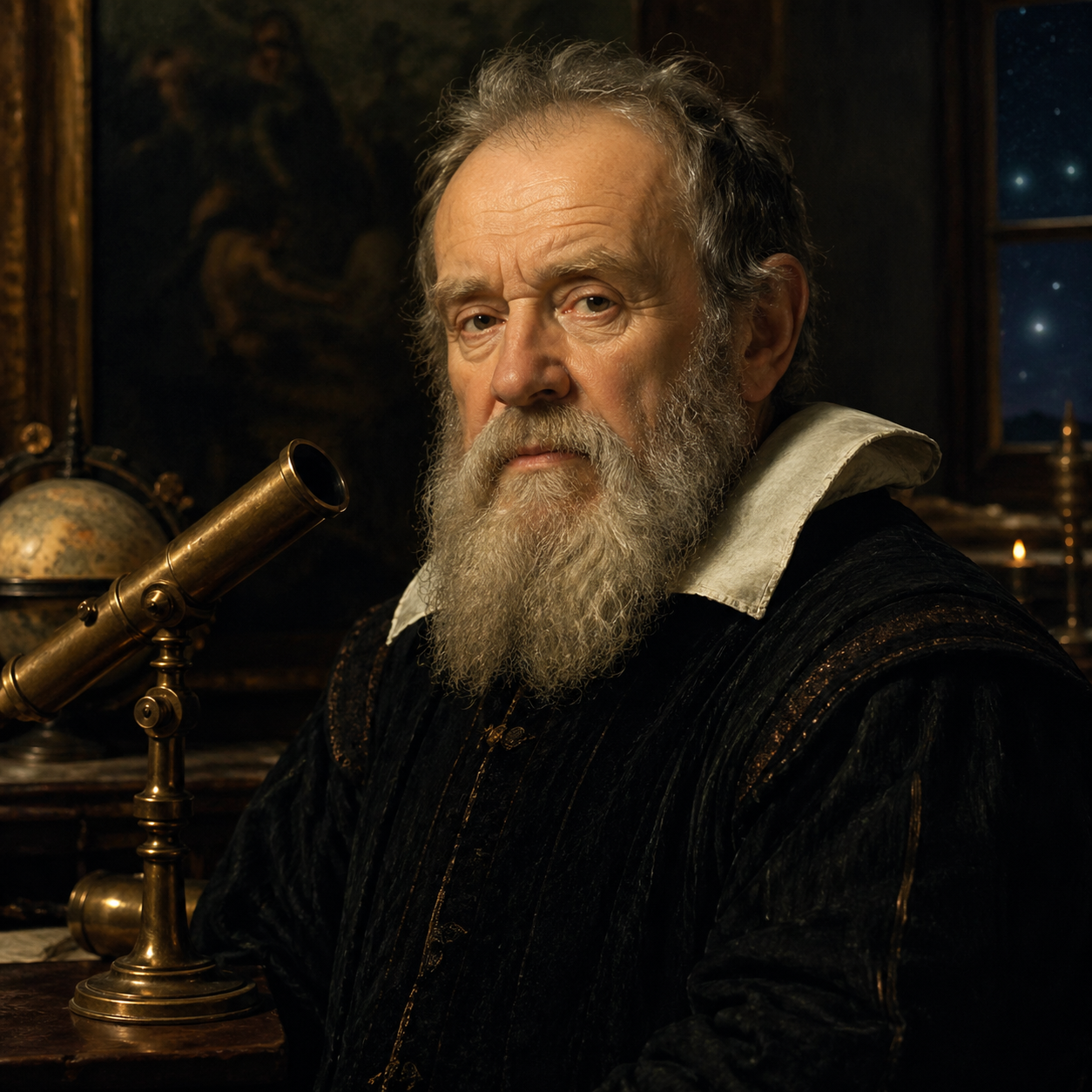
Galileo Galilei — "The great book of nature is written in mathematical symbols."
The great book of nature is written in mathematical symbols.
The great book of nature is written in mathematical symbols.
Click any product to generate a realistic preview. Up to 3 at a time.
* Initial load can take up to 90 seconds — revising the preview in another color is nearly instant.
"It is a beautiful and admirable thing to search out the causes of natural phenomena."
"I do not think it is necessary to believe that the same God who gave us our senses, our reason, and our intellect, also intended us to forego their use."
"To apply oneself to a search for the truth, without any intent to serve some predetermined end, is the true path to discovery."
"The error of the senses is not less, but rather greater, if we try to correct them by reason without experience."
"The difficulties in the study of the infinite arise because we attempt, with our finite minds, to discuss the infinite, assigning to it those properties which we give to the finite and limited; but th…"
Found in 1 providers: grok
1 source checked
Reality itself follows mathematical rules — the universe isn't random chaos but an ordered system that can be decoded through numbers, geometry, and equations. To truly understand nature, you must learn its language, which is mathematics. Observation alone isn't enough; you need mathematical reasoning to extract the deeper patterns governing how planets move, objects fall, and forces interact.
Galileo spent his career translating physical phenomena into mathematical relationships — calculating projectile trajectories, deriving the law of falling bodies, and describing planetary motion quantitatively. His telescope observations were meaningless without the mathematics to interpret them. This conviction drove his break from Aristotelian philosophy, which relied on verbal reasoning rather than numerical measurement.
In early modern Europe, natural philosophy relied heavily on ancient Greek texts and theological interpretation rather than quantitative analysis. Galileo's era saw the printing press spread scientific ideas while the Church maintained doctrinal authority over cosmology. His insistence on mathematical description over scholastic argument made him revolutionary — and dangerous — directly contributing to his conflict with the Inquisition.
AI-generated insights based on extensive research and information for context. Factual errors? Email [email protected].
Your cart is empty