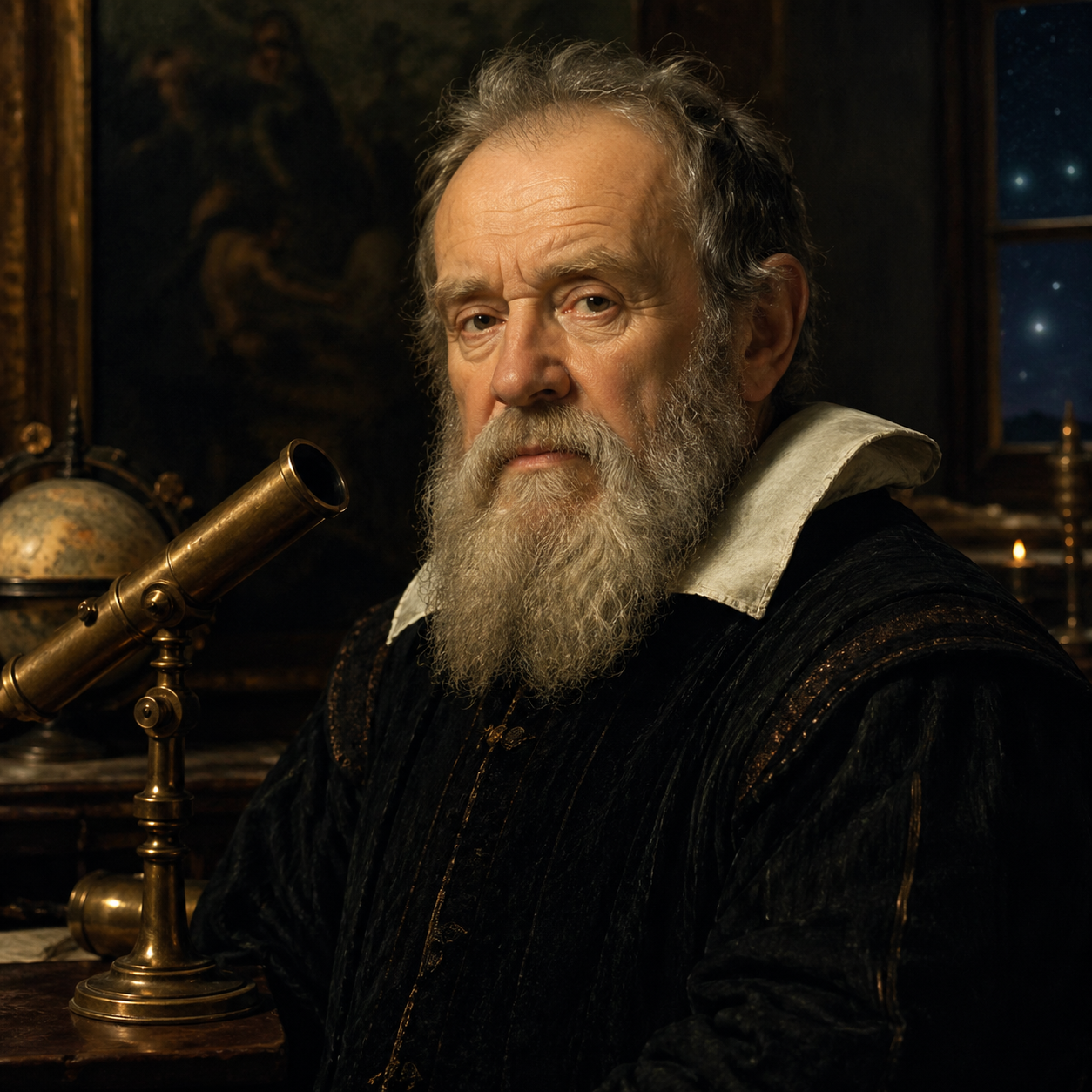
Galileo Galilei — "The deeper we penetrate into the universe, the more we realize that it is writte…"
The deeper we penetrate into the universe, the more we realize that it is written in the language of mathematics.
The deeper we penetrate into the universe, the more we realize that it is written in the language of mathematics.
Click any product to generate a realistic preview. Up to 3 at a time.
* Initial load can take up to 90 seconds — revising the preview in another color is nearly instant.
"The book of nature is written in the language of mathematics."
"The deeper I go into the sciences, the more I am convinced that the world is the work of an all-wise Creator."
"The motion of the earth is a fact, not a theory."
"The two books from which I draw my knowledge are the book of the created world and the book of the Holy Scripture."
"It is not necessary to examine all the arguments against a position, but only the strongest."
A more elaborate version of his famous statement from 'The Assayer'.
Date: 1623
Life & AgingFound in 1 providers: grok
1 source checked
The universe isn't random or arbitrary — it operates according to precise patterns that mathematics can capture and express. The more rigorously we study nature, the more we find mathematical relationships at its core: orbits follow equations, forces obey ratios, motion traces predictable curves. Understanding the cosmos means learning to read its underlying mathematical grammar, not just observing its surface appearances.
Galileo literally wrote in 'The Assayer' (1623) that nature's book is written in the language of mathematics. He abandoned Aristotle's qualitative descriptions and used geometry and ratios to describe falling bodies, projectile paths, and pendulum swings. His telescope observations demanded mathematical modeling to interpret. He built modern physics on the premise that quantities, not essences, are what nature reveals.
In early 17th-century Europe, Aristotelian natural philosophy still dominated universities, explaining nature through qualities like 'hot,' 'cold,' and 'heavy' rather than equations. Copernicus, Kepler, and Galileo were dismantling this framework, showing that planetary orbits and physical laws obeyed mathematical rules. This was radical: elevating math from a merchant's tool to the very structure of reality, directly challenging Church-backed scholasticism.
AI-generated insights based on extensive research and information for context. Factual errors? Email [email protected].
Your cart is empty