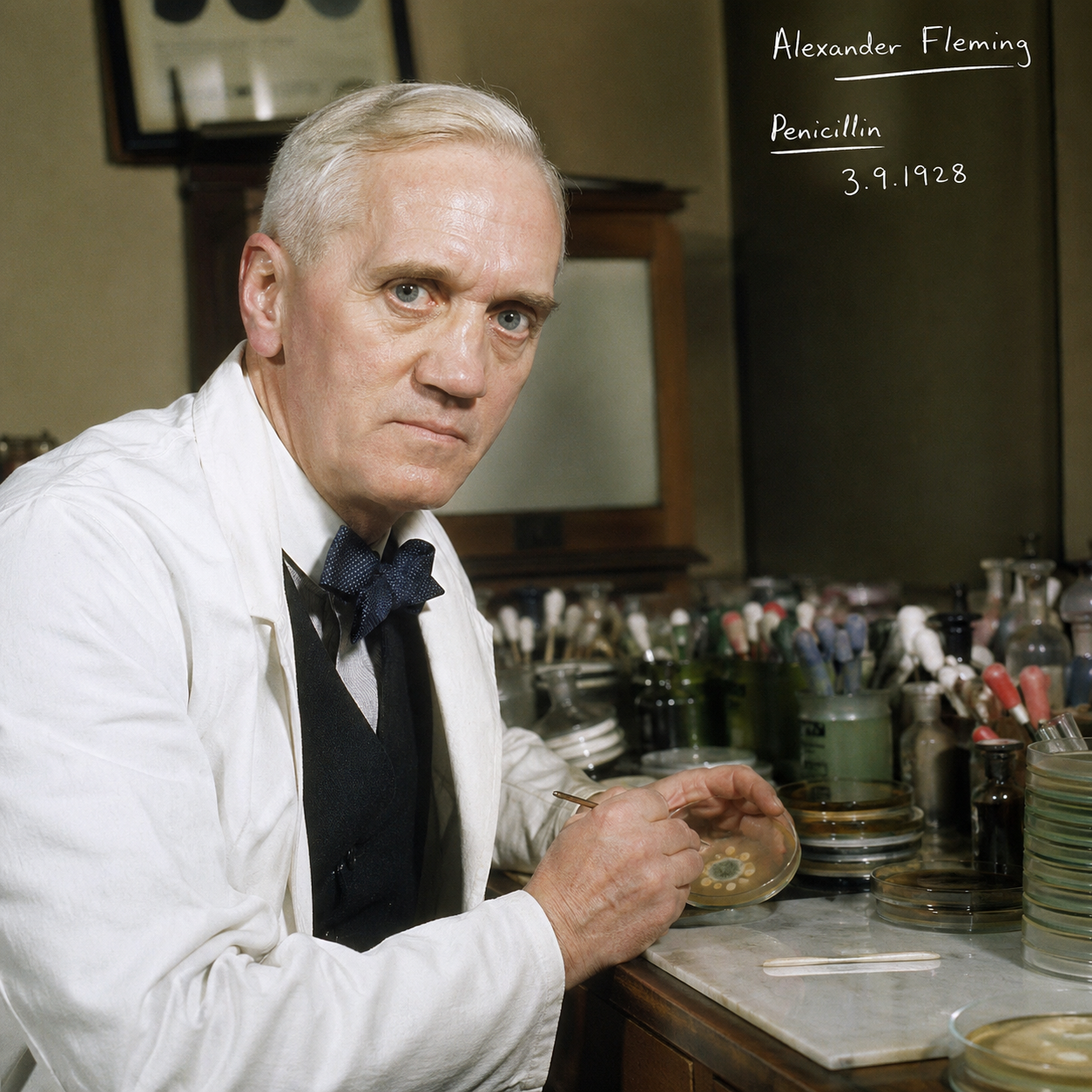
Alexander Fleming — "The greatest danger in the world is ignorance, and the greatest weapon is knowle…"
The greatest danger in the world is ignorance, and the greatest weapon is knowledge.
The greatest danger in the world is ignorance, and the greatest weapon is knowledge.
Click any product to generate a realistic preview. Up to 3 at a time.
* Initial load can take up to 90 seconds — revising the preview in another color is nearly instant.
"The mold was a lucky accident, but the observation was not."
"Many difficulties were encountered in the early attempts to isolate and purify penicillin."
"I have been asked by many people how I came to discover penicillin. The answer is that I did not discover it. I just happened to notice it."
"The accidental contamination of my cultures by a mold was not an unusual event in a bacteriological laboratory. What was unusual was my decision to investigate the mold."
"The public will probably never understand the difficulties that beset the path of the original investigator."
Found in 1 providers: grok
1 source checked
Ignorance is humanity's most destructive force — it allows disease, conflict, and suffering to persist unchecked. Knowledge, by contrast, is the ultimate tool for solving problems and protecting lives. When people understand how the world works, they can act effectively against threats that would otherwise overwhelm them. Awareness and education are not passive virtues but active defenses against preventable harm.
Fleming's entire career embodied this truth. Before penicillin, bacterial infections killed millions simply because no one knew how to stop them. His 1928 discovery that Penicillium mold killed bacteria transformed ignorance into knowledge — and that knowledge saved hundreds of millions of lives. Fleming consistently emphasized scientific curiosity and observation as moral duties, not merely professional habits.
Fleming worked through two World Wars, when soldiers died more often from infected wounds than bullets. Antibiotics didn't exist; sepsis was a death sentence. Simultaneously, germ theory was still being institutionalized globally, and public health literacy was dangerously low. In this context, the gap between knowing and not knowing was literally the difference between mass death and survival.
AI-generated insights based on extensive research and information for context. Factual errors? Email [email protected].
Your cart is empty