Erwin Schrodinger — "The greatest discovery of all is that the universe is alive."
The greatest discovery of all is that the universe is alive.
The greatest discovery of all is that the universe is alive.
Click any product to generate a realistic preview. Up to 3 at a time.
* Initial load can take up to 90 seconds — revising the preview in another color is nearly instant.
"The most important thing for a scientist is to be open to new ideas and to be willing to question established beliefs."
"The world is not something that exists independently of us. It is something that we create."
"The scientific method is a powerful tool, but it is not the only way to gain knowledge."
"Quantum physics thus reveals a basic oneness of the universe."
"Imagination is more important than knowledge."
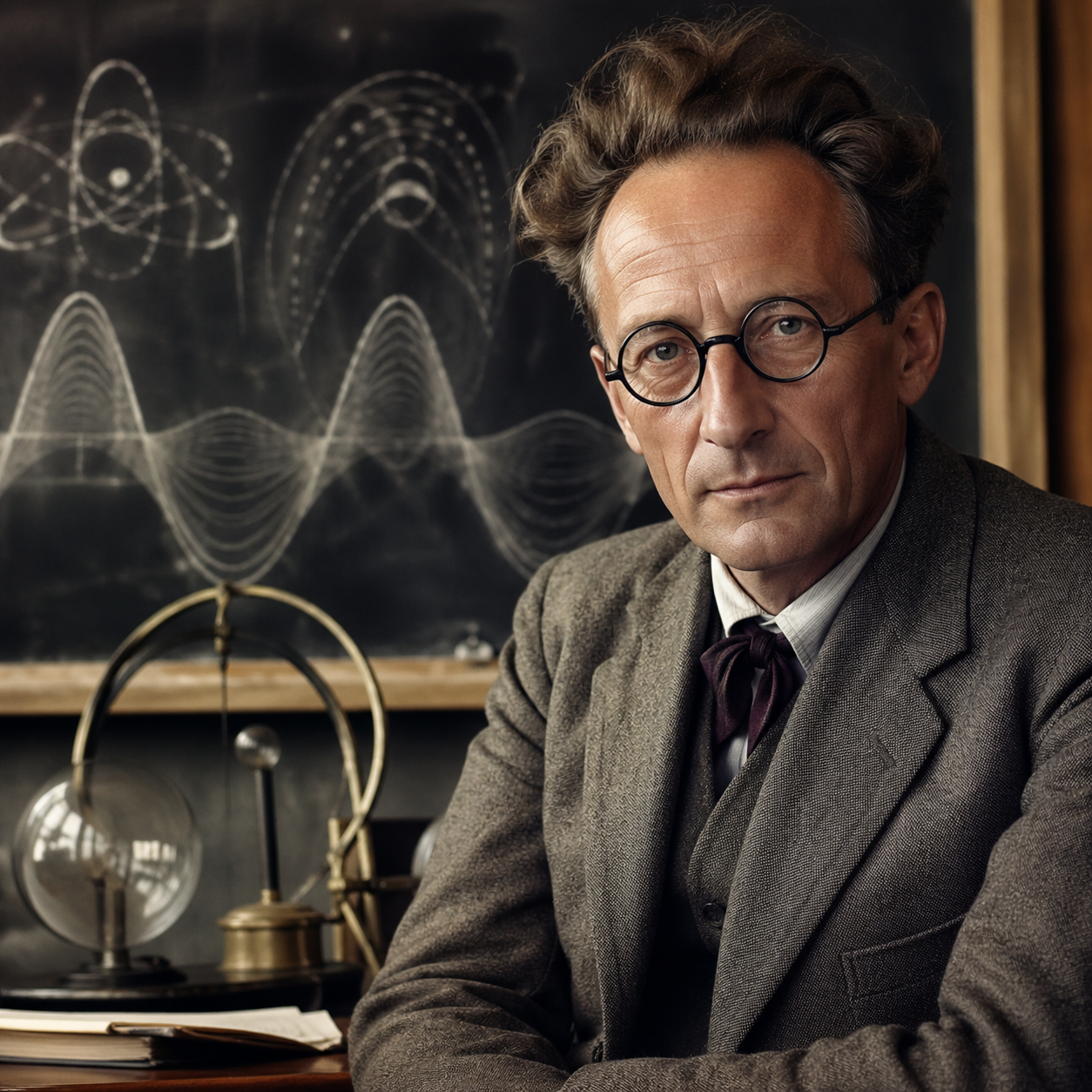
Austrian physicist who shared the 1933 Nobel for the wave equation that bears his name and the famous cat thought-experiment. Closely associated with Werner Heisenberg (matrix-mechanics rival who reached the same physics by different math) and Albert Einstein (his pen-pal on quantum interpretation). For an intellectual contrast, see Niels Bohr, Danish physicist and architect of the Copenhagen interpretation — Schrödinger's cat thought-experiment was specifically designed to ridicule Bohr's 'observer-dependent reality' reading of quantum mechanics — Schrödinger thought the Copenhagen interpretation was absurd; the cat was meant as reductio ad absurdum.
Attributed, but precise source and wording are difficult to pin down.
Date: Unknown
ShockingFound in 1 providers: grok
1 source checked
Reality itself is not inert matter governed by mechanical laws, but something dynamic, participatory, and self-organizing. The universe isn't a dead clockwork machine we observe from outside; it has an inner aliveness, a quality of being that mirrors consciousness itself. This challenges purely materialist assumptions and suggests existence has intrinsic vitality rather than being a collection of passive objects following deterministic rules.
Schrödinger spent his career dismantling classical mechanical physics through wave mechanics, showing particles aren't solid billiard balls but probabilistic wave functions. His 1944 book 'What Is Life?' pioneered applying quantum physics to biology, directly inspiring DNA's discovery. He deeply engaged Eastern philosophy, particularly Vedanta, which held consciousness as fundamental to reality—making this statement a natural synthesis of his physics and philosophical worldview.
The mid-20th century saw quantum mechanics demolish Newtonian certainty, revealing an observer-dependent, probabilistic universe. Simultaneously, cybernetics, systems theory, and early complexity science emerged, suggesting nature self-organizes rather than simply running down. Cold War materialism dominated culture, yet physicists like Schrödinger, Bohr, and Heisenberg were privately wrestling with consciousness, meaning, and whether scientific reductionism could ever fully capture reality's nature.
AI-generated insights based on extensive research and information for context. Factual errors? Email [email protected].
Your cart is empty