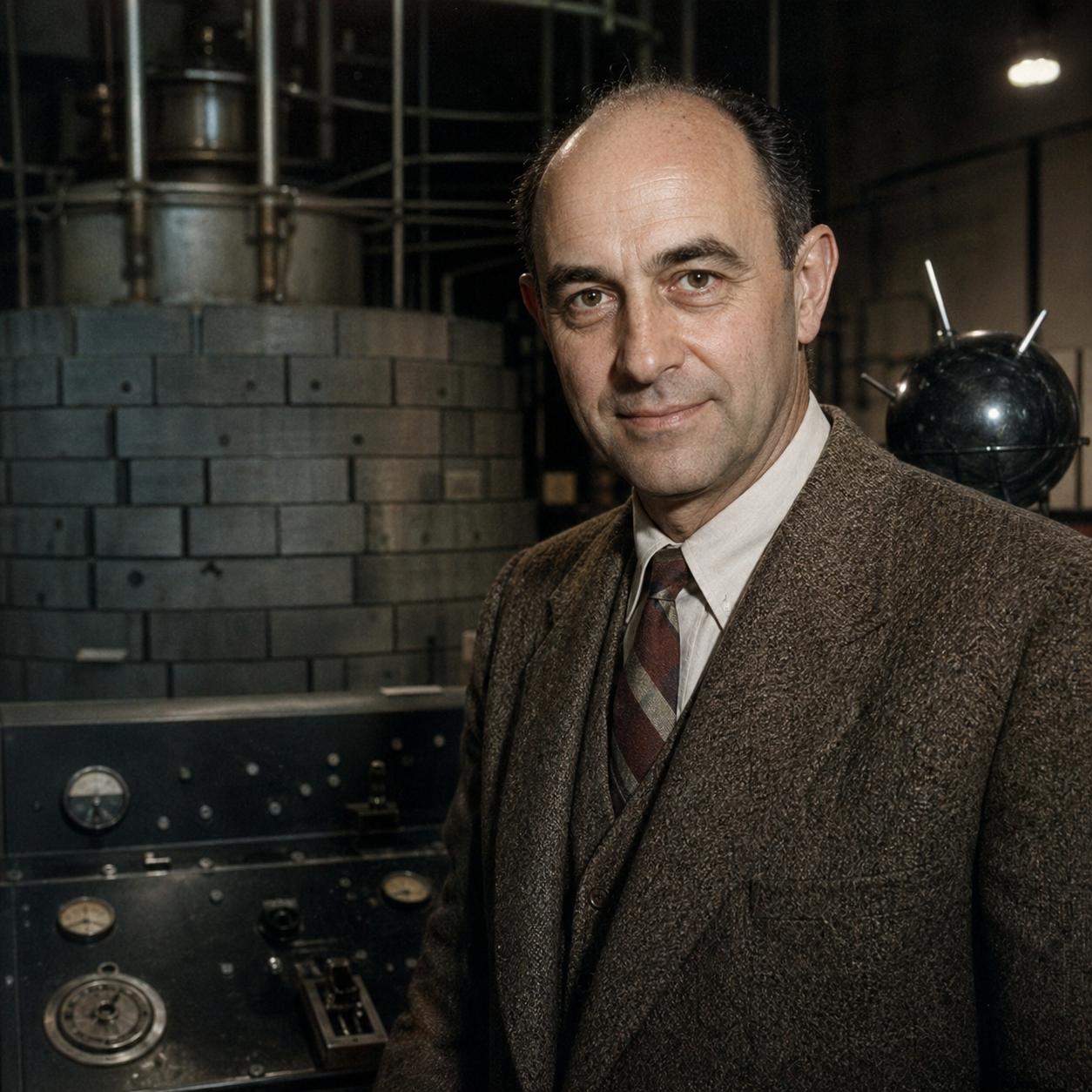
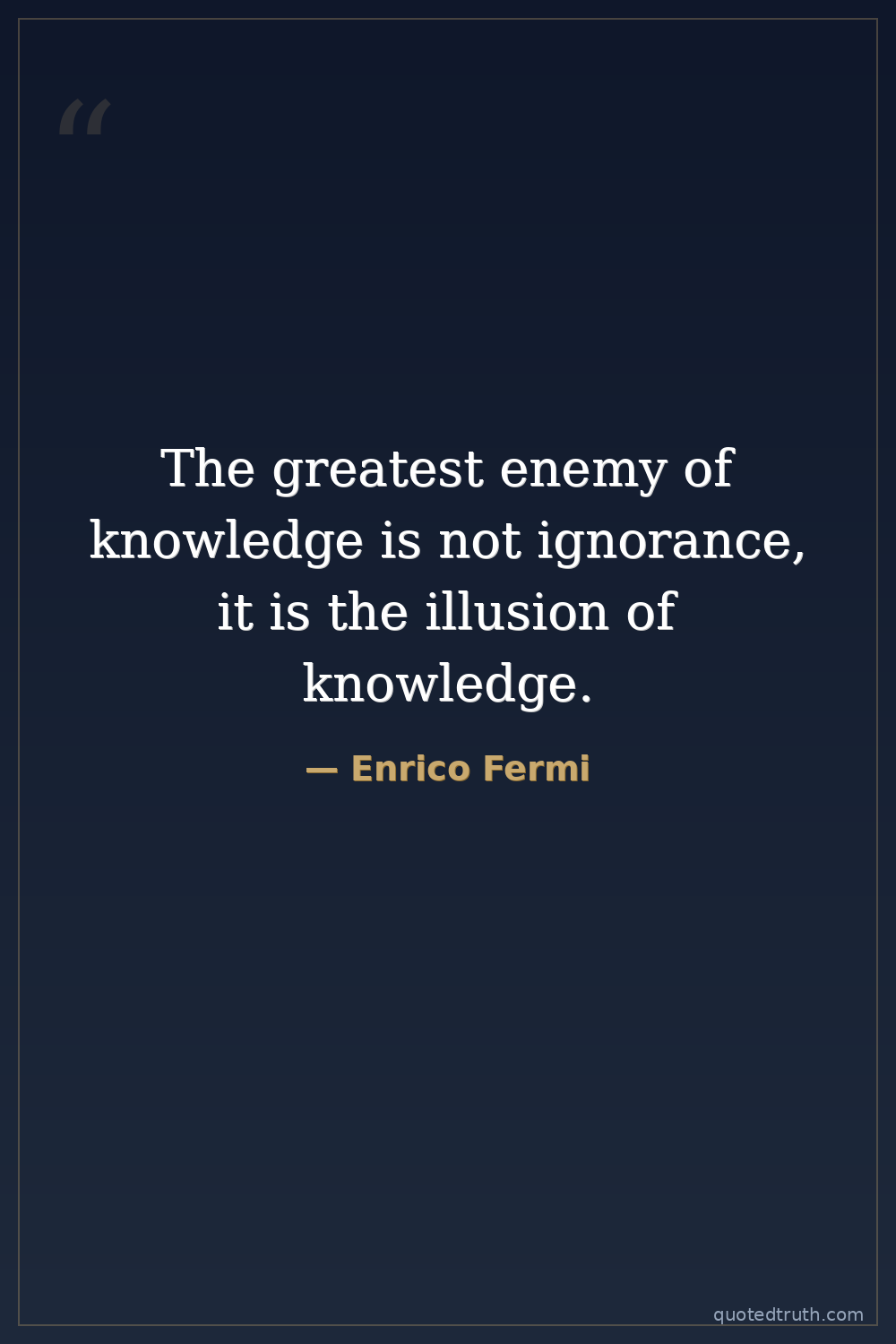
Enrico Fermi — "The greatest enemy of knowledge is not ignorance, it is the illusion of knowledg…"
The greatest enemy of knowledge is not ignorance, it is the illusion of knowledge.
The greatest enemy of knowledge is not ignorance, it is the illusion of knowledge.
Click any product to generate a realistic preview. Up to 3 at a time.
* Initial load can take up to 90 seconds — revising the preview in another color is nearly instant.
"It is not enough to know how to build a bomb. One must also know how to control it."
"I hope it works."
"I remember my friend Johnny von Neumann used to say, 'with four parameters I can fit an elephant and with five I can make him wiggle his trunk.'"
"I hope it won't take long."
"My father used to say that the only way to learn something is to make mistakes, and then learn from them."
Found in 1 providers: grok
1 source checked
False certainty is more dangerous than admitting you don't know something. When people believe they already understand a topic, they stop questioning, stop learning, and resist correction. True ignorance at least leaves room for curiosity. But someone convinced they already have the answer closes off inquiry entirely—making confident mistakes that real ignorance would never permit. The most treacherous gap in knowledge is the one you don't know exists.
Fermi built his career on precise estimation and honest uncertainty quantification—his famous Fermi problems trained physicists to distinguish what they knew from what they assumed. Working on Chicago Pile-1 and the Manhattan Project, miscalculation meant catastrophe. He demanded assumptions be tested, not trusted, and surrounded himself with rigorous skeptics. His distrust of comfortable assumptions shaped every experiment and theoretical framework he touched throughout his life.
Fermi worked through the 1930s–1950s, when atomic science carried enormous, poorly understood consequences. Scientists and governments operated with dangerous overconfidence about nuclear technology—what it could do and how it could be controlled. The Manhattan Project showed how institutional certainty could outpace actual understanding. Post-Hiroshima debates about radiation exposure, deterrence strategy, and fallout revealed how badly the illusion of mastery had shaped decisions with generational consequences.
AI-generated insights based on extensive research and information for context. Factual errors? Email [email protected].
Your cart is empty