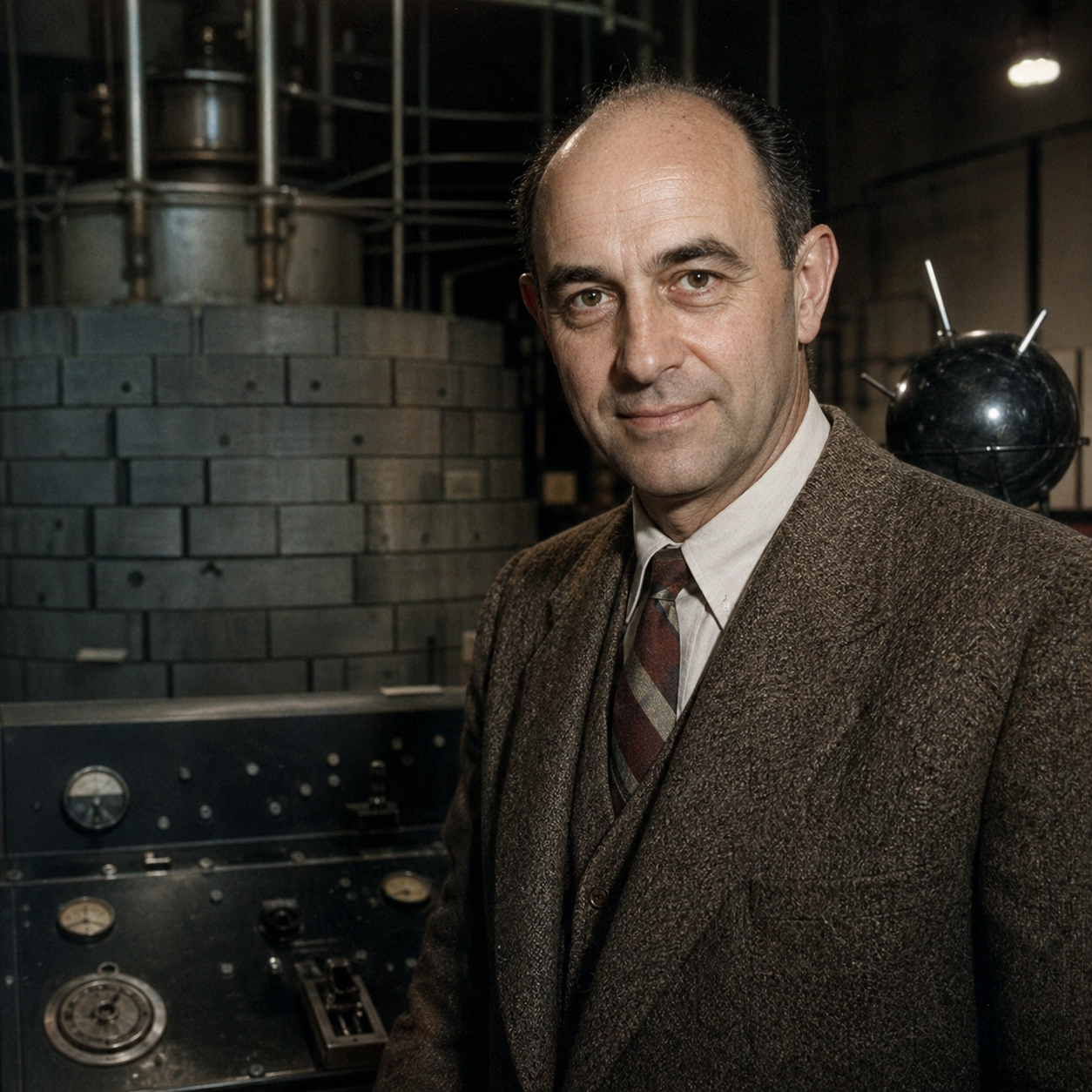
Enrico Fermi — "When we were working on the atomic bomb, we knew that we were doing something th…"
When we were working on the atomic bomb, we knew that we were doing something that would change the world forever.
When we were working on the atomic bomb, we knew that we were doing something that would change the world forever.
Click any product to generate a realistic preview. Up to 3 at a time.
* Initial load can take up to 90 seconds — revising the preview in another color is nearly instant.
"It is not enough to invent. One must also know how to sell."
"The universe is a grand experiment, and we are all part of it."
"The atomic age will either usher in a new era of prosperity, or it will be the end of civilization."
"Before the test, I was nervous and had a very bad night. But when I saw the explosion, I became very calm."
"I have been very lucky in my life. I have always been able to do what I wanted to do, and I have always been able to do it with people I liked."
Found in 1 providers: grok
1 source checked
This quote expresses the profound collective awareness scientists felt during the Manhattan Project — that their work transcended ordinary research. They weren't merely solving physics equations; they were permanently reshaping civilization. The word 'forever' captures the irreversibility of nuclear weapons: once that knowledge existed, it could never be erased. It conveys both the weight of responsibility and the sobering recognition that science had crossed a threshold with no return.
Fermi built the first artificial nuclear reactor at Chicago Pile-1 in December 1942 and worked directly at Los Alamos on the bomb's physics. Famous for 'Fermi estimation' — solving vast unknowns with calm, disciplined reasoning — he embodied pragmatic genius. This quote reflects his characteristic directness: no moralizing, just clear-eyed acknowledgment that the physics he mastered carried civilization-scale consequences. His participation as an Italian immigrant who fled fascism added deeply personal stakes to that awareness.
World War II (1939–1945) drove unprecedented government mobilization of science. Nazi Germany was pursuing its own nuclear program, creating genuine urgency. The Manhattan Project secretly employed over 130,000 people across multiple sites. When the Hiroshima and Nagasaki bombs fell in August 1945, they ended the Pacific War but launched the Cold War arms race, the Doomsday Clock, and the concept of mutually assured destruction — permanently binding scientific progress to existential geopolitical risk.
AI-generated insights based on extensive research and information for context. Factual errors? Email [email protected].
Your cart is empty