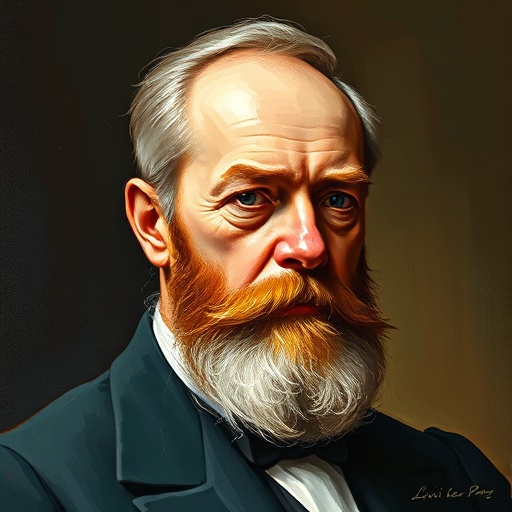
Louis Pasteur — "The greatest error is to believe that one knows everything."
The greatest error is to believe that one knows everything.
The greatest error is to believe that one knows everything.
Click any product to generate a realistic preview. Up to 3 at a time.
* Initial load can take up to 90 seconds — revising the preview in another color is nearly instant.
"The scientific life is a life of constant battle against error."
"The role of the infinitely small in nature is infinitely large."
"I am unable to find any experimental evidence that supports the doctrine of spontaneous generation."
"I have great hopes that the vaccine against rabies will be a success."
"My passion for truth was the only guide of my life."
Attributed, emphasizing humility in the pursuit of knowledge.
Date: Late 19th Century (approx.)
InspirationalFound in 1 providers: grok
1 source checked
True learning requires admitting how much you do not know. The moment you assume your knowledge is complete, you stop questioning, stop testing, and stop growing. Arrogance about understanding is more damaging than simple ignorance because it blocks the curiosity needed to discover new truths. Real progress depends on humility, constant doubt, and the willingness to challenge what you think you already have figured out.
Pasteur built his career by overturning confident assumptions, including spontaneous generation, which established scientists treated as settled fact. He insisted on rigorous experiments rather than authority, and his germ theory was initially mocked by physicians certain they already understood disease. His breakthroughs in vaccination and pasteurization came from questioning what medicine and industry believed they knew, making intellectual humility the foundation of his entire scientific method.
The nineteenth century was an age of scientific overconfidence, where established academies resisted microbial explanations for disease and surgeons operated without handwashing. Miasma theory dominated medicine, and industrial fermentation failures baffled chemists who thought the process understood. Pasteur worked during a revolution in laboratory science, where entrenched experts clashed with experimental evidence. His warning against assumed mastery captured a moment when dogma routinely cost lives until patient investigation replaced certainty.
AI-generated insights based on extensive research and information for context. Factual errors? Email [email protected].
Your cart is empty