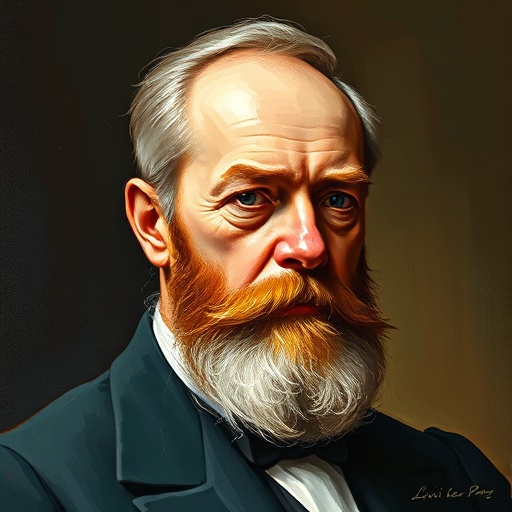
Louis Pasteur — "There are no such things as applied sciences, only applications of science."
There are no such things as applied sciences, only applications of science.
There are no such things as applied sciences, only applications of science.
Click any product to generate a realistic preview. Up to 3 at a time.
* Initial load can take up to 90 seconds — revising the preview in another color is nearly instant.
"The role of the infinitely small in nature is infinitely large."
"The scientist has to be a poet in his heart and a logician in his mind."
"Wine is the most healthful and hygienic of beverages."
"Posterity will one day laugh at the sublime foolishness of the modern materialistic philosophy."
"I have been working so hard that I sometimes forget to eat."
Attributed, emphasizing the fundamental unity of scientific knowledge.
Date: Late 19th Century (approx.)
EducationalFound in 2 providers: grok,deepseek
2 sources checked
Pasteur rejects the idea that 'applied science' is a separate discipline from 'pure science.' There is just one science, and practical inventions are simply that science being put to work. You cannot have useful applications without first doing rigorous fundamental research. Splitting knowledge into 'theoretical' versus 'practical' camps is artificial, because every real-world solution traces back to underlying scientific principles discovered through basic inquiry.
Pasteur lived this principle. His work on molecular asymmetry and microbial fermentation was pure curiosity-driven research, yet it produced pasteurization, vaccines for anthrax and rabies, and the germ theory that revolutionized medicine and brewing. He repeatedly showed that solving farmers' wine-spoilage problems or saving children from rabies grew directly from laboratory study of microorganisms, not from a separate 'practical' tradition divorced from scientific theory.
In 19th-century France, universities and industry increasingly debated whether science should serve commerce or pursue truth for its own sake. Engineering schools and 'practical' technical institutes were rising alongside research academies. Pasteur, defending state funding for fundamental research, pushed back against politicians and industrialists who wanted only immediately profitable work. His era saw the birth of industrial chemistry, public health reform, and the professionalization of science as a unified intellectual enterprise.
AI-generated insights based on extensive research and information for context. Factual errors? Email [email protected].
Your cart is empty